Sunday Sep 13, 2026
Sunday Sep 13, 2026
Wednesday, 28 January 2026 00:04 - - {{hitsCtrl.values.hits}}

By Amira Cader
Sri Lanka must move beyond reactive disaster response and adopt coordinated, risk-informed development strategies if it is to address the growing link between natural disasters and poverty, experts said at a public policy discussion held yesterday in Colombo.
Delivering the opening remarks United Nations Development Program (UNDP) Resident Representative in Sri Lanka Azusa Kubota stressed that disaster risk can no longer be treated as a stand-alone humanitarian issue.
“Natural disasters increasingly intersect with poverty, inequality and development choices. Addressing them requires collective effort, strong coordination and long-term planning,” she said.
She noted that UNDP’s engagement in Sri Lanka focuses on strengthening institutional preparedness, improving coordination across agencies and supporting communities to anticipate and adapt to future risks rather than merely recover from losses.
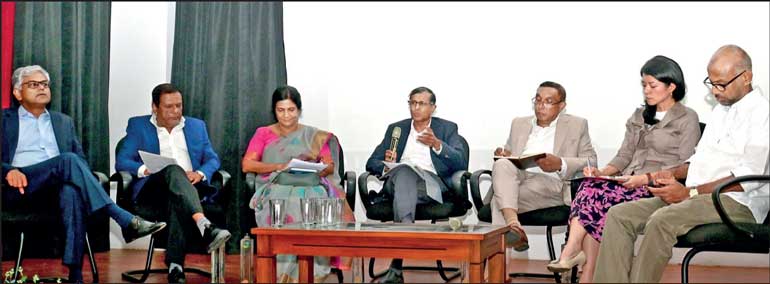
The forum, titled “Facing the Future: Natural Disasters and Poverty in Sri Lanka,” was organised by the Centre for Poverty Analysis (CEPA) in collaboration with the Centre for Environmental Studies and Sustainable Development of the Open University of Sri Lanka
Moderating the discussion, CEPA Senior Advisor and Visiting Senior Fellow at ODI Global and a leading Sri Lankan economist Dr. Ganeshan Wignaraja said Sri Lanka stands at a crossroads.
“The question is whether disasters will continue to push people back into poverty, or whether they will trigger reforms that make development more inclusive and resilient,” he noted.
CEPA Executive Director Prof. Sirimal Abeyratne highlighted that repeated climate-related shocks have exposed structural weaknesses in Sri Lanka’s development model.
“Disasters are not just natural events, their impacts are shaped by policy failures, weak planning and socio-economic vulnerabilities,”
He observed, adding that poverty reduction strategies must integrate disaster risk and climate adaptation.
John Keells Holdings PLC Chairman/CEO Krishan Balendra said businesses have a role that goes beyond post-disaster relief.
“Private sector investment must factor in resilience, sustainability and community wellbeing. This is essential not only for social responsibility, but for economic continuity,” he noted.
Balendra, who is also a member of the Rebuilding Sri Lanka Fund established in response to Cyclone Ditwah, said the initiative has mobilised Rs. 4.2 billion from the private sector to support recovery efforts.
He further noted that public–private collaborative projects are essential not only for immediate reconstruction but also for delivering long-term benefits by strengthening resilience and sustainability in rebuilding initiatives.
Former CEPA Executive Director Dr. Herath Gunathilake noted that recovery efforts often rebuild what existed before, without addressing underlying risks.
“If we rebuild the same systems in the same locations, we recreate vulnerability. ‘Building back better’ must mean building smarter,” he said.
University of Moratuwa Prof. Jagath Munasinghe emphasised the importance of spatial planning and land-use regulation, warning that unplanned urban expansion continues to place low-income communities in high-risk areas.
Central Environmental Authority- Strategic Environmental Assessment Director Kusala Malakelama stressed the value of nature-based solutions.
“Environmental systems such as wetlands and flood plains are not obstacles to development—they are protective assets that reduce disaster risk,” she said.
The discussion concluded with panelists outlining seven priority actions to help Sri Lanka face future disasters and poverty with greater awareness. These included strengthening awareness at school level, building community-based services at divisional and district levels and improving early warning systems, with experts noting that even false alarms are preferable to delayed responses when lives are at risk.
Panelists also stressed the need to address underlying structural challenges, including governance gaps, development mindsets and fragmented planning approaches.
Calls were made for risk-informed development planning, stronger monitoring mechanisms and blended public–private collaboration to ensure that rebuilding efforts not only restore what was lost but reduce vulnerability over the long term.
Pix by Lasantha Kumara




