Thursday Oct 15, 2026
Thursday Oct 15, 2026
Monday, 11 May 2026 00:00 - - {{hitsCtrl.values.hits}}
By Divya Thotawatte
Sri Lanka’s post-crisis recovery has stabilised key macroeconomic indicators, but tightening global conditions leave little room for policy mistakes or short-term stimulus, officials and development experts warned recently.
They shared these views at the inauguration of the international conference on ‘Poverty and Development in Times of Crisis,’ organised to mark the 25th anniversary of the Centre for Poverty Analysis (CEPA).
Speakers reflected on how the multiple shocks Sri Lanka’s economy had faced in recent years had significantly affected incomes, savings, and cost of living, exposing deeper vulnerabilities in the economy.
Delivering the keynote speech, Central Bank of Sri Lanka (CBSL) Deputy Governor Dr. Chandranath Amarasekara warned that global financial conditions, including the impact of the Middle East conflict, had become more difficult for emerging economies, especially with rapidly tightening monetary conditions, frequent shocks, and geopolitical fragmentation that restricted policy choices.
“With small global economies like ours, economic errors are no longer absorbed slowly, they are exposed quickly. This reality places a premium on policy flexibility, clear communication, and frameworks that are robust, not just optimal under benign conditions,” he said.
Dr. Amarasekara said that policymakers should not interpret the current stabilisation as permanent. Advising that macroeconomic management must be continuous and disciplined rather than reactive, he stressed that long-term growth must come from structural reforms rather than short-term fiscal or monetary stimulus.
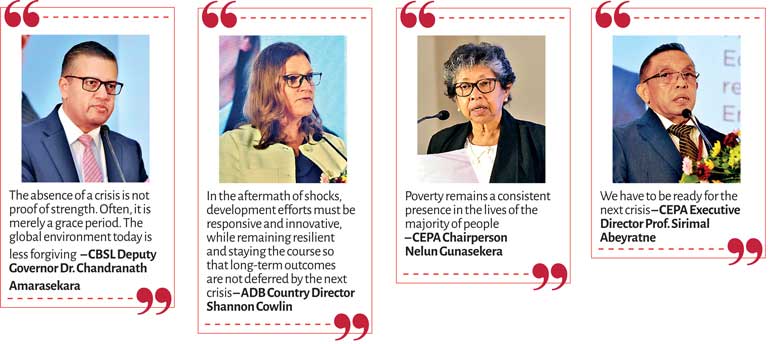
“The absence of a crisis is not proof of strength. Often, it is merely a grace period. The global environment today is less forgiving,” he said.
He also highlighted major gaps in national data, noting that key statistics on poverty and living standards still predated both the COVID-19 pandemic and the 2022 economic crisis.
However, he also highlighted the fiscal conditions since the crisis, stating that the Government had moved from relying heavily on overdrafts from State banks to maintaining a surplus within the banking system.
“The Government, which owed to state banks through a large overdraft, now has a large surplus maintained as deposits with the banking sector. Nevertheless, repeated shocks that are mostly beyond the control of policymakers suggest that the resilience of the economy and people will continue to be tested in the period ahead,” he said.
The Deputy Governor also said that the CBSL had expanded oversight of financial institutions through market conduct supervision to address “unacceptable practices” in lending and deposit-taking. He added that greater emphasis was being placed on financial literacy and inclusive finance to strengthen public engagement with the financial system and improve resilience among households.
The need for improved crisis response systems
Speaking at the event, Asian Development Bank (ADB) Country Director Shannon Cowlin also warned that repeated crises would continue to pose economic and social risks globally, making it necessary for countries and development institutions to build faster and more flexible response systems.
“The ongoing war in the Middle East now adds new risks,” she said, noting how Sri Lanka had already faced repeated shocks over the past few decades, including the tsunami, terrorist attacks, the COVID-19 pandemic, the economic crisis, and Cyclone Ditwah. She explained that development responses could not focus only on reconstruction or restoring pre-crisis conditions anymore.
“In the aftermath of shocks, development efforts must be responsive and innovative, while remaining resilient and staying the course so that long-term outcomes are not deferred by the next crisis,” Cowlin said, adding that the ADB was also introducing new emergency financing mechanisms to help countries respond more quickly to disasters and crises.
She explained that the repeated crises had exposed deep social vulnerabilities and weaknesses in economies, pushing many people into poverty and reversing the development gains, including among households which had been previously financially secure.
Cowlin stressed that future crisis response would require stronger institutions, scalable social protection systems, and better coordination to protect vulnerable populations including women, children, older persons ,and persons with disabilities during periods of economic and social stress.
“This requires stronger institutions, clearer policy frameworks, better coordination, and digital integration to improve delivery and monitoring,” she said.
CEPA Chairperson Nelun Gunasekera also highlighted that the repeated crises over the past two decades had exposed deep structural weaknesses and widened inequalities, especially among vulnerable and low-income groups. She said poverty had remained a “consistent presence in the lives of the majority of people” despite the periods of economic recovery, and that development policies must focus on long-term resilience, stronger social protection systems, and addressing the root causes of vulnerability.
CEPA Executive Director Prof. Sirimal Abeyratne said Sri Lanka had moved “25 years back” in terms of poverty and development following the economic crisis and other recent shocks, warning that earlier gains had proven to be “too shallow and too vulnerable” to withstand external pressures and short-term policy decisions. “We have to be ready for the next crisis,” he urged.
– Pix by Lasantha Kumara




