Friday Oct 16, 2026
Friday Oct 16, 2026
Monday, 9 February 2026 04:26 - - {{hitsCtrl.values.hits}}
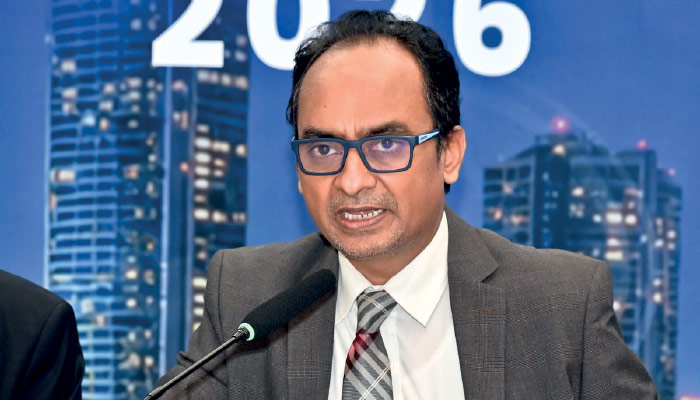
Indian Acting High Commissioner to Sri Lanka Dr. Satyanjal Pandey
By Charumini de Silva
Indian Acting High Commissioner to Sri Lanka Dr. Satyanjal Pandey said India’s rapid economic expansion, coupled with its continued engagement with open trade and investment, offers Sri Lanka a rare opportunity to anchor recovery and long-term growth in a volatile geoeconomic environment.
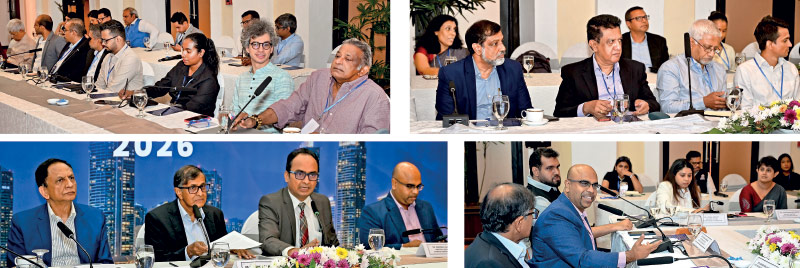
Addressing policy thinkers, diplomats, and business leaders at the inaugural Colombo Geoeconomics Conference (CGC) 2026, organised by the Centre for Law and Security Studies (CLASS) and the Chintan Research Foundation (CRF) India, with the support of the Indian High Commission, last Friday, Dr. Pandey pointed out that as the global economic order fragments under the weight of protectionism, sanctions, and tariff wars, Sri Lanka’s most realistic path to resilience may lie closer to home.
Dr. Pandey said the erosion of the old global order has created instability, but it has also opened space for regional partnerships to shape new economic realities. “For Sri Lanka, aligning policy frameworks, investment priorities, and infrastructure planning with India’s growth trajectory may offer a way not only to buffer external shocks, but to secure a more durable role in an increasingly contested global economy,” he added.
He acknowledged that the existing port infrastructure will not be sufficient to support India’s ambitions. The plans to expand port capacity could fit in with Sri Lanka’s globally competitive ports, positioning the island as a logistics and transshipment hub in the Indian Ocean.
“The Colombo Port is among the best in the world in terms of handling efficiencies,” Dr. Pandey said, pointing out that Sri Lankan capacity could ease India’s infrastructure bottlenecks while strengthening the island’s own revenue base.
He opined that such cooperation could also accelerate Sri Lanka’s long-discussed economic diversification.
Beyond apparel and tourism, Dr. Pandey pointed to opportunities in ports, renewable energy, connectivity, and integrated supply chains.
He suggested that deeper cooperation with India would allow Sri Lanka to leverage proximity as an economic advantage rather than perceive it through a narrow security lens.
“Too often, India-Sri Lanka relations are framed almost exclusively in geopolitical terms. The more consequential perspective is geoeconomic. Sri Lanka should be seen not as a strategic threat, but as a geoeconomic potential, one that remains underutilised despite its location astride key maritime routes,” he said.
He noted that developing economies face rising risks as traditional stabilisers of global trade and finance weaken.
“Countries of the global south remain constrained by structural asymmetries, post-colonial legacies, and the uneven outcomes of liberalised trade, pressures now intensified by debt distress and sustainability challenges,” he said.
Dr. Pandey cited that Sri Lanka’s own trajectory, emerging from a severe debt and balance-of-payments crisis, reflects these vulnerabilities.
“Debt sustainability will dominate global economic debates for at least the next decade as preferential trade schemes and special dispensations for poorer economies come under increasing scrutiny. The playing field will only get sharper,” he cautioned, leaving little room for neutrality or strategic autonomy except for countries with strong economic agency and resilience.
Against this backdrop, he stressed that India’s strategy of pragmatic engagement stands out. “Despite the global drift towards protectionism, India has continued to pursue liberal but balanced trade agreements, concluding deals with partners such as Australia, the United Arab Emirates (UAE), and the UK, while deepening negotiations with the EU, US, and parts of Latin America within the past few years,” he added.
These frameworks, Dr. Pandey noted, are calibrated to protect politically sensitive sectors including agriculture and small and medium-sized enterprises, priorities that closely mirror Sri Lanka’s own economic concerns.
He said for Sri Lanka, India’s outward push represents less a competitive threat than a lever for growth.
“Under India’s ‘Neighbourhood First’ policy, Sri Lanka’s prosperity is viewed as inseparable from India’s own economic ascent. If you prosper, you grow India close. In your prosperity, we see India’s prosperity,” he said, adding that the relationship must be understood as mutually reinforcing rather than hierarchical.
India is already among Sri Lanka’s largest investors and is its second-largest trading partner, but Dr. Pandey asserted that the character of investment matters as much as its scale.
He recalled that Indian companies committed capital during Sri Lanka’s 2022 crisis, demonstrating a long-term approach aligned with the island’s development needs rather than short-term opportunism.
Dr. Pandey suggested that this model could help Sri Lanka stabilise capital inflows at a time when global investment decisions are increasingly shaped by geopolitical calculations rather than pure market logic.
He said maritime infrastructure is emerging as one of the most promising areas of complementarity. With India’s economy nearing $ 4 trillion and targeting much higher levels over the coming decade, around 80% of its trade already moves by sea.
- Pic by Daminda Harsha Perera