Thursday Oct 22, 2026
Thursday Oct 22, 2026
Monday, 22 June 2026 00:00 - - {{hitsCtrl.values.hits}}
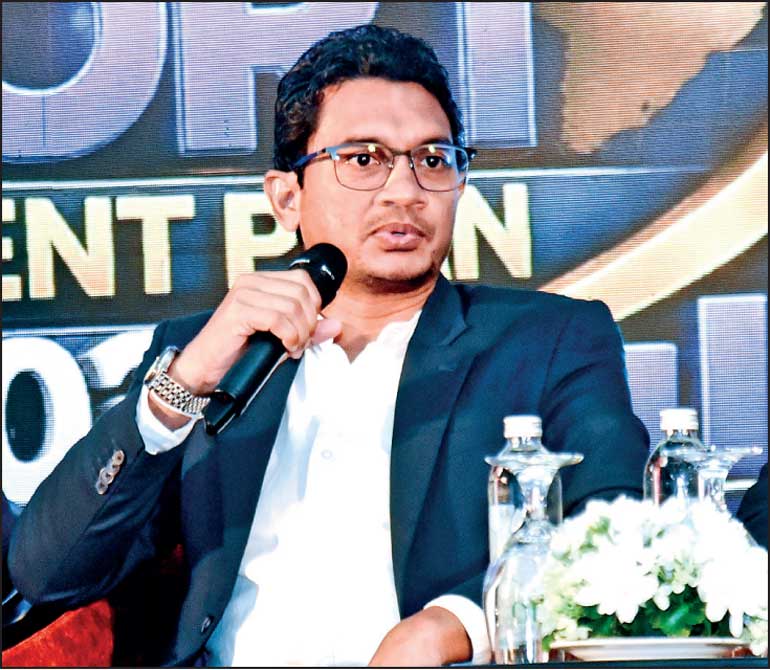
Industry and Entrepreneurship Development Deputy Minister Chathuranga Abeysinghe
-Pic by Upul Abayasekara
By Charumini de Silva
Industry and Entrepreneurship Development Deputy Minister Chathuranga Abeysinghe expressed confidence that Sri Lanka’s ambitious target of increasing exports to $ 36 billion under the National Export Development Plan (NEDP) is achievable, but only if the country urgently delivers long-delayed reforms, attracts strategic foreign investment and tackles high energy costs that are eroding competitiveness.
Speaking at a panel discussion during the launch of the NEDP, he argued that the biggest challenge facing Sri Lanka was no longer policy formulation, but implementation, warning that export ambitions would remain on paper unless the country moved quickly to remove structural barriers that have constrained exporters for years.
“The first thing we need to do is focus on implementation,” he said, noting that the plan’s priorities had been shaped directly by exporters and industry stakeholders.
Defending the Government’s goal of lifting exports to $ 36 billion, Abeysinghe said the target was intentionally ambitious and necessary to drive transformation.
“It is important for a Government to have ambitious targets because ambition drives not only policymakers, but also exporters, officials and investors,” he said.
He noted that several export sectors were already recording annual growth rates of between 15% and 20%, which could naturally lift exports to around $ 30 billion. The remaining $ 6 billion, however, would have to come from diversification, value addition and entirely new growth sectors.
The Deputy Minister identified two immediate priorities that could determine whether the target is achieved; improving access to raw materials and supply chains for existing exporters, and attracting export-oriented foreign direct investment (FDI) that integrates Sri Lanka into global production networks.
“Our domestic resource base has limitations, so enabling imports of raw materials and improving supply-chain efficiency are critical. The second game changer is attracting the right FDI that connects Sri Lanka to global markets and value chains,” he said.
He said Sri Lanka seeks to significantly expand exports, while navigating a volatile global trading environment marked by geopolitical tensions, shifting tariffs and slowing growth in several key economies.
Despite those uncertainties, Abeysinghe argued that exporters should focus on long-term market opportunities rather than short-term disruptions.
“Global uncertainties have always existed. The key question is how Sri Lanka connects with growing markets over the long term,” he stressed.
While Europe and the US remain important destinations, he said future export growth would increasingly depend on expanding access to East Asia, India, Africa and the Middle East.
At the same time, the Deputy Minister acknowledged that exporters face mounting challenges, particularly from unpredictable global trade policies and Sri Lanka’s high energy costs.
“The first challenge is the unpredictability of the global economic environment,” he said, stressing that businesses require policy certainty and stable trading relationships to make long-term investments.
“The second challenge is Sri Lanka’s energy costs. Addressing energy affordability and accelerating the transition to renewable energy could provide a significant competitive advantage for our exporters,” he added.
Abeysinghe also highlighted longstanding inefficiencies within the export support ecosystem, saying excessive bureaucracy, delays in approvals and high certification costs continue to discourage investment and expansion.
“Many exporters tell us that certification costs are too high, approvals take too long, and they must engage with multiple agencies to complete a single process. These are practical barriers that we are trying to eliminate,” he added.
The Government is therefore prioritising digitalisation, trade facilitation reforms, single-window systems and logistics improvements under the NEDP, measures he described as essential for building a genuinely export-oriented economy.
The Deputy Minister also identified agriculture and plantation exports as one of Sri Lanka’s biggest untapped opportunities, particularly in sectors such as tea, cinnamon, spices and rubber.
However, he cautioned that unlocking higher export earnings from these industries would require urgent reforms to traceability systems, supply-chain integration and quality standards over the next one to two years.
“FDIs would also play a decisive role,” he said, adding that fragmented domestic industries often lack the capital required for large-scale modernisation.
“FDIs can bring capital, technology and expertise that help modernise these industries,” he said.
Abeysinghe disclosed that while Sri Lanka continues to attract investment approvals, a significant share relates to expansions by existing investors rather than entirely new investments, underscoring weaknesses in the country’s investment climate.
“That highlights the need to improve the overall investment ecosystem,” he said.
The Government is also seeking to create a more transparent trade regime by moving away from para-tariffs, a shift Abeysinghe described as essential for negotiating meaningful trade agreements and improving market access.
He also warned that Sri Lanka’s growing skills shortage could become one of the biggest constraints on future export growth.
“We also face an acute skills shortage. This is one of the most significant constraints on future export growth,” he said, calling for education and training systems to be aligned with the workforce needs of export industries.
Abeysinghe said success should not be measured solely by headline export numbers. Instead, he pointed to three indicators that would demonstrate whether the strategy is working: increased value addition, stronger inflows of strategic FDI and greater participation by small and medium-sized enterprises in export markets.
“I want to see Sri Lanka exporting more processed and branded products rather than raw materials. If we can demonstrate progress in value addition, strategic FDI and SME participation over the next three years, we will know that the strategy is delivering results,” he said.




