Wednesday Oct 28, 2026
Wednesday Oct 28, 2026
Wednesday, 28 October 2026 00:03 - - {{hitsCtrl.values.hits}}
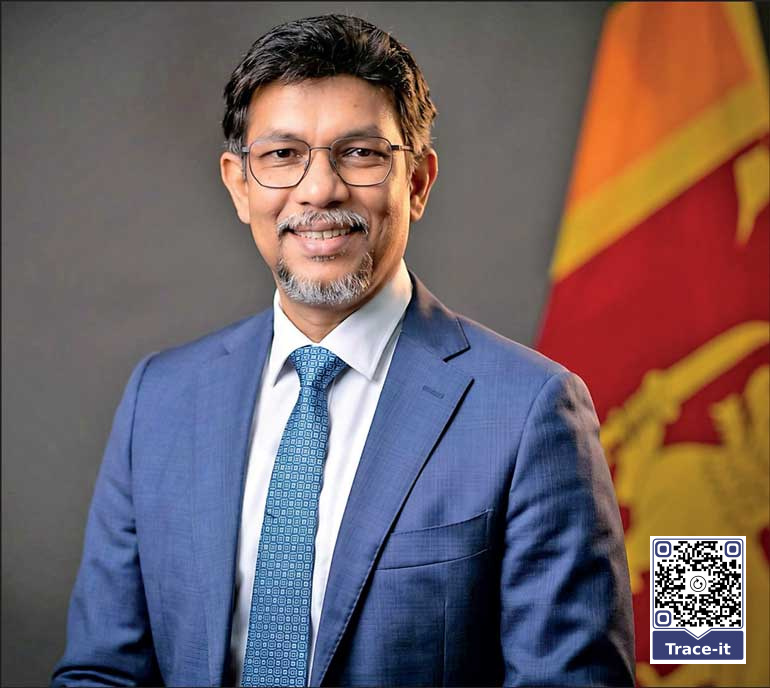
Digital Economy Deputy Minister Eng. Eranga Weeraratne
Digital Economy Deputy Minister Eng. Eranga Weeraratne believes fintech will play a key role in moving Sri Lanka from a cash-heavy to a cash-light economy. Ahead of the Sri Lanka FinTech Festival 2026, organised by the FinTech Forum Sri Lanka with the Ministry and scheduled at Shangri-La Colombo from 2-3 November, he reiterated the Ministry’s vision for the event, the investment and policy changes under way, and plans to make Sri Lanka a regional fintech hub. 
Q: What is the Ministry’s vision for the Sri Lanka FinTech Festival 2026, and how can the event help position Sri Lanka as a competitive fintech hub in the global digital economy?
A: When the Ministry was established, we identified digital payments as one of the key pillars of the country’s digitalisation. Sri Lanka is a very cash-heavy society, with about Rs. 1.48 trillion in circulation as notes and coins, and more than 99% of retail transactions still happen in cash. People withdraw cash and then transact in cash, so many sectors remain informal. We want a more formal industrial and SME sector and moving from cash heavy to cash light is our ambition.
Fintech will play a key role in the transformation. Our target is to involve the private sector more in the Government and country digitalisation, because banks, formal financial institutions and fintech companies can provide the digital payment rails the country needs.
We do not have to reinvent everything. India, Singapore, Kenya and others offer successful case studies, and an event such as this, it brings foreign expertise into the country so we can learn from it. It also lets us showcase our success stories to the world, ensuring Sri Lankan companies gain international exposure and access to international markets.
Q: The festival brings together policymakers, startups, investors, and established financial institutions. How important is cross-industry collaboration in accelerating innovation and shaping the future of Sri Lanka’s financial services sector?
A: Formal financial institutions and private sector fintech companies need to work together. Current policy frameworks may have to change in order for fintech organisations to provide more independent services, and we are looking at that policy change. It would also let them provide more public services, from payment rails to tap-and-go, and card-based solutions. We need foreign industry players to come to the country and work with local industry to deliver these services.
Existing financial institutions will continue to dominate the space. What we need is a bridge between traditional financial models and fintech models, and it is where technology companies add value. Fintech companies are agile. Therefore, their transformation will be much faster than traditional institutions. We need the right balance between the two to accelerate the shift.
Q: As Sri Lanka advances its digital economy, how does the Ministry plan to ensure that fintech innovation translates into greater financial inclusion, particularly for rural communities and underserved populations?
A: There are several benefits to a cash-light society. We currently spend about 1.5% of GDP on handling cash, from printing and secure transport to storage and management. Digital payments bring the cost down, and transactions become more transparent because revenue is recorded and maintained digitally.
The informal sector also becomes more formal. When micro, small and medium businesses move to digital payments, they adopt formal cash management and cashless accounting practices. Their business history can then justify funding from formal financial institutions, which makes them more investable and lifts the whole economy. It also includes rural communities and underserved populations.
The Government is also moving towards e-invoicing, collected centrally over digital rails. To achieve this, SMEs and other businesses need to use ERP and point-of-sale systems, which is much needed to make e-invoicing work.
Q: What competitive advantages and investment opportunities can Sri Lanka offer to global investors attending the festival, and how can these be leveraged to attract foreign investment and scale the country’s digital economy?
A: There are two sides to it. First, we are looking for foreign direct investment into digital platforms in Sri Lanka. Although certain payments are already available, we have much more to develop, from smart cards to tap-and-go payments, and we invite foreign investors to invest in them.
Second, some solid fintech solutions have been developed here, and we can offer our experience, expertise and solutions to other countries, because many markets are still behind Sri Lanka. Approaching those markets is also part of the exercise.
To attract investors, we will showcase the economic opportunity in the country, including the gaps, and speak openly about the Government’s vision and policy. We will also market our digital workforce, products and solutions, thereby foreign investors can invest in our products, intellectual property and companies, and help open markets abroad.
Q: How is the Ministry working with fintech startups, banks, and other financial institutions to foster an enabling environment for innovation, entrepreneurship, and the wider adoption of digital financial services?
A: There are multiple initiatives. We run start-up development programs covering incubation and facilitation, and Disrupt Asia, a conference to connect start-ups with investors. We are also setting up a fund of funds, a Government sovereign fund, to support research and development and start-ups to create more intellectual property in the country. Our strategy is to keep startups headquarters in Sri Lanka allowing companies to grow internationally.
The fund will be a matching funding scheme for foreign investors who invest in Sri Lanka, run by an independent fund manager. The policy papers are in the final stage, and next year’s Budget will include an allocation to facilitate it.
Q: What key regulatory, policy, and digital infrastructure developments are underway to strengthen Sri Lanka’s fintech ecosystem, build investor confidence, and accelerate the country’s digital transformation?
A: With the Fund of Funds, we also see a gap in the regulatory environment for fund management. Foreign and local funds are currently set up as private limited companies under the Companies Act, which means double taxation and capital movement restrictions. For a fund to operate properly, we must provide tax pass-through and capital mobility. We are therefore bringing in a qualified venture company funding scheme as a regulatory framework, most likely with the Securities and Exchange Commission, which we would like to see as the regulatory body for fund management. Policy development is under way and we expect to have it in place from next year.
We will also establish special virtual economic zones, which will allow foreign institutions to set up virtually in Sri Lanka and use supporting services from here, and at the same time operating under the Sri Lankan Government framework.
On digital infrastructure, we have invited foreign hyperscalers to establish cloud infrastructure and AI data centres in the country, and we see tremendous interest from those investors. We are evaluating the expressions of interest received and will publish a baseline of the facilities the Government is willing to provide. We will then discuss with individual investors how to attract them and set up the data centres here. The strategy is for these data centres to serve not only local demand but also to make Sri Lanka an AI and data centre hub for the region.
Q: Can the festival help position Sri Lanka as a regional hub for future fintech and events?
A: Sri Lanka can be a fintech festival hub for South Asia. We are going to expand the festival into a regional event, with the aim of attracting more foreign participants to showcase their solutions here. It would also help make Sri Lanka a MICE hub, and fintech is a very attractive proposition in that sense, from the Gulf to Singapore.




