Thursday Oct 22, 2026
Thursday Oct 22, 2026
Wednesday, 2 September 2026 00:00 - - {{hitsCtrl.values.hits}}
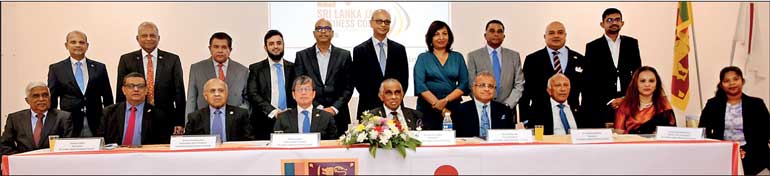
Executive Committee for Year 2026/2027
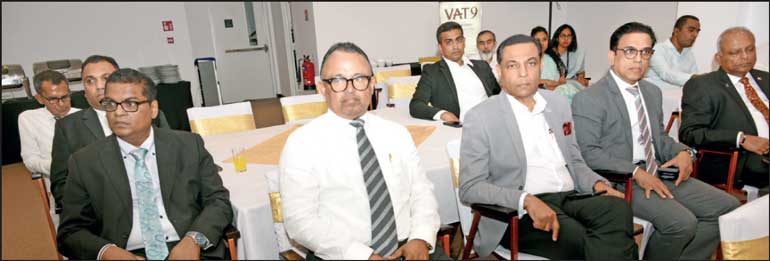
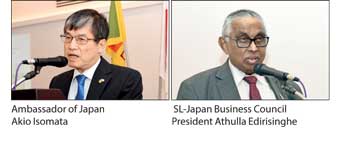 The Sri Lanka – Japan Business Council (SLJBC) of the Ceylon Chamber of Commerce recently held its 47th AGM, with the Ambassador of Japan and Patron of the Council Akio Isomata in attendance.
Hirohama Ceylon Ltd., Director Athulla Edirisinghe was re-elected as President of the SLJBC for the year 2026/27. Hayleys Advantis Ltd., Managing Director Ruwan Waidyaratne, Spear International Ltd., Managing Director Shamil Mendis and Prudential Shipping Lines Ltd., Managing Director Rohitha Mendis were elected as Senior Vice President, Vice President and Treasurer of the Council, respectively. Andrew The Travel Company Ltd., Managing Director Mahen Kariyawasan will continue to serve on the committee as the Immediate Past President.
The committee comprises representatives from Amano Lanka Engineering Ltd., BOV Capital Ltd., Brandix Apparel Ltd., Heritage Teas Ltd., Kalhari Enterprises Ltd., Lanka Harness Ltd., Dentsu Grant Ltd., MAC Holdings Ltd., and Vidullanka PLC. By invitation: HVA Foods PLC (subsidiary of George Steuart & Co), Spillburg Holdings Ltd., and Vaughan Chemicals Ltd.
Chief Guest, Ambassador of Japan to Sri Lanka Akio Isomata, outlined three priorities for deepening bilateral economic relations: an effective and forward-looking trade and investment policy, the promotion of domestic industrial policy, and expanded investment in renewable energy.
He noted that Sri Lanka’s ongoing review of its Free Trade Agreement policy would be important in shaping the country’s future negotiating landscape and encouraged Sri Lanka to look eastward toward Southeast Asia and Japan, proposing that the country adopt an export-oriented industrial model similar to the “Look East” and “Act East” policies pursued by Malaysia and India. He welcomed the Government’s National Export Development Plan 2026 and National Mineral Policy 2026 as consistent with Japan’s vision of connecting Sri Lanka’s export-related manufacturing sectors with India’s high-growth manufacturing base.
On energy security, the Ambassador referred to Japan’s newly launched “Power Asia” initiative, a $ 10 billion financing package extended through JICA, JBIC and NEXI to assist Asian countries — including Sri Lanka — in securing crude oil supplies, building storage infrastructure, and developing biofuel and next-generation solar technologies, with the facility open to direct application by private companies as well as governments. He urged the Sri Lankan business community to overcome complacency and take bold, decisive action to seize the opportunities before them, noting that while Sri Lanka has missed earlier waves of Japanese investment, further opportunities continue to emerge, and reaffirmed Japan’s commitment to continue working closely with Sri Lanka.
In his address, President Athulla Edirisinghe paid tribute to the Sasakawa Peace Foundation (The Nippon Foundation) and its Chairman Yohei Sasakawa for his magnanimous support in establishing this elegant permanent home for the Sri Lankan enterprises affiliated with the Embassy of Japan engaged in promoting Japanese culture, education and bilateral relations with Japan.
Edirisinghe reflected on nearly seven decades of humanitarian and development support extended by Japan to Sri Lanka that is too numerous to mention. He made special reference to the support given during the COVID-19 pandemic, the recent economic crisis and Ditwah as exceptional.
However, reviewing the history of Japanese investment in the region from the 1970s onward, he observed that Sri Lanka had missed many occasions to attract Japanese foreign direct investment due to the closed economy of the country, the absence of industrial zones and periods of political instability. However, neighbouring countries in Southeast Asia benefited.
He also referred to how Sri Lanka lost several opportunities thereafter due to the prevailing war in the country and economic crises, whereas neighbouring countries benefited.
Edirisinghe paid tribute to the Ministry of Economy, Trade and Industry, Japan, for its proposal in 2025 for a Sri Lanka–Japan Economic Corridor as a timely opportunity to draw on Japanese knowledge, technology, and partnership rather than investment alone, and called on Sri Lankan businesses, industry associations, and the wider community to come together in dialogue with the Government to ensure the country does not miss this opportunity as well.
- Pix by Shehan Gunasekara




