Friday Oct 16, 2026
Friday Oct 16, 2026
Monday, 17 August 2026 03:46 - - {{hitsCtrl.values.hits}}
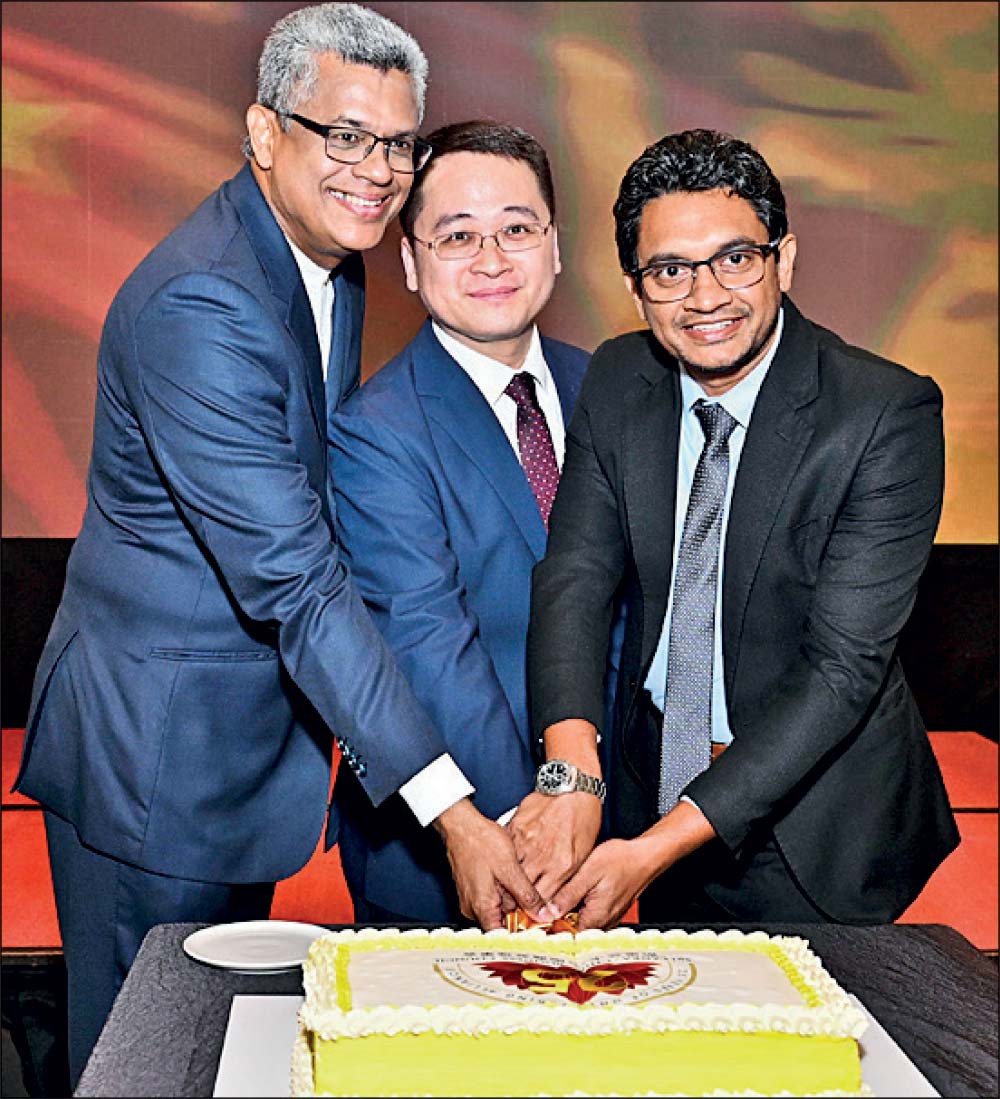
From left: Sri Lanka-China Business Council President Haroun Cader, Embassy of the People’s Republic of China Deputy Chief of Mission Zhu Yanwei and Industry and Entrepreneurship Development Deputy Minister Chathuranga Abeysinghe
 The Sri Lanka-China Business Council (SLCBC) recently marked its 25th anniversary with renewed calls to deepen bilateral trade, attract greater Chinese investment, and address the longstanding trade imbalance between the two countries.
The silver jubilee celebration was held grandly at the Shangri-La Colombo, bringing together representatives of the Sri Lankan and Chinese governments, diplomats, private sector leaders, and past presidents of the council to reflect on the 25 years of strengthening commercial ties between Sri Lanka and China.
Government officials and business leaders spoke at the event, highlighted Sri Lanka’s ongoing economic reforms and future investment opportunities.
Addressing the gathering, Chief Guest Trade, Commerce, Food Security and Cooperative Development Minister Wasantha Samarasinghe underlined that China was one of Sri Lanka’s most significant economic partners and reaffirmed the Government’s commitment to creating a stable, transparent and investor-friendly business environment.
Acknowledging the strength of bilateral trade, he said, “there is a big difference between import and export between the countries. While benefiting both countries, let’s still look for opportunities and trade partnerships that benefit both countries and its peoples to reduce this gap.” He further added that the SLCBC was well positioned to identify emerging opportunities in trade, investment, and technology while continuing to serve as a bridge between businesses, policymakers, and investors.
Deputy Minister of Industry and Entrepreneurship Development Chathuranga Abeysinghe also spoke at the event, noting that Sri Lanka was entering a period of significant economic reform aimed at improving competitiveness. “The biggest transformation that is taking place now is the tariff policy. We are opening our markets by removing our para tariffs, which are CESS and PAL, by 2029.”
The Deputy Minister encouraged Sri Lankan investors to pursue partnerships with established Sri Lankan businesses, particularly in value-added manufacturing, technology, logistics, and export-oriented industries, rather than focusing solely on greenfield investments.
Deputy Chief of Mission Zhu Yanwei reaffirmed China’s commitment to expanding cooperation with Sri Lanka under the Belt and Road Initiative. “We are ready to deepen our work with our Sri Lankan friends across infrastructure, the digital economy, green energy, modern agriculture, and the rural economy, tapping into entirely new engines for growth.”
He said China would continue opening its market further to Sri Lankan exports, like tea, gems, rubber, and spices, while encouraging more Chinese companies to invest in Sri Lanka’s manufacturing, tourism, and renewable energy sectors.
“At the same time, we want to push for the investment and financing cooperation that is both transparent and sustainable, offering genius support for Sri Lankan long-term economic recovery.”
The Deputy Chief of Mission identified three priority areas for future collaboration: restarting negotiations on the proposed Free Trade Agreement (FTA), supporting Sri Lanka’s economic recovery through greater investment, and strengthening risk management and business facilitation mechanisms for investors. He further highlighted that balancing bilateral trade should remain a priority, adding that closer cooperation between the two countries could help more Sri Lankan businesses gain access to the Chinese market while reducing trade barriers.
SLCBC President Haroun Cader also spoke at the event, noting how the council had evolved into an important bridge connecting the business communities of both countries over the past 25 years. He said that while agreements may have initiated business relationships, trust and sustained engagement had ultimately determined the council’s long-term success. “The Council has become a bridge between businesses and institutions. It has helped companies find partners, understand markets, and explore new opportunities.”
He stressed that the next phase of Sri Lanka-China economic relations should focus on creating balanced and sustainable growth by expanding market access for Sri Lankan small and medium-sized enterprises, attracting technology-driven investment and strengthening innovation.
Cader also highlighted that there was a growing importance in digital trade, artificial intelligence, renewable energy, and advanced manufacturing, calling businesses to convert dialogue into tangible commercial outcomes.
The evening concluded with a toast celebrating 25 years of Sri Lanka-China business cooperation and expressing confidence that stronger commercial partnerships would contribute to greater prosperity for both countries in the year ahead.
- Pix by Daminda Harsha Perera