Thursday Oct 22, 2026
Thursday Oct 22, 2026
Friday, 10 July 2026 00:03 - - {{hitsCtrl.values.hits}}
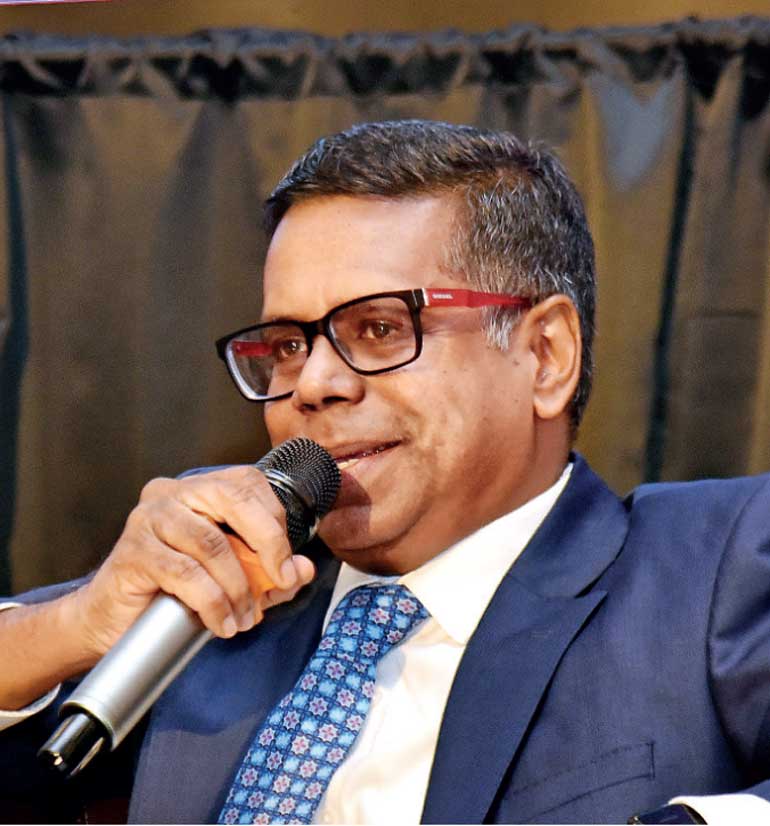
Director/CEO Dilshan Rodrigo
Sri Lanka’s small and medium-sized enterprises (SMEs) are undermining their own access to finance by understating revenues and profits to minimise tax liabilities, forcing banks to independently reconstruct financial statements before extending credit, Union Bank of Colombo PLC Director/CEO Dilshan Rodrigo said.
Addressing the CA Sri Lanka 5th Annual Economic and Tax Symposium last week, Rodrigo said the widespread practice of maintaining multiple sets of accounts had become a structural impediment to SME financing, preventing banks from moving towards cash flow-based lending.
His comments comes amid repeated calls by SMEs for easier access to credit and a growing culture of entitlement for Government-backed financing.
“At the moment, many SMEs, unfortunately, don’t pay tax. They pay very minimal tax. There are two sets of accounts or three sets of accounts. There are lots of challenges,” he said.
Rodrigo said the contradiction was that while SMEs frequently criticised banks for demanding collateral, lenders could not rely solely on reported financial statements where revenues and profits were materially understated.
He said banks routinely examined sales books and other underlying business records before reconstructing borrowers’ financial statements, often finding actual turnover to be around 40% higher than reported.
“Bankers actually reconstruct the financials. They go and look at the sales book and then check the numbers. You find that it’s 40% higher than that. Then you find probably the profit is understated,” he said.
Rodrigo suggested the issue was well understood within the accounting profession, noting that audited financial statements were not always sufficient because the quality and rigour of audits varied significantly across firms.
“There are reputed audit firms, but there are also lots of other chartered accountants. It might be audited, but if it’s not from a recognised firm, audited accounts are known to have significant understatement in them,” he said.
He argued that resolving the problem required more than simply insisting on audited accounts, calling instead for stronger accounting standards, more rigorous audits and an independent SME credit-rating framework that would improve confidence in financial reporting.
“It is important for SMEs to be transparent with their financials. It is important for rating agencies to get involved in making sure those numbers are correct. Then banks can actually support them with less collateral, maybe cash flow-based, because there is a rating and there is actual business repayment capacity indicated in the financials,” Rodrigo said.
He said such reforms would create a virtuous cycle, enabling banks to lend against verified cash flows rather than property, improving tax compliance and making SMEs more attractive to equity investors.
Drawing on India’s experience, Rodrigo said credible financial reporting and rating infrastructure had enabled SMEs to attract both bank financing and strategic investors, giving businesses an incentive to accurately reflect their financial performance rather than suppress taxable profits.
Rodrigo also highlighted a structural constraint on long-term SME financing, noting that commercial banks remained funded predominantly by short-term deposits.
“We don’t find more than 1% of deposits beyond five years. Nobody is committing to 20-year deposits,” he said, arguing that long-term industrial and technology investments would require deeper capital markets and a stronger venture capital ecosystem rather than conventional bank lending.
Pic by Upul Abayasekara




