Sunday Sep 13, 2026
Sunday Sep 13, 2026
Monday, 2 February 2026 01:00 - - {{hitsCtrl.values.hits}}
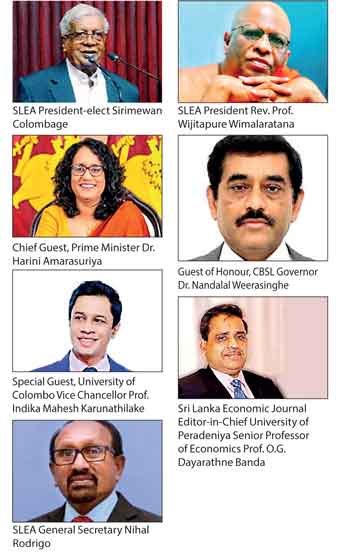 The Sri Lanka Economic Association (SLEA) is set to host its Annual International Conference on 6-7 Februar. This landmark event, themed ‘Tansforming the Services Sector for Economic Revival in Sri Lanka,’ comes at a critical juncture as the country moves beyond stabilisation towards a phase of long-term structural transformation.
The inauguration of the conference will take place at 4 p.m. on 6 February at the Jasmine Hall, Bandaranaike Memorial International Conference Hall (BMICH), Colombo. Prime Minister Dr. Harini Amarasuriya will grace the occasion as the Chief Guest, joined by Central Bank of Sri Lanka (CBSL) Governor Dr. Nandalal Weerasinghe as the Guest of Honour, University of Colombo Vice Chancellor Prof. Indika Mahesh Karunathilake as the Special Guest, and a distinguished gathering of policymakers, academics, and researchers. The technical sessions, featuring in-depth scholarly presentations, will follow on 7 February at the Faculty of Arts, University of Colombo.
In recent years, the services sector has proven to be the most resilient component of the Sri Lankan economy, contributing over 60% to the GDP. However, as global markets evolve through digitalisation and shifting trade patterns, the SLEA identifies an urgent need to modernise this sector. The conference aims to serve as a high-level platform where academia, policymakers, and industry leaders can converge to redefine the services landscape.
Under the leadership of SLEA President Rev. Prof. W. Wimalaratana, the Association has fostered a strategic collaboration with the Department of Economics at the University of Colombo and Siam University, Thailand.
Emphasising the necessity of this shift, Rev. Prof. Wimalaratana said: “Current trajectories in Sri Lanka’s economic restructuring underscore the services sector as the primary driver of value addition and growth. As sectors such as ICT, finance, and tourism undergo rapid development, the integration of rigorous academic inquiry into policy frameworks is imperative to mitigate volatility. This conference functions as a strategic nexus, facilitating the translation of empirical research into actionable blueprints for national economic revitalisation.”
This international partnership underscores the SLEA’s commitment to benchmarking Sri Lanka’s progress against regional peers who have successfully leveraged services for rapid development.
A primary focus of the two-day summit will be the integration of “modern technology,” specifically exploring how Artificial Intelligence (AI), data analytics, and ICT can be seamlessly embedded into traditional service models.
The SLEA contends that for Sri Lanka to remain globally competitive, the nation must transit from basic service delivery toward high-value, knowledge-based exports.
SLEA President-elect Prof. Sirimewan Colombage highlighted the strategic importance of this transition within the current economic climate: “Sri Lanka’s economic recovery critically depends on the strategic transformation of the services sector, generating employment, foreign exchange, and inclusive growth. The emerging activities of the sector are characterised by high-tech, high-value-added, and knowledge-intensive services that are less vulnerable to global market volatility than traditional products. The current macroeconomic stability, buttressed by the International Monetary Fund (IMF)-supported economic reforms, fosters services-led recovery. The SLEA conference focuses on the need to accelerate the transition of the services sector from domestic-based activities to an internationally competitive, export-oriented powerhouse by enduring sound macroeconomic reforms, embracing digitalisation, and enhancing infrastructure.”
Tourism and hospitality, long the lifeblood of the nation’s foreign exchange earnings, will also take centre stage. Discussions will move beyond arrival numbers to focus on ‘Tourism Economics,’ analysing how the country can increase the value-per-visitor and ensure that the benefits of the industry are distributed more equitably across the rural economy.
Beyond digitalisation and tourism, the conference will tackle the complexities of the financial sector. With the debt restructuring process reaching an advanced stage in 2026, the SLEA plans to propose frameworks for a more resilient banking and finance ecosystem. This includes modernising regulatory governance to support small and medium enterprises (SMEs) while maintaining national fiscal stability.
The human element remains at the core of the SLEA’s vision. A dedicated session on ‘Human Capital and the Future of Work’ will address the mismatch between current educational outcomes and the needs of a modern services economy. The conference will advocate for urgent reforms in vocational training and higher education to prepare the youth for a globalised labour market.
Sustainable and inclusive growth will serve as the overarching philosophy for all policy recommendations generated during the event. The SLEA emphasised that economic revival cannot be measured by GDP figures alone; it must be reflected in improved living standards, poverty reduction, and the strengthening of the nation’s social capital.
A significant highlight of the event will be the introduction of actionable policy briefs. These documents, synthesised from research papers presented by local and international experts, are intended to provide a roadmap for the Government’s Public Investment Program (PIP) for 2026–2030, ensuring that academic rigour translates into practical governance.




