Saturday Oct 17, 2026
Saturday Oct 17, 2026
Thursday, 13 August 2026 00:30 - - {{hitsCtrl.values.hits}}
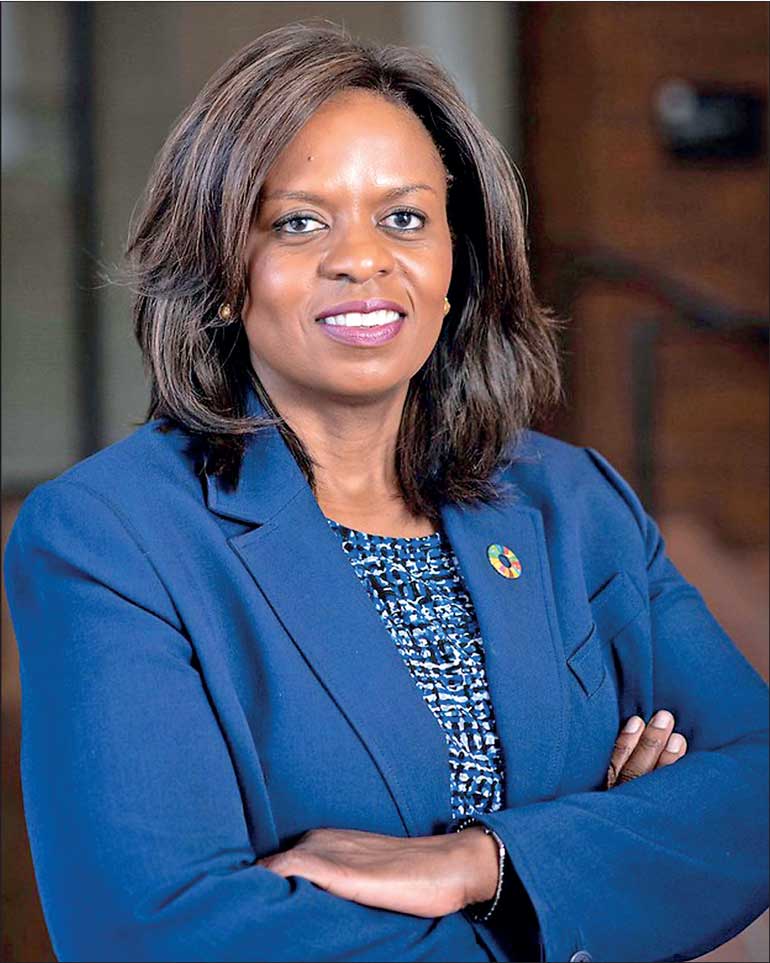
UN Assistant Secretary-General and UN Global Compact CEO and Executive Director Sanda Ojiambo
By Shanika Sriyananda
Ethical leadership is increasingly critical to long-term business resilience, with integrity, anti-corruption and inclusive decision-making helping to create a level playing field for businesses, UN Assistant Secretary-General and UN Global Compact (UNGC) CEO and Executive Director Sanda Ojiambo, said.
She stressed that corruption not only undermines fair competition but also drains resources that could otherwise support public services, investment and job creation.
“If you want to be in business for the long term, ethical leadership simply has to be the way to go,” Ojiambo said in an exclusive interview with the Daily FT during her visit to Sri Lanka for Forward Faster Now | APAC 2026.
With more than two decades of experience across the private sector, multilateral institutions and public-private partnerships, under her leadership, the UNGC has undergone a period of significant growth and strategic transformation, strengthening its role as the leading platform for business engagement in advancing the Sustainable Development Goals (SDGs).
She has championed initiatives such as Forward Faster to accelerate corporate action on climate, gender equality, living wages, water resilience and finance, while deepening collaboration between business, Governments and the UN system.
Explaining the UNGC’s principles, she said part of its work was to help create an ecosystem in which businesses can operate free of corruption and bribery.
Ojiambo encouraged Sri Lankan businesses to join the UNGC network and highlighted the value of this network in strengthening business capabilities, connecting Sri Lankan CEOs with a wider network of peers and facilitating the exchange of experiences and best practices. Following are excerpts from the interview:
Q: Investor expectations are changing rapidly. How are governance, transparency and human rights performance increasingly influencing investment decisions and access to capital?
A: Yes, investor expectations are changing rapidly, driven by consumer awareness, political expectations and the evolution of environmental, social and governance (ESG) considerations. As the focus on sustainable development grows, human rights and governance are becoming increasingly important.
In mature markets, we are seeing much greater scrutiny of these issues. But for markets such as Sri Lanka, there is also a significant opportunity for companies to adopt sustainability practices early and help shape the investment opportunities available to them. In some cases, businesses and markets are moving ahead of regulation.
The world is becoming increasingly interconnected, and supply chains now extend across borders. It has been encouraging to see the Sri Lankan businesses I have met recognise the importance of governance, human rights and ESG.
There is also growing awareness among business leaders that if they want to remain in business for the long term, all these metrics matter. They are increasingly influencing investment decisions among listed companies, while more SMEs and other businesses are also adopting them.
Q: You mentioned the importance of SMEs. How do you see the role played by SMEs in this changing business environment?
A: SMEs are extremely important in every economy. They are a key part of the economy itself, but they are also an important component of the supply chains of large multinational companies.
About half of the UN Global Compact’s participants are large companies and the other half are SMEs.
For SMEs seeking to participate in global supply chains, particularly in markets such as Europe, ESG parameters are becoming increasingly important because of the regulatory and compliance environment.
That is why many SMEs see value in starting early and working with initiatives such as the UN Global Compact to ensure they are prepared to participate in global supply chains.
We are also hearing from SMEs seeking financing that banks are increasingly offering easier access to green loans and other forms of green financing when companies meet certain sustainability credentials.
For SMEs, sustainability is therefore not something foreign or alien. It can make them more investor-ready, more attractive to partners and better prepared for global trade.
Q: Around the world, geopolitical instability, supply chain disruption and climate risks are becoming permanent business realities. What does business resilience look like in this new era, and how should companies prepare?
A: In the context of Sri Lanka, I have been very impressed by the number of companies – from large conglomerates to smaller businesses – that recognise the importance of business resilience for economic recovery.
Responsible businesses need to recognise that they want to be here for the long term. It is not simply about short-term business activity.
They need to establish sound business practices covering governance, energy, their climate footprint, human rights, labour and fair wages. All of these are important because the economic recovery path Sri Lanka wants to pursue is a long-term one.
Businesses therefore need a forward-looking trajectory and must recognise that sustainability is critical to what they want to achieve. They also need to work alongside the Government in driving transformation.
Many of the businesses I have met also have much higher aspirations. They are looking for regional trade opportunities and seeking to contribute to broader global goals. That makes it particularly important to place sustainability at the centre of their strategies.
Q: Sri Lanka has an opportunity to reposition itself in regional value chains. How can responsible business practices strengthen export competitiveness and attract long-term international investment?
A: It has been impressive to hear from Sri Lankan businesses about the extent to which they are already operating not only in Sri Lanka but across the region, in sectors ranging from textiles and manufacturing to consumer goods.
I would say Sri Lankan businesses are already well positioned in the regional economy, rather than simply poised to enter it. What I have learned is that their vision is much larger than satisfying the domestic market.
I have heard about businesses with a strong footprint across Asia and globally. What does that demonstrate? First, quality.
If companies are part of global supply chains, it means they are meeting sustainability, quality, environmental and labour standards. They are also demonstrating strength in logistics and logistics management and are building the capacity of their workers.
I have seen strong adherence to quality standards and a clear desire to move beyond the local market towards regional and global markets. Businesses are also attracting the financing and investment they need to expand.
We have just launched the Responsible Business Coalition with the Colombo Stock Exchange. It will bring together key actors to advance responsible business, not simply for companies, but also to support the Government's efforts towards economic recovery. The private sector is a key partner in that process.
Q: How important is the political stability of a country to the growth of businesses?
A: I will respond to that broadly. Business cannot succeed where an overall country or economy is failing. The two have a very symbiotic relationship.
The role of Government is to create an enabling environment for business to thrive. Business, in turn, creates jobs, generates income, provides goods and services and keeps the economy moving.
Business needs Government and Government needs business. When there is no balance between the two, neither can achieve sustainable long-term progress.
Q: Integrity is increasingly becoming a strategic asset rather than simply a compliance requirement. Why should CEOs view ethical leadership as fundamental to business resilience?
A: If you want to be in business for the long term, ethical leadership simply has to be the way to go.
But it is important to understand what ethical leadership actually means. Through the work of the UNGC, it is closely linked to principles such as anti-corruption and anti-bribery, as well as taking a long-term and inclusive approach to business.
Part of our work is to help create an ecosystem in which businesses can operate free of corruption and bribery.
Why is that important? It levels the playing field and allows all actors to participate fairly in business opportunities. Corruption also represents a significant loss to an economy – money that could otherwise go towards public services, investment and job creation.
Ethical leadership is therefore important not only for business integrity, but also to ensure that resources are available for public investment and economic development.
Ultimately, poor leadership results in poor business decisions, and that does not help drive an economy forward.
Q: What practical advice would you offer Sri Lankan companies that want to future-proof their businesses while remaining commercially successful?
A: First, I would encourage them to join the UNGC Network in Sri Lanka. It has 15 years of history in building strong business networks.
Sustainability is a journey, not an end in itself. There are always opportunities for companies to improve and pursue continuous improvement.
The UNGC provides an opportunity not only to build skills, but also to become part of a network of business leaders committed to the continued growth of the Sri Lankan economy and its role in the region.
Second, the exchange of experiences between CEOs and the opportunity to learn from peers is extremely important.
Third, we are increasingly creating opportunities for businesses to engage in dialogue with the Government – not for lobbying or advocacy, but to create a space where the two can interact on how to build economic resilience.
Business needs resilient economies. Government needs economic resilience, and so does the United Nations. That partnership is therefore extremely important.
Q: Many business leaders still perceive sustainability as a cost centre rather than a commercial strategy. From your experience working with thousands of companies globally, what distinguishes organisations that see sustainability as a source of competitive advantage?
A: More and more businesses are recognising that sustainability is a competitive advantage.
The world we live in does not have finite resources. Energy is a good example. The world is currently experiencing different forms of energy crisis, driven by geopolitical developments as well as the fact that energy resources are limited.
Companies that take a longer-term view are therefore important.
But businesses have already demonstrated that they can be both sustainable and profitable. We see companies decarbonising while increasing profitability. It is possible to pay fair living wages and remain profitable.
Water stewardship and energy management are also important. Companies are becoming more efficient in their use of natural resources while remaining profitable.
If sustainability is not already factored into a company’s balance sheet, it needs to be. At some point, the cost of becoming sustainable will be extremely high as we compete for increasingly scarce resources.
The earlier companies incorporate sustainability into their planning, the more likely they are to remain profitable in the long term.
Q: Why is ‘Responsible Business is Resilient Business’ central to Sri Lanka’s next phase of economic recovery?
A: I am really impressed with the Sri Lankan businesses I have met and their ability to navigate the shocks that have come their way – whether climate shocks, economic shocks or others – while continuing to focus on how they can build resilience over time.
That is important because businesses are critical for job creation, income creation, social cohesion and the integration of society and communities.
Resilience is therefore key. Some of our discussions have focused on how to galvanise businesses through the Responsible Business Coalition, as well as how to create alternatives in energy sources and address climate action.
From our discussions with businesses, it is very clear that this is important for moving forward.
Sri Lanka is a small country, and shocks can therefore be particularly severe. Smaller economies tend to be hit harder than larger ones.
But there is another side to that. Because Sri Lanka is small, it also has agility. It can turn around much faster than a larger country with more complex systems.
Sri Lanka has proved its resilience over time. Whether it is a terrorist attack, a climate event or an economic crisis, the country has experienced significant shocks. But look at where Sri Lanka is today. It is a matter of turning around relatively quickly.
That advantage is something many larger countries do not have.
At the same time, Sri Lankan companies need to adopt the UNGC’s 10 Principles and integrate them into their business strategies. If Sri Lanka wants to be part of the global economy, its companies need to measure up to global standards.
The UNGC provides a framework that companies in sophisticated economies can use, and it can be used here as well. It allows Sri Lankan companies to measure themselves against global standards and move alongside larger industries and markets.
The UNGC allows Sri Lankan businesses to see beyond the country’s borders and become part of a global community.
We have a network here in Sri Lanka, while globally there are 68 other country networks, with businesses in more than 130 countries. Joining the UNGC therefore means becoming part of a much broader global business community.




