Tuesday Sep 15, 2026
Tuesday Sep 15, 2026
Tuesday, 15 September 2026 04:00 - - {{hitsCtrl.values.hits}}
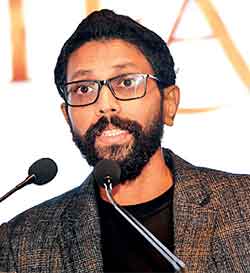 |
| For seven years, we asked people to pick a book. Now we are asking a nation to pick each other up - one reader, one club, one story at a time - Pick a Book Founder Ragulan Tharmakulasingam |
By Shanika Sriyananda
Can AI bring the joy and imagination that a book gives? Can it provide the warmth of a conversation that brings soul-to-soul connection? Can it inspire a love of reading and, most importantly, can it give us the smell of a new book?
These questions were among those raised at the recently held Readers’ Summit 2026, organised by Pick a Book under the theme ‘Human edge begins with reading’, which brought writers, leading entrepreneurs, readers and publishers together.
Pick a Book Sri Lanka, a seven-year-old reading movement, is now moving beyond book clubs, seeking to build a national ecosystem of readers, authors, publishers and booksellers as artificial intelligence transforms how people access information.
When was the last time you had a real conversation — not an exchange on Instagram or Facebook, or even a voice message, but a conversation that began with an idea and went somewhere?
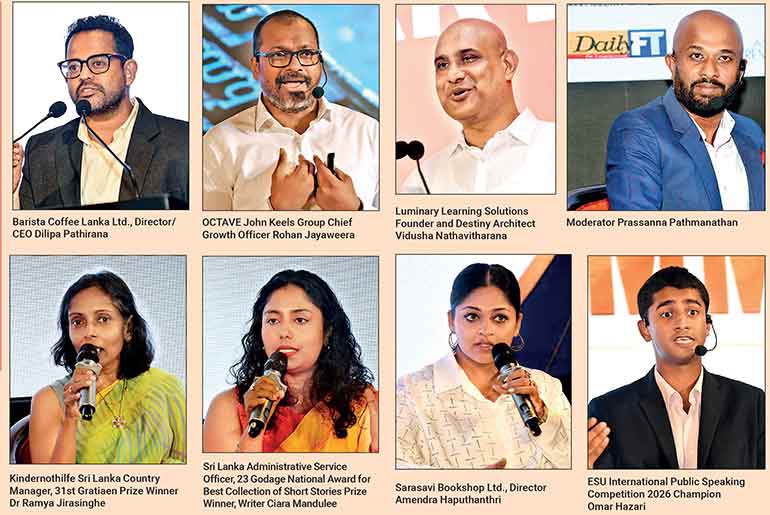
That was the question posed by Barista Coffee Lanka Director and CEO Dilupa Pathirana, at the Readers’ Summit in Colombo, as he explored the relationship between reading, knowledge and human connection.
“Because for a conversation, you need a topic,” Pathirana said, adding that the material for that conversation comes from what people have listened to, experienced and, ultimately, read.
In an age in which people are bombarded with information, his message gives greater meaning to the objective of the summit, which promotes the idea that reading matters not simply because books contain knowledge, but because they give people something to think about and talk about.
“We are having a conversation with somebody who lived 500 years ago,” Pathirana said, describing the extraordinary reach created by writing and books.
For him, writing represented one of humanity’s great leaps. Spoken communication allowed people to warn one another of danger or point out where food could be found. Writing went further, allowing one person to leave a thought for someone else to discover long after the writer was gone.
The question of what happens to reading when machines can increasingly do the reading for us was placed at the centre of the Pick a Book 2026 campaign.
Pathirana’s answer was to look back at what writing and reading have enabled humans to do: preserve thoughts, share knowledge across generations and engage in conversations with people who lived centuries before us.
Founded seven years ago as a network of book clubs, Pick a Book is now attempting to turn its community into a much larger reading ecosystem.
Pick a Book Founder Ragulan Tharmakulasingam believes the rise of artificial intelligence makes the proposition more urgent.
“We are living through a moment where machines can read everything and understand almost none of it, and where attention has become the scarcest thing any of us owns,” he said. “In that world, reading is no longer a pastime. It is the human edge.”
The movement has already moved beyond simply encouraging people to buy and read books. Members discuss and debate them, exchange them, donate them and gift them, turning reading from a solitary activity into a social one.
“Pick a Book is a platform of possibilities, where books open doors to knowledge, meaningful connections, and the lifelong journey of becoming your best self,” Ragulan said, adding that its next phase is considerably more ambitious.
The movement plans to establish specialised clubs aimed at different communities, including CEO, entrepreneurs’, fiction and mindfulness clubs. But the centrepiece of its 2027 roadmap is The Serendib Circle, a proposed ecosystem connecting book clubs, authors, publishers and booksellers.
The idea is to give individual clubs access to infrastructure, technology and networks that would be difficult to create independently, while allowing them to maintain their own identities.
“Most book clubs run on passion, but they can’t build a platform, a home, the technology or the connections on their own. That takes scale. So we’re opening ours. The things you couldn’t build alone but now shared,” Ragulan said.
The program will give authors direct access to engaged readers, publishers a network of reading communities and booksellers a channel to some of the country’s most active book buyers.
More importantly, it represents a change in scale for Pick a Book - from creating readers to connecting the institutions and communities that make a reading culture possible.
That idea fits closely with the movement’s philosophy. A book does not have to provide the final answer. It can instead create the question that leads to another book, another conversation or another way of seeing the world.
Pick a Book’s social initiative, Read and Rise, is also gaining momentum. Launched last year with the donation of 30,000 books to children and communities with limited access to reading material, the program is now moving towards developing sustained reading habits.
Weekly reading sessions are being conducted in underprivileged schools, shifting the focus from distributing books to developing regular readers.
“A book is a beginning, but a habit is what changes a life. This year we are moving from giving books to building readers, week after week, in the schools that need it most. Reading should never be a privilege,” Ragulan said.
The initiative is significant because while a book can be donated once, a reading habit can influence a child’s education, imagination and ability to engage with the world for years.
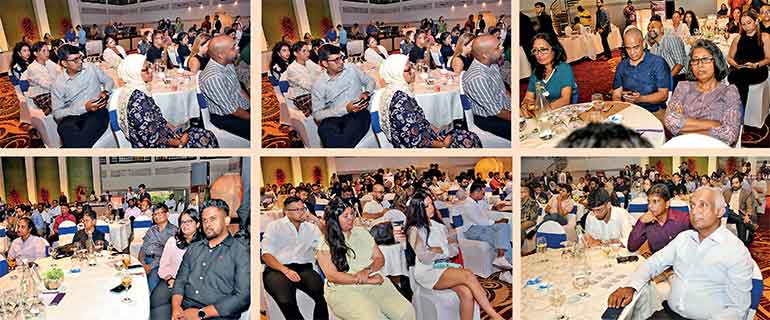
The summit reflected the movement’s increasingly broad reach, bringing together business leaders, authors, educators and literary figures.
Ragulan’s second novel, ‘The Last Cup of Tea’, was also launched at the summit, bringing a deeply personal dimension to an event focused on the value of reading.
The book explores motherhood, identity, loss and transformation, built around Ragulan’s idea that a woman is, in a sense, born twice - first as a woman and again when she becomes a mother.
He reflected on how families celebrate the birth of a child while rarely recognising that the same moment also marks the birth of a mother.
The final section of the book moves into fiction, with its family, characters and story shaped by personal experiences and emotions.
“The feeling behind it is not,” he said, explaining that although the story is fictional, some of the moments and emotions behind it came from experiences through which he had come to understand himself.
The book, he said, is not only about his own mother but about motherhood in a wider human context.
“The mother is part of my complete civilisation,” he said.
Alongside Pathirana, John Keells Group OCTAVE Chief Growth Officer Rohan Jayaweera spoke on ‘Readers’ Advantage: Winning in the Age of AI’, while leadership educator Vidusha Nathavitharana spoke on the value of reading from his childhood and revealed the ‘Books that he would save from a fire’.
Moderated by corporate trainer Prassanna Pathmanathan, a panel featuring Gratiaen Prize-winning writer Dr. Ramya Jirasinghe, award-winning author and administrative officer Ciara Mandulee, and Sarasavi Bookshop Director Amendra Haputhanthri discussed how a simple thought can develop until it becomes a novel or a book.
The discussion brought together different stages of the publishing journey, from the creation of an idea and the writing process to the eventual relationship between books and their readers.
ESU International Public Speaking Competition 2026 Winner Omar Hazari also spoke at the summit about pages, chapters and books, and how small steps shape our lives. He also spoke about how he was inspired to read through his mother’s encouragement.
For Pick a Book, the next seven years could therefore be very different from the first seven. The movement is now asking individuals not only to pick up a book, but also to build the networks, habits and communities needed to make reading a national culture.
“Those are exactly the capacities that reading builds,” Ragulan said, referring to thinking, imagination and deeper human connection.
“For seven years, we asked people to pick a book, but now we are asking a nation to pick each other up - one reader, one club, one story at a time.”
Barista was the Title Sponsor, with Cinnamon Grand Colombo as Hospitality Partner, Daily FT as Print Media Partner and The Asian Review as Literary Partner. PickMe, GD, Zerostix, SLIQ, Softlogic GLOMARK and Vintage Ceylon also supported the event as partners.
- Pix by Shehan Gunasekara




