Monday Sep 21, 2026
Monday Sep 21, 2026
Friday, 19 December 2025 00:00 - - {{hitsCtrl.values.hits}}
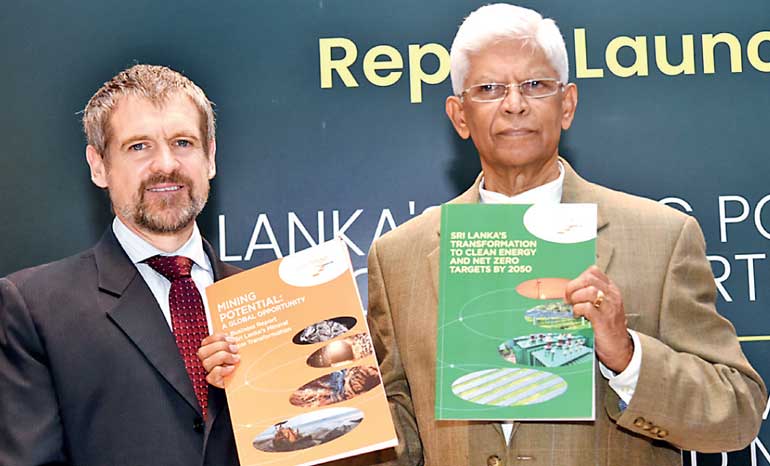
Pathfinder Foundation Chairman Bernard Goonetilleke (right) and Australian High Commissioner Matthew Duckworth pose with the two reports launched this week
 By Amira Cader
The Pathfinder Foundation, in collaboration with the Australian Trade and Investment Commission (Austrade), launched two major business reports examining Sri Lanka’s future in mineral development and clean energy transition held at the Courtyard by Marriott, Colombo yesterday.
The reports—Mining Potential: A Global Opportunity – A Business Report on Sri Lanka’s Mineral Sector Transformation and Sri Lanka’s Transformation to Clean Energy and Net Zero Targets by 2050—offer strategic insights into how Sri Lanka can leverage its natural resources and policy reforms to drive sustainable economic growth while meeting global climate commitments.
The event commenced with opening remarks by Pathfinder Foundation Chairman Bernard Goonetilleke highlighted the importance of evidence-based policy and international collaboration in positioning Sri Lanka as a competitive player in global mineral and energy markets.
He noted that the country’s high-purity mineral resources and strategic geographic location present a unique opportunity for value addition and investment-led growth.
Delivering the special address as Guest of Honour, the Australian High Commissioner Matthew Duckworth reaffirmed Australia’s commitment to supporting Sri Lanka’s economic recovery and long-term development.
“Australia remains committed to supporting Sri Lanka’s economic recovery and long-term development through strong partnerships built on sustainability and transparency. By advancing responsible mining practices, accelerating clean energy solutions and deepening private-sector collaboration, we can strengthen resilient supply chains that deliver shared economic and environmental benefits for both our countries,” Duckworth noted.
The official launch of the two reports was followed by detailed presentations from the lead contributors.
Faculty of Engineering, Department of Earth Resources Engineering Prof. D.M.D.O.K. Dissanayake highlighted that Sri Lanka possesses high-purity graphite, mineral sands, rare earth elements, quartz and apatite, all of which are essential for electric vehicles, renewable energy, semiconductors and fertiliser production.
He noted that mineral exports could increase from $ 389 million to $ 778 million, while the sector’s contribution to GDP could rise from 2% to 5% through value addition and downstream processing. Recent economic reforms, including longer mining leases, digital licensing and incentives such as the Trincomalee Special Economic Zone, were cited as positive developments for investors.
However, challenges remain, including outdated technology, fragmented regulation and the need for stronger environmental and community engagement frameworks.
Prof. Dissanayake stressed that any future offshore or deep-sea mining must comply with international environmental standards with a clear critical minerals policy, technology partnerships, ESG compliance and skills development are essential for positioning Sri Lanka as a competitive and sustainable player in global mineral supply chains.
The Clean Energy and Net Zero Report was presented by Sri Lanka Sustainable Energy Authority Director General Harsha Wickramasinghe outlined the country’s strong renewable energy potential in solar, wind, hydro and biomass, alongside the urgent need to reduce reliance on costly fossil fuel imports. The presentation emphasised accelerating clean energy investments, strengthening grid infrastructure, expanding energy storage and adopting supportive regulatory frameworks to ensure a reliable and sustainable energy transition.
Wickramasinghe also underscored the importance of technology adoption, private-sector participation and international collaboration in delivering Sri Lanka’s long-term climate and energy goals.
A lively question-and-answer session followed, allowing participants from government, industry, academia and the diplomatic community to engage with the presenters on policy making, investment readiness, environmental safeguards and community engagement.
Concluding remarks were delivered by Austrade Country Director – Trade and Investment Shameel Javadh and Pathfinder Foundation Executive Director Dr. Dayaratna Silva, Both emphasised the importance of sustained collaboration between Sri Lanka and international partners, particularly in areas such as technology transfer, value-chain development and capacity building.
The studies highlighted a clear pathway for Sri Lanka to strengthen its role in regional and global supply chains while advancing its net zero ambitions. The importance of continued collaboration between government, industry and international partners to translate policy vision into long-term, inclusive and environmentally responsible growth.




