Tuesday Sep 15, 2026
Tuesday Sep 15, 2026
Tuesday, 3 February 2026 03:57 - - {{hitsCtrl.values.hits}}

From left: Capital Maharaja Group Executive Director Nimal S. Cooke, Prof. Kithsiri Dissanayake, Pathfinder Foundation Chairman Bernard Goonetilleke, Bogala Graphite Lanka CEO Amila Jayasinghe, Prof. Ajith De Alwis, and PF Executive Director Dr. Dayaratna Silva
The Pathfinder Foundation (PF) convened its Seventh Diplomatic Dialogue, themed “Unlocking Sri Lanka’s Mineral Sector – Opportunities for Sustainable Investment and Strategic Partnerships”, bringing together Colombo-based diplomats, government officials, academics, think tank representatives, and business leaders.
The dialogue forms part of PF’s ongoing effort to position Sri Lanka as a credible participant in global critical mineral supply chains by linking the country’s mineral endowment to policy reform, investment readiness, and value-added industrial development. The discussions were informed by the Foundation’s report “Mining Potential: A Global Opportunity”, launched in December 2025 in collaboration with AUSTRADE.
Ahead of the dialogue, the Pathfinder Foundation convened a consultative meeting on 22 January with representatives of diplomatic missions from Australia, India, Japan, and the United States, as well as industry and academic experts. Participants agreed to establish an International Study Group on Critical Minerals, to be facilitated by the PF. Nimal Cooke will serve as the group’s convenor.
The Study Group will serve as a platform for sustained policy dialogue and cooperation, focusing on supporting Sri Lanka’s critical minerals sector, identifying pilot projects, and facilitating foreign direct investment aligned with trusted global supply chains. Pathfinder Foundation will advance this agenda through targeted research, structured consultations, and continued engagement with international partners.
Delivering the opening remarks, at the Pathfinder Foundation Seventh Diplomatic Dialogue Chairman Bernard Goonetilleke highlighted Sri Lanka’s unique position in the global minerals landscape and the growing importance of high-quality mineral resources for modern technologies and the global energy transition. Sri Lanka is endowed with significant resources, including ultra-high-purity vein graphite, mineral sands, apatite, quartz, mica, and rare-earth elements (REEs). Vein graphite, with a carbon content of up to 99.9%, is globally recognised for use in electric-vehicle batteries, energy storage, and advanced industrial applications.
Presentations by Prof. Kithsiri Dissanayake and Prof. Ajith De Alwis of the University of Moratuwa emphasised the need to translate Sri Lanka’s strategic mineral advantages into knowledge-driven, export-oriented development. They highlighted opportunities to align mineral development with the global energy transition through pilot projects, stronger collaboration among academia, industry, and Government, and the application of advanced technologies—including nanotechnology—to upgrade downstream processing and maximise value addition.
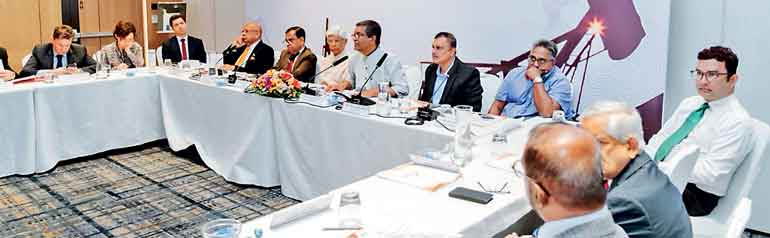 Industry panellists Bogala Graphite Lanka Ltd., CEO Amila Jayasinghe and the Capital Maharaja Group Executive Director Nimal S. Cooke, underscored the urgency of modernising mining operations and regulatory frameworks. They noted that regulatory reform, digital licensing, and investor-friendly approval mechanisms are essential to improving transparency, reducing approval timelines, and attracting long-term investment. Public–private partnerships were identified as a practical pathway to accelerate sector development. Strategic processing zones, including Trincomalee, were highlighted as potential hubs for graphite, heavy mineral sands, and REEs, with a focus on producing export-ready, value-added products.
Participants welcomed the Government’s initiative to develop a new national policy on mineral resources, particularly to address licensing delays and institutional bottlenecks. They emphasised the importance of structured stakeholder consultation before finalising the policy and noted the relevance of Pathfinder Foundation’s research and convening platform in supporting this process. Plans are also underway to establish a digital, one-stop approval system as part of the policy reform effort. The mineral sector’s inclusion in the forthcoming five-year National Export Development Plan was seen as an important step towards addressing regulatory, infrastructure, and energy-related constraints.
Concluding the dialogue, it was noted that realising Sri Lanka’s mineral potential would require investor-friendly policies, a predictable regulatory environment, pragmatic value-addition strategies, and close collaboration among the Government, industry, and research institutions.




