Friday Oct 16, 2026
Friday Oct 16, 2026
Tuesday, 30 June 2026 05:55 - - {{hitsCtrl.values.hits}}
By Charumini de Silva
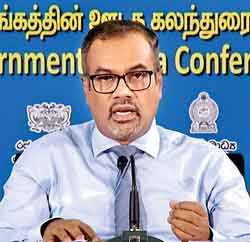 |
| Finance and Planning Deputy Minister Dr. Anil Jayantha Fernando |
The Government last week outlined an ambitious Customs modernisation program aimed at strengthening revenue administration, facilitating trade and eliminating leakages, while confirming that the phased removal of para-tariffs will commence in 2028 as part of broader structural reforms.
Responding to questions on the recent visit by an International Monetary Fund (IMF) delegation to Sri Lanka Customs, Finance and Planning Deputy Minister Dr. Anil Jayantha Fernando said the discussions centred on building a more efficient, transparent and technology-driven revenue collection system, although he was not directly involved in the meeting.
“The idea is to have a robust, efficient and transparent revenue collection system,” he said, noting that Customs reforms have been a Government priority since the beginning of its economic reform program.
Dr. Fernando said digitalisation remains at the heart of the reform agenda. Customs has already introduced electronic platforms for import documentation, foreign exchange remittances and online payment of service charges, significantly reducing the need for physical interactions between traders and Customs officials.
He said the broader objective extends beyond increasing tax revenue.
“The objective is not to increase tax revenue, but to increase and enhance trade facilitation, whereby we collect the required taxes without leaving any room for leakages,” he said, identifying revenue leakages as one of the biggest weaknesses in the existing system.
As part of the reform package, the Government will also move ahead with a new Customs Ordinance, greater automation of clearance procedures and wider use of risk-based inspections supported by modern technology.
Dr. Fernando also noted that the Cabinet this week approved the procurement of new non-intrusive inspection (NII) scanners, which will enable Customs to adopt risk-based cargo screening rather than relying on physical inspections.
“If you have modern scanners and appropriate technology, it is easy for Customs to apply a risk assessment-based strategy,” he said, adding that low-risk consignments could be cleared more quickly, while enforcement resources are concentrated on higher-risk shipments.
The Deputy Minister also confirmed that Sri Lanka’s para-tariff rationalisation program will begin in 2028, with the phased removal of the cess as previously announced.
“For most products, 50% of the cess will be removed in 2028, followed by a further 25% in 2029, with the remaining balance eliminated by 2030,” he said.
However, following consultations with domestic manufacturers, he said the Government has agreed to adopt a slower transition for around 107 selected HS codes, where industries feared that rapid removal could undermine their competitiveness against imports.
“For these products, only 25% of the cess will be removed in both 2028 and 2029, with the remaining 50% phased out in 2030,” he explained.
To cushion the impact on local industry, Dr. Fernando said protection would instead be provided through a simplified four-band Customs tariff structure comprising rates of 0%, 10%, 20% and 30%.




