Thursday Oct 22, 2026
Thursday Oct 22, 2026
Wednesday, 24 June 2026 00:07 - - {{hitsCtrl.values.hits}}
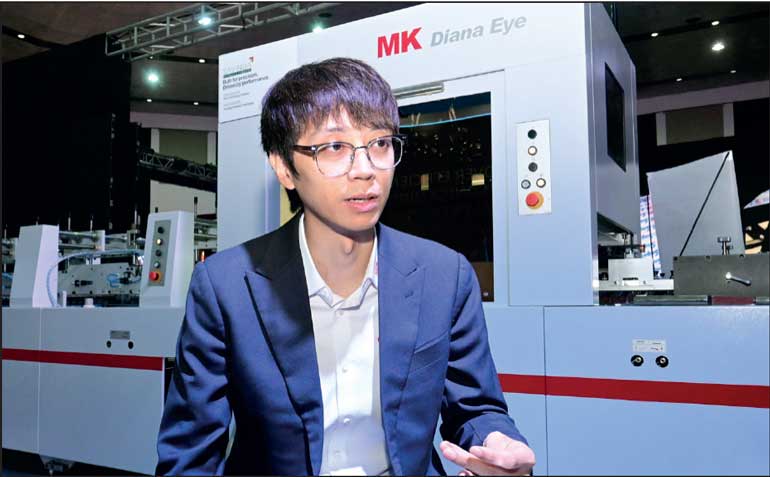
Masterwork Group General Manager – Sales Maxen Liu
– Pic by Sameera Wijesinghe
By Amira Cader
As the global printing and packaging industry undergoes a significant transformation driven by automation, artificial intelligence and smart manufacturing, industry leaders are increasingly focused on delivering integrated solutions that enhance efficiency, sustainability and long-term competitiveness.
These trends took centre stage at Sri Lanka Print Expo 2026, organised by the Sri Lanka Association of Printers (SLAP), which brought together industry stakeholders, technology providers and manufacturers to explore the future of the sector.
Among the international participants was Masterwork Group General Manager - Sales Maxen Liu, representing one of China’s leading manufacturers of printing, packaging and post-press solutions.
In an interview with the Daily FT, Liu shared insights into emerging industry trends, innovation, sustainability and why he believes Sri Lanka is among Masterwork’s fastest-growing markets.
Q: Could you briefly introduce Masterwork Group and its global footprint?
A: Masterwork Group has been operating for 31 years. We started with hot stamping and die-cutting machines, and today we have expanded to seven product series with more than 100 machine models. Our portfolio includes hot stamping, die-cutting, foil printing, inspection systems, laser die-cutting and digital solutions.
Our vision is to become a total solutions provider for the printing and packaging industry. In addition to machinery, we now offer smart factory solutions, including ERP and MES software systems, automated guided vehicles (AGVs), robotic pallet transfer systems and smart warehouse solutions. Together, these technologies enable customers to build fully integrated smart factories.
Q: What are the biggest trends currently shaping the global printing and packaging industry?
A: The first major trend is the shift from standalone machines to complete solutions. Customers no longer want just one machine; they are looking for integrated systems that improve productivity across the entire production process.
The second trend is efficiency. Machines are long-term investments that may be used for 10 to 20 years. Customers increasingly focus on efficiency, productivity and cost performance rather than simply comparing purchase prices.
Chinese manufacturers have made significant progress in recent years. While European machines have traditionally been recognised for stability, Chinese companies now offer excellent performance combined with strong cost competitiveness.
Q: How is digital transformation influencing post-press and finishing technologies?
A: We are seeing more short-run orders, which means job changeover times need to be shorter. If machine setup takes too long, productivity is reduced.
To address this, we have developed features that reduce make-ready times and simplify operation. Functions such as Quick Set and Auto Set enable operators to prepare machines much more efficiently, reducing downtime and increasing productivity.
Q: Masterwork is known for innovation. What recent innovation are you most excited about?
A: We invest between five and seven percent of our annual revenue in research and development, which helps us continue leading the market through innovation.
One innovation I am particularly proud of is our patented Dual Press technology. This machine combines hot stamping and die-cutting in a single pass.
This was especially valuable in China’s tobacco packaging sector, where some products require multiple hot-stamping processes. With Dual Press technology, two hot-stamping operations and die-cutting can be completed in a single pass, significantly improving efficiency while reducing waste.
It is a good example of how innovation can increase productivity while supporting sustainability goals.
Q: How are emerging technologies such as AI and smart manufacturing impacting your systems?
A: We have a dedicated subsidiary focused on smart manufacturing solutions. Before introducing solutions to customers, we first test them in our own factories.
We have around 150 people working in software development and coding. We combine our practical experience with research and development to create integrated solutions that include software systems, AGVs, smart warehouses and intelligent manufacturing platforms.
We are also exploring how artificial intelligence can be connected to our machinery and software systems. In the future, AI could become the brain of the printing plant, helping manufacturers optimise operations and improve decision-making.
Q: What should printing companies invest in today to remain competitive over the next decade?
A: Automation.
Labour costs continue to increase, while automation technologies are becoming more mature, accessible and cost-effective.
Companies should focus on two areas. The first is logistics automation, including material handling and warehouse management. The second is production automation through advanced machine features and intelligent configurations that reduce manual intervention and improve efficiency.
Q: There are concerns that AI and automation may affect jobs. What is your perspective?
A: I do not believe jobs will be completely replaced. Technology can improve efficiency significantly, but people will continue to play an important role.
Instead of replacing workers, AI and automation will allow people to focus on more creative, higher-value and specialised tasks. Human experience, judgment and creativity remain essential.
Q: Sustainability has become a major focus worldwide. How is Masterwork helping customers reduce their environmental impact?
A: Sustainability is increasingly important for customers, especially in international markets.
One of our core philosophies is that we focus on customer interests, not just customers themselves. Sustainability is one of those interests.
In addition, we have entered the renewable energy sector and now provide rooftop solar panel solutions for industrial customers. This is another way we are helping businesses improve sustainability while reducing operating costs.
Q: What opportunities do you see for Sri Lanka’s printing and packaging industry?
A: Sri Lanka has become one of our top five emerging markets.
We have supplied a significant number of machines across the pre-press, printing and post-press segments. The market is showing strong momentum, and there is clear interest in adopting modern technologies.
I believe there are significant opportunities for local companies to improve efficiency, expand capabilities and enhance competitiveness through technology adoption.
Q: How does Sri Lanka compare with other emerging markets, and are there plans to strengthen partnerships here?
A: Absolutely. We want to strengthen our cooperation with our local partner and continue exploring the market with a broader product portfolio.
We see long-term potential in Sri Lanka and are committed to supporting the industry’s development.
Q: What advice would you offer local printing companies looking to grow and compete internationally?
A: One of the best ways to learn is through exposure to successful operations.
We hope to organise dedicated visits for Sri Lankan customers to China so they can see advanced manufacturing facilities and reference customers across different industries, including premium packaging, wine labels and tobacco packaging.
Learning from successful examples can help businesses understand market trends, technologies and operational strategies that can be adapted locally.
Q: What challenges does the industry currently face?
A: Economic conditions remain one of the biggest challenges.
Even when customers appreciate the value of new technology and machinery, investment decisions are influenced by the broader economic environment. When economies face difficulties, businesses also become more cautious.
We are confident in our products and solutions, but economic stability plays a major role in supporting industry growth and investment.
Q: What is your vision for the future of printing and packaging over the next five years?
A: Some people describe printing and packaging as a sunset industry, but I disagree, especially when it comes to packaging.
Every product needs packaging. It is part of our daily lives, and demand will continue to exist. That is why I believe packaging is an evergreen industry.
I expect the sector to continue growing steadily year by year. It may not grow as rapidly as industries such as artificial intelligence or digital technology, but it will continue expanding at a stable pace, closely aligned with economic growth.
Q: Which technology do you believe will be the biggest game changer for the industry?
A: Artificial intelligence.
AI has the potential to transform how printing plants operate by improving efficiency, decision-making and integration across manufacturing processes.
Q: Finally, what message would you like to share with industry professionals and young people considering a career in this field?
A: Stay humble and stay curious.
This is not an industry where success happens overnight. You cannot expect to move from the starting point to the top within a very short period.
However, if you work hard, continue learning and remain committed to improvement, you will grow steadily and achieve success. Consistency and dedication are the keys to long-term success.
As the industry continues to evolve, Liu believes success will depend on embracing automation, AI and smart manufacturing while maintaining a strong focus on customer value. He sees significant opportunities for Sri Lanka to strengthen its competitiveness through technology adoption and industry collaboration.
Looking ahead, Liu remains optimistic about the future of the industry, citing steady demand, technological innovation and growing opportunities in emerging markets such as Sri Lanka.
“Every product needs packaging,” he said. “That’s why I believe it is an evergreen industry.”




