Thursday Oct 22, 2026
Thursday Oct 22, 2026
Monday, 24 August 2026 05:48 - - {{hitsCtrl.values.hits}}
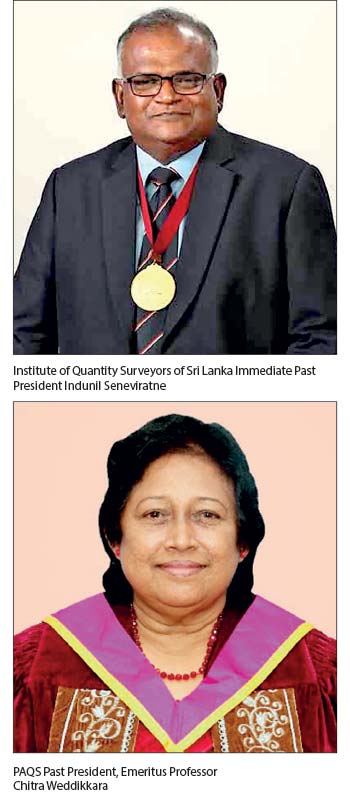
As Sri Lanka prepares to host the PAQS Congress 2026 this week, the country’s Quantity Surveying profession is presented with an opportunity to engage more closely with its regional counterparts, share knowledge and demonstrate the strength of its professional community. The Daily FT spoke to the Institute of Quantity Surveyors of Sri Lanka (IQSSL) Immediate Past President Indunil Seneviratne and PAQS Past President, Emeritus Professor Chitra Weddikkara on the significance of PAQS, the global mobility of Sri Lankan Quantity Surveyors, the role of technology and the profession’s contribution to the wider economy
 Q: For those outside the profession, what is PAQS and why does it matter?
Seneviratne: The Pacific Association of Quantity Surveyors is a regional body representing Quantity Surveyors in the Asia-Pacific region, with Sri Lanka represented by the IQSSL. PAQS provides a platform for regulating education, research and the sharing of research outcomes among member countries. It also accredits undergraduate and postgraduate programmes in areas such as cost management and Quantity Surveying. This recognition provides global mobility for graduates, allowing a person qualifying in Sri Lanka to pursue opportunities in countries such as Australia, New Zealand, Japan and Hong Kong.
Prof. Weddikkara: I would describe PAQS as a bridge that connects Quantity Surveying professionals across different countries. The building sector is becoming increasingly multinational, with projects, consultants, contractors, investors and technologies crossing national borders. PAQS gives professional institutions an opportunity to connect, share knowledge and experiences, learn from one another and collectively strengthen the profession across the region.
Q: What does hosting PAQS 2026 mean for Sri Lanka?
Prof. Weddikkara: As a former President of PAQS, I see hosting the 2026 Congress in Sri Lanka as a particularly significant achievement for our profession. It gives local professionals the opportunity to engage directly with leading practitioners and experts from across the region. Internationally, it puts Sri Lanka in the spotlight and allows us to showcase the strength and professionalism of our Quantity Surveying community. More importantly, it gives us an opportunity to share our own experiences and contribute to the future direction of the profession in the Asia-Pacific region.
Seneviratne: This is only the second time Sri Lanka is hosting the Congress, following the first in 2011. It gives us exposure to current industry practices, best practices and new technology tools being used in the industry. When people come and present their findings, that knowledge is shared, and it becomes a good learning curve for the present generation as well as the future generation of the profession.
Q: The theme is ‘Constructing the Evolution: Unleashing Human Intelligence’. What does that mean for the profession?
Seneviratne: AI tools are now being used across industries, and the conference will focus on how they can benefit Quantity Surveying, while also identifying the roles where human intelligence will remain the main focus. That is a very worthwhile discussion for the profession.
Prof. Weddikkara: Technology should support our profession, not define it. The experience, judgement, ethics and wisdom of a Quantity Surveyor remain fundamental to good professional practice. The Congress gives us an opportunity to embrace technological advancement while preserving and strengthening the human intelligence that sits at the heart of the profession.
Q: How does Sri Lanka’s participation in PAQS benefit professionals and the domestic industry?
Prof. Weddikkara: Sri Lanka has built a strong and respected position within PAQS through the continuous involvement of IQSSL. Our professionals have contributed to committees, technical discussions, research and regional professional development. We are not merely recipients of regional developments; we should be contributors to them.
Seneviratne: When new procurement methods or contract standards emerge, or when we face problems, we can tap into other member countries and see how they have solved those problems. Sharing lessons learned from other countries is very valuable. At the same time, Sri Lankan professionals who gain experience overseas can potentially return when the local economy requires their expertise and contribute significantly to the construction industry and the wider economy.
Q: Sri Lankan Quantity Surveyors are highly regarded internationally. What drives that reputation?
Seneviratne: One of the reasons is our professional and ethical standards. Quantity Surveyors manage other people's money and clients' money, so one has to be very ethical in doing this. We have produced a strong brand of Sri Lankan Quantity Surveyors who are capable of doing this successfully.
Prof. Weddikkara: I would add sound technical knowledge, practical experience, adaptability and professional integrity. Sri Lankan professionals have been exposed to a wide range of projects and challenging commercial environments. Many have progressed into senior management and leadership positions internationally, reflecting the confidence placed in their professional judgement and capabilities.
Q: What is the wider economic role of Quantity Surveying?
Prof. Weddikkara: Cost control is not simply about spending less; it is about making the right decisions and achieving the best possible value from every rupee invested. Particularly in public infrastructure, every rupee needs to be planned, managed and accounted for properly. In that way, Quantity Surveying contributes directly to stronger infrastructure governance and the wider national economy.
Seneviratne: This is a national responsibility of the profession. When government undertakes a development project, Quantity Surveyors are involved in managing costs, which ultimately means managing public money. Every taxpayer's rupee spent should have accountability and deliver value for money.
Q: What should students, professionals and industry stakeholders take from PAQS 2026?
Seneviratne: Quantity Surveying was perhaps not a very well-known profession in the past, but it has now become a prominent profession in the global arena. For clients and developers, if you want to get value from your project and from every rupee you spend, you should be hiring a qualified Quantity Surveyor to manage your costs.
Prof. Weddikkara: My message to the next generation is simple: never stop learning, never stop questioning and never stop innovating. Embrace technology and new ideas, but always preserve the professional judgement, integrity and responsibility that define the profession. For industry stakeholders, good governance, transparent procurement, responsible cost management and long-term value are essential. Every rupee invested deserves professional care, accountability and the best possible value.
Q: What does PAQS 2026 ultimately represent for Sri Lanka?
Prof. Weddikkara: It is an opportunity to share our journey, learn from the region and demonstrate the strength and professionalism of Sri Lankan Quantity Surveyors. We should welcome the PAQS community not only as international colleagues, but as friends and partners in the development of our profession.
Seneviratne: Bringing the 2026 Congress to Sri Lanka gives us national exposure to what we have been doing, and that is another plus point for IQSSL and Sri Lanka in the global arena.




