Thursday Oct 22, 2026
Thursday Oct 22, 2026
Wednesday, 15 July 2026 00:20 - - {{hitsCtrl.values.hits}}
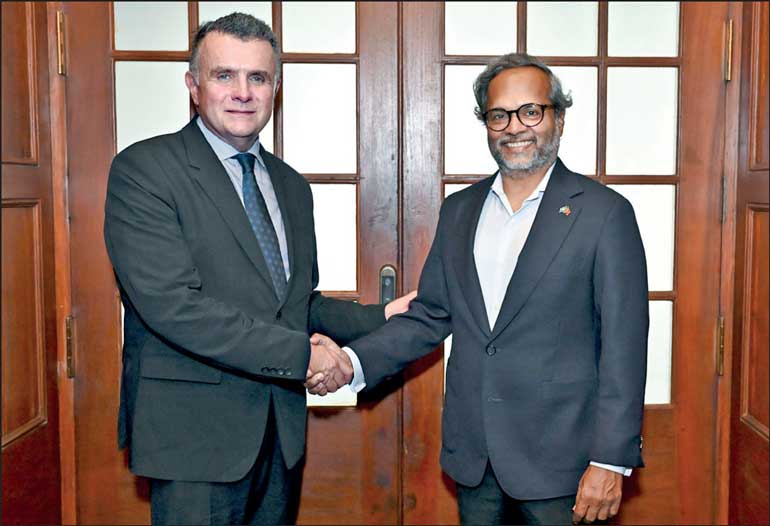
Swedish Ambassador to India, Bhutan, Maldives, Nepal, and Sri Lanka Jan Thesleff (left) with Swedish Consul-General in Colombo Sanjay Kulatunga
– Pic by Daminda Harsha Perera
After nearly four years of strengthening bilateral relations, outgoing Swedish Ambassador Jan Thesleff leaves optimistic about Sri Lanka’s future. Having witnessed Sri Lanka’s recovery from one of its worst economic crises, Thesleff believes the island nation has demonstrated remarkable resilience and is increasingly winning the confidence of international investors.
In this exclusive interview with the Daily FT, he discusses why Swedish companies continue to expand their presence in Sri Lanka, the growing importance of education and technology partnerships, emerging opportunities in renewable energy and healthcare, the need for direct air connectivity to boost tourism, and why he considers Sri Lanka’s greatest asset to be its people.
Below are excerpts of the interview;
By Charumini de Silva
Q: Looking back at your tenure, what stands out most about Sri Lanka?
A: Sri Lanka has consistently impressed me with its resilience. The country has endured challenges that were largely beyond its control, from the pandemic and global economic shocks to the tsunami, extreme weather events and the recent Middle East crisis. Yet, despite these setbacks, Sri Lanka has repeatedly demonstrated an ability to recover. Compared to my previous visit six months ago, I can already see tangible progress. Developments such as the Port City are no longer just plans on paper but are visibly taking shape. There is a strong inner resilience and optimism that makes me believe Sri Lanka is moving in the right direction.
Q: How do Swedish businesses view Sri Lanka as an investment destination?
A: The overall sentiment is positive. Investors value stability and predictability, and Sri Lanka has made significant progress in creating a more stable investment environment. Capital is highly mobile and can move anywhere in the world. If investors choose Sri Lanka, it is because they see opportunities and confidence in the country’s fundamentals. One of Sri Lanka’s key strengths today is the consistency and predictability of its policy direction under the current administration. Investors want confidence that policies announced today will continue tomorrow, allowing them to plan long-term. That sense of stability is an important factor in attracting investment, and it is one of the reasons Swedish businesses continue to view Sri Lanka positively.
Q: Sweden has around 80 companies operating in Sri Lanka. How significant is that?
A: It is actually quite significant. Sweden has about 300 companies in India, which is a vastly larger market, so having around 80 companies in Sri Lanka reflects substantial engagement. Many Swedish businesses started small and have expanded successfully over the years. Often, Swedish entrepreneurs first come to Sri Lanka, discover the country’s potential and then ask themselves how they can contribute using their expertise, technology and business experience. Around half of the Swedish companies operating in Sri Lanka are in the ICT sector, reflecting the country’s strong talent pool and growing reputation as a technology hub. Their continued expansion demonstrates confidence not only in Sri Lanka’s workforce, but also in its long-term growth potential.
Q: What sectors are attracting Swedish interest?
A: Information and communication technology (ICT) and niche apparel manufacturing continue to be the strongest sectors attracting Swedish interest. Sri Lanka’s highly educated and skilled workforce remains one of its greatest competitive advantages, particularly in knowledge-based industries. We are also seeing manufacturing operations, particularly in apparel, relocating from other parts of Asia to Sri Lanka. That is a clear indication of confidence in the country’s stable business environment and skilled labour force. Beyond these sectors, we see growing opportunities in renewable energy, healthcare, life sciences, food processing and food packaging, where Swedish technology and expertise can complement Sri Lanka’s export earnings as development ambitions.
Q: Sweden has been involved in Sri Lanka’s energy sector for decades. How is that partnership evolving?
A: The partnership continues to deepen. Following Sweden’s involvement in the Kotmale Hydropower Project in the 1980s, Sweden’s development finance institution, Swedfund, collaborates with the Ceylon Electricity Board (CEB) to help Sri Lanka achieve its renewable energy targets and stabilise its national grid. This partnership focuses on transitioning the country away from fossil fuels. As Sri Lanka rapidly expands renewable energy, with solar panels becoming increasingly common across the country, maintaining grid stability becomes more challenging. Sweden is contributing technical expertise and feasibility studies to help address this issue.
Q: Swedish investment firm EQT has invested heavily in Sri Lankan technology companies. What does that signify?
A: Portfolio investments tell an important story. When a firm like EQT invests over $ 1 billion in Sri Lankan technology companies such as WSO2 and 99X, it demonstrates confidence in the quality, talent, professionalism, governance and long-term prospects of Sri Lankan businesses. Unlike foreign direct investment (FDIs), where a foreign business model is simply replicated in another country, portfolio investments reflect confidence in companies that have been built locally. These investments are a strong vote of confidence in Sri Lanka’s entrepreneurial ecosystem.
Q: Education has become an important pillar of bilateral relations. Could you elaborate more?
A: Sri Lanka has become one of the largest sources of postgraduate students to Sweden, second only to India and ahead of countries such as China. I strongly believe undergraduate education can be obtained in one’s home country, but postgraduate education benefits greatly from international exposure. Sweden offers around 950 master’s programs in English, making higher education accessible without the need to learn Swedish. These graduates often return home with advanced skills and international experience. I call this “intellectual remittances.” Financial remittances are important, but intellectual remittances are equally valuable because they strengthen Sri Lanka’s human capital and reduce the long-term effects of brain drain.
Q: Which new sectors should receive greater attention in future Sweden-Sri Lanka cooperation?
A: Healthcare and life sciences offer enormous potential for future collaboration. Sweden has globally recognised companies such as AstraZeneca and Elekta, and there is considerable scope to deepen partnerships with Sri Lanka in medical technology, healthcare solutions and life sciences. Another promising area is sustainable mining. Modern Swedish technology enables “non-invasive” mining methods that minimise environmental damage, while allowing countries to responsibly extract valuable minerals. This approach balances economic development with environmental protection and could become an important area of future cooperation as Sri Lanka explores its mineral resources more sustainably.
Q: People of Sweden are considered high-end travellers. How can Sri Lanka attract more Swedish tourists?
A: The single biggest game changer would be direct air connectivity. Swedish travellers increasingly prefer direct flights, especially given growing uncertainty surrounding transit hubs in the Middle East. Stockholm is actively looking at direct flight connectivity. Eliminating stopovers will significantly improve Sri Lanka’s attractiveness. Swedish visitor numbers have largely recovered to pre-pandemic levels of around 18,000 annually after falling sharply during the pandemic, but there remains considerable room for growth. In addition, there are Swedish hospitality companies that are exploring potential opportunities on setting up hotels in Sri Lanka.
Q: What role does culture play in strengthening bilateral relations?
A: Culture creates lasting connections. One of our ambitions has been to bring a Geoffrey Bawa exhibition to Stockholm. We have already identified a museum interested in showcasing Sri Lanka’s tropical modernist architecture. We also celebrate “Cinnamon Day” every year on 4 October, reflecting the unique connection between our countries. Sri Lanka is the world’s largest producer of cinnamon, while Sweden is among the world’s largest consumers on a per-capita basis. The Ceylon Cinnamon that we all love is not just a spice, but a true work of art. It takes a lot of skill and dedication to carry on the legacy. I’ve experienced the process and it was truly amazing. These events combine Swedish and Sri Lankan culinary traditions and attract several hundred participants annually.
Q: What should be the next priorities for the incoming Swedish Ambassador?
A: The strong momentum in trade and investment should continue. Over the past four years, we have worked towards organising at least one major Swedish trade delegation to Sri Lanka annually, and I hope that remains a priority. There is significant scope to further strengthen cooperation in food processing, food packaging, renewable energy, healthcare, life sciences and sustainable mining. These are sectors, where Swedish innovation and technology align well with Sri Lanka’s development priorities, and they offer considerable opportunities for both countries to build long-term partnerships.
Q: Are there any major initiatives already planned for trade and investment?
A: Yes. A major Swedish business delegation will visit Sri Lanka in January 2027 under the leadership of Business Sweden. The delegation will also participate in ‘Sri Lanka Expo 2027’, marking Sweden’s first-ever organised participation in the country’s flagship export exhibition. This will be another important milestone in expanding bilateral commercial relations and will provide Swedish companies with an opportunity to explore new partnerships and investment opportunities across a range of sectors.
Q: On a personal note, what memories will you take away from Sri Lanka?
A: The people. Places can always be revisited, but it is the people who leave the deepest impression. Even during Sri Lanka’s most difficult periods, people welcomed us with warmth and smiles. That resilience and hospitality are extraordinary and are among the country’s greatest strengths. I first visited Sri Lanka in 1993 during my honeymoon and returned to many of the same places over the years, including the Galle Face Hotel. I have covered most parts of the Southern coast including Galle, Bentota, Lunuganga and Hambantota. I have also visited Kandy, Mt. Lavinia to name a few. If I had to choose one favourite destination, it would probably be Galle together with Galle Face. Islands have a unique character, and Sri Lanka possesses something very special. It is that combination of resilience, talent, warm hospitality and optimism is precisely why I remain optimistic about Sri Lanka’s future and why I believe it will continue to attract investors, businesses and tourists in the years ahead.




