Friday Sep 25, 2026
Friday Sep 25, 2026
Thursday, 11 December 2025 06:16 - - {{hitsCtrl.values.hits}}
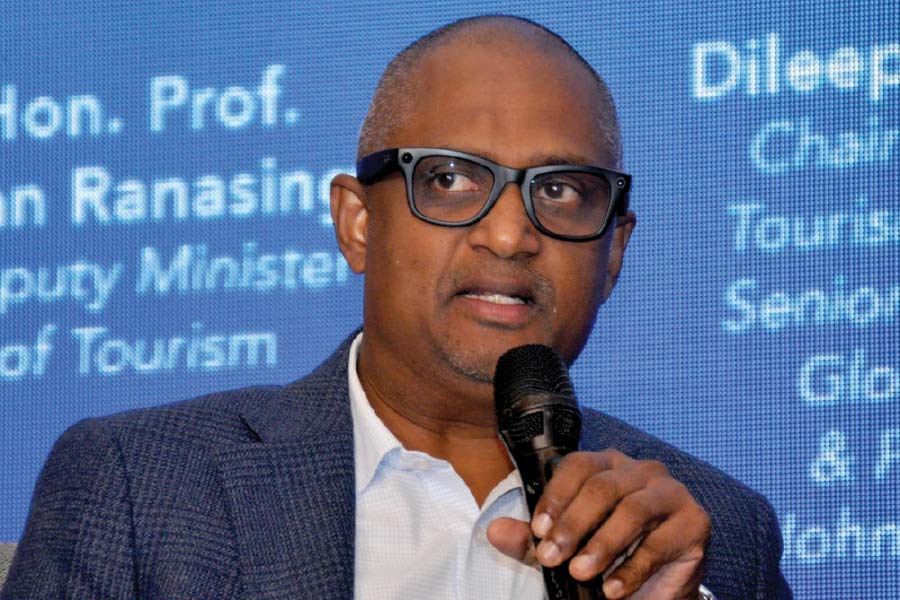
National Tourism Committee Chairman Dileep Mudadeniya - Pic by Lasantha Kumara
By Charumini de Silva
Sri Lanka Tourism Advisory Committee Chairman Dileep Mudadeniya stressed that nation branding and destination marketing are fundamentally different, whilst urging the policymakers and industry stakeholders to clearly understand this distinction when shaping Sri Lanka’s long-term tourism strategy.
He made these remarks recently during a panel discussion titled, ‘Turning Data into Direction: Shaping Tourism Together’ organised by Australia’s Market Development Facility (MDF), in collaboration with the Sri Lanka Tourism Development Authority (SLTDA) to launch Sri Lanka’s 12- month national airport exit survey to support data-driven tourism planning in the country.
Mudadeniya noted that nation branding is not a marketing campaign, but the reputation a country earns over decades through consistent policy, governance, public diplomacy, cultural exports, innovation, and overall national behaviour.
“A nation brand cannot be built through advertisements,” he said, citing Incredible India as an example of a tourism campaign rather than a driver of India’s global reputation.
According to Mudadeniya, a country’s brand strength reflected in global indices, directly affects tourism return on investment (RoI).
He pointed out that Malaysia delivers significantly higher returns on tourism marketing spend because it enjoys a stronger national image. “Good country brands are easier to market. Mediocre ones need more money,” he said.
He stressed that Sri Lanka must build a stronger national image through sustained policy consistency. Only then will tourism marketing become more effective.
“Nation branding is earned, not bought,” he reiterated, adding that it takes 10 to 15 years for a country to change its image through consistent policy.
However, he said this a very strategic role which the Governments have now established and do it in a very bland manner through the policies of the country.
“For example, ‘Clean Sri Lanka’, policy can be a great way to enter the nation branding process. Because when the nation brand is established, then the tourism people will find it easier to market it,” he added.
On tourism marketing and research, Mudadeniya said the current research initiative by the SLTDA and MDF is a solid start, but must evolve into a more rigorous, continuous process.
He highlighted global best practices such as Australia’s daily airport exit surveys, integration of forward-booking data, credit card spending details, STR hotel analytics, and data from Online Travel Agencies (OTA) platforms, to create an accurate, comprehensive tourism intelligence dashboard.
He proposed merging datasets, institutionalising research at a national level and commercialising the outputs so that private-sector stakeholders can subscribe and utilise insights, strengthening industry-wide decision-making.
Mudadeniya also underscored the need to differentiate market-driven strategy (responding to current demand) from marketing-driven strategy (creating new demand through innovation), noting that research alone cannot define the full scope of tourism development.
On the impending global marketing campaign, he clarified that the Sri Lanka Tourism Promotion Bureau (SLTPB) is the custodian and implementer, while the Advisory Committee only provides guidance.
He stressed that the campaign must be underpinned by a formal marketing strategy involving segmentation, targeting, market prioritisation, financial planning, RoI projections and clear performance measurement.
He acknowledged bureaucratic hurdles, but said the industry and advisory bodies remain committed to supporting the campaign’s implementation.
“Everyone has opinions about tourism, but decisions must be backed by data and grounded in operational realities,” he noted.
Mudadeniya called for deeper private-sector involvement through the SLTPB, saying stronger collaboration will ensure greater accountability, better strategy and a more competitive national tourism brand in the long term.




