Monday Sep 28, 2026
Monday Sep 28, 2026
Monday, 10 August 2026 00:06 - - {{hitsCtrl.values.hits}}
By Devan Daniel
Sri Lanka's economic future will increasingly be determined not by its proximity to India but by its ability to make itself competitive enough to participate in India's rise, according to an emerging consensus among Government, business leaders, diplomats and strategic thinkers at the Lanka India Business Association's India Calling forum yesterday.
Although approaching the issue from different perspectives, speakers repeatedly returned to the same proposition: as global supply chains become more regional, investment decisions become increasingly influenced by geopolitics and artificial intelligence reshapes production, Sri Lanka's comparative advantage will depend on completing structural reforms, strengthening institutions and becoming a more competitive economy.
The convergence was notable because it extended well beyond traditional calls for stronger bilateral trade. Instead, speakers argued that Sri Lanka should view India less as an export market than as an anchor around which to build integrated supply chains, industrial partnerships, technology collaboration and investment.
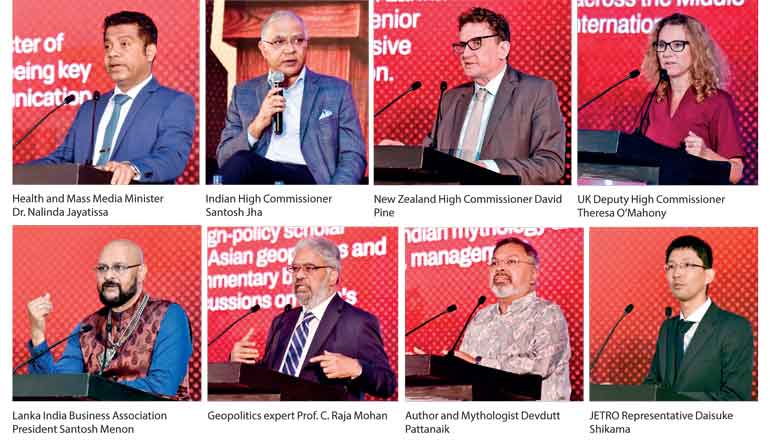
Health and Mass Media Minister
Dr. Nalinda Jayatissa said the Government viewed economic recovery as only the first stage of a broader restructuring programme.
"We are not merely recovering; we are restructuring. Our economic direction is guided by discipline, transparency and collaboration. We are moving away from dependency-driven models towards a value-creating economy, one that is competitive, export-orientated and innovation-driven."
He argued that the next phase of Sri Lanka-India economic relations must extend beyond merchandise trade.
"The numbers speak for themselves. India remains one of Sri Lanka's largest trading partners and a key source of investment. But our ambition must go beyond trade volumes. We must deepen value chains, strengthen industrial cooperation and facilitate technology partnership."
Dr. Jayatissa acknowledged that competitiveness depended on the quality of institutions rather than policy announcements.
"Investors do not seek promises; they seek certainty. We are committed to maintaining policy stability, improving regulatory frameworks and ensuring that institutions function with accountability."
He added that the Government's role was to facilitate rather than direct economic activity.
"We welcome investment, but we align it with national priorities. At the same time, we recognise that the private sector is an engine of growth. Governments must facilitate, not obstruct. Our role is to remove barriers, provide clarity and ensure a level playing field."
Indian High Commissioner to Sri Lanka Santosh Jha said India had become Sri Lanka's largest investor, accounting for more than 50% of investment into the country last year, as economic ties expanded beyond trade into energy, connectivity, technology and start-ups.
He argued that India's experience showed the importance of process-level reforms, noting that it had removed more than 1,500 redundant laws and eased or abolished over 40,000 compliance requirements.
"Those are the reforms that actually on the ground make more difference. The process reforms. Usually, these are the biggest obstacles to achieving the kind of groundbreaking, breakout goals that we all aspire to."
Jha said Sri Lanka and India now needed to deepen economic integration through energy connectivity, more flights and ferry services, an updated Free Trade Agreement and new industrial corridors. He also pointed to technology cooperation, noting that Sri Lanka was the first overseas recipient of India's NASSCOM Disha program, under which 40 Sri Lankan entrepreneurs and innovators are receiving mentorship from Indian CEOs.
He cited India's $ 4.1 billion assistance during Sri Lanka's economic crisis as an example of the relationship delivering tangible outcomes, while arguing that its longer-term strength would depend on consistently producing economic results.
New Zealand High Commissioner David Pine illustrated the economic integration argument through his country's economic integration with Australia, suggesting Sri Lanka faced choices similar to those confronting New Zealand four decades ago.
"Successful integration with a larger neighbour comes not from resisting economic change, but from actively shaping it. Our integration was achieved by investing in competitiveness, by building trust, and by creating conditions that allow businesses and people to seize new opportunities."
Rather than weakening a smaller economy, he argued, integration rewarded those prepared to reform.
"The second lesson is that economic integration isn't a zero-sum game. The third lesson is that openness can strengthen competitiveness."
Pine also cautioned against permanent industrial protection.
"Government support works best when it is well-targeted, transparent and time-bound. Its purpose should be to prepare industries for competition, not to shield them indefinitely from market realities. The goal should be permanent competitiveness, not permanent support."
UK Deputy High Commissioner Theresa O'Mahony approached the discussion from the perspective of investment competitiveness, arguing that Sri Lanka's skilled workforce already provided a comparative advantage but structural weaknesses continued to discourage foreign investors.
"Sri Lanka at the moment has some of the most expensive energy in the region and often that is used as an example of why it is difficult to come and invest in Sri Lanka, particularly from an industrial perspective."
She said procurement practices were unfair and reform would become increasingly important as Sri Lanka sought to position itself within commercial opportunities created by the recently concluded UK-India Free Trade Agreement.
"We need to work out how to modernise Sri Lanka's procurement rules to ensure that there is enough FDI into Sri Lanka to allow them to invest in the energy sector, to reduce costs overall and to ensure that a greater number of businesses want to come and invest in Sri Lanka."
"There are UK companies that want to come and invest here but often don't because they don't feel that the procurement processes are competitive and fair."
Lanka India Business Association President Santosh Menon argued that Sri Lanka had yet to convert India's economic expansion into tangible domestic gains.
"While Indians invested $ 30 billion globally last year, only less than a billion dollars was invested in Sri Lanka."
He also questioned why Sri Lanka attracted only 452,000 Indian visitors out of roughly 30 million outbound Indian travellers annually.
"If indeed it is a transformative opportunity, how soon should Sri Lanka and India respond to the calling? What's holding India and Sri Lanka back?"
Geopolitics expert Prof. C. Raja Mohan placed the discussion within a broader transformation of the international economy, arguing that the era of unconstrained globalisation had given way to one dominated by trusted partnerships, regional supply chains and technological competition.
He suggested South Asian policymakers needed to rethink long-held assumptions about development.
"Policies that are designed to produce prosperity are much better than policies that seek to distribute the existing gain."
"Prosperity must be a part of the national goal."
Prof. Raja Mohan said geopolitical fragmentation made regional cooperation increasingly valuable.
"In this world of fragmentation, regional engagement, engagement with what is now called the trusted partners, becomes that much more critical."
He argued that geography should be treated as an economic asset rather than merely a political reality.
"The need for us to do more with each other on a regional basis, on the basis of existing opportunities that exist whether geographic or economic, has become very, very crucial."
Looking ahead, he said artificial intelligence represented another opportunity for collaboration.
"The age of AI offers an unprecedented level of prosperity. In a fragmenting world of global economy, the need for more regional collaboration, building on existing synergies, especially between close neighbours, becomes very, very important,” he said.
Japan External Trade Organisation (JETRO) Representative Daisuke Shikama outlined a proposed export-oriented industrial corridor linking Sri Lanka with India's manufacturing base, saying the initiative could raise Sri Lanka's GDP by an estimated 9.3% by 2030 if identified trade and investment constraints are addressed.
Under the concept proposed by Japan to the Sri Lankan Government last September, Sri Lanka would supply components and intermediate goods to India, where finished products could be manufactured for export to markets including the Middle East, Africa and ASEAN. Japan views the region as a production base through which it could expand investment, strengthen supply chains and improve access to the Global South.
Shikama said the proposed roadmap had identified electronics, mineral products and agri-resources, including rubber, as sectors where Sri Lanka's existing or potential capabilities could complement India's import requirements. Potential Sri Lankan exports include natural graphite, silicon, capacitors, power circuits, wire harnesses, printed circuit board assemblies and medical-device components, while rubber-based intermediate goods could feed India's automotive, home appliance and medical-device industries.
However, he identified Sri Lanka's reliance on imported raw materials, electricity costs and supply fluctuations, workforce migration, rising wages, high corporate taxes, limited technology for value-added production and policy inconsistency among constraints to developing the proposed supply chain.
A particular constraint is the 35% minimum domestic value-addition requirement under existing rules of origin, which Shikama said could not be met by certain industries because the necessary raw materials and domestic supply chains were unavailable. The Japanese side has proposed reducing the threshold to 25% for specified products, alongside changes to accumulation rules.
He said the rules-of-origin regime under the India-Sri Lanka Free Trade Agreement was being reviewed, with the two countries having already conducted 40 rounds of negotiations.
JETRO's modelling estimates that implementation of the proposed roadmap, including resolution of identified hard and soft constraints, could increase Sri Lanka's GDP by 9.3% by 2030. The corresponding estimated GDP impact for India is 1.28%.
JETRO Colombo also serves as the Secretariat of the Japanese Chamber of Commerce and Industry in Sri Lanka, which comprises 80 Japanese companies operating in the country.
Author and Mythologist Devdutt Pattanaik drew on Sri Lanka's centuries-old role in Indian Ocean commerce to argue that regional prosperity had historically been built through trade and exchange rather than political boundaries.
He pointed to Sri Lankan cinnamon reaching Mesopotamia and Egypt around 3,000 years ago, alongside the island’s trade in sapphires and pearls, as evidence of its longstanding position within maritime networks connecting South Asia with West and Southeast Asia.
“Peace comes when there is trade. When I give you something and you give me something in exchange,” Pattanaik said.
-Pix by Upul Abayasekara




