Thursday Oct 22, 2026
Thursday Oct 22, 2026
Friday, 3 July 2026 00:20 - - {{hitsCtrl.values.hits}}
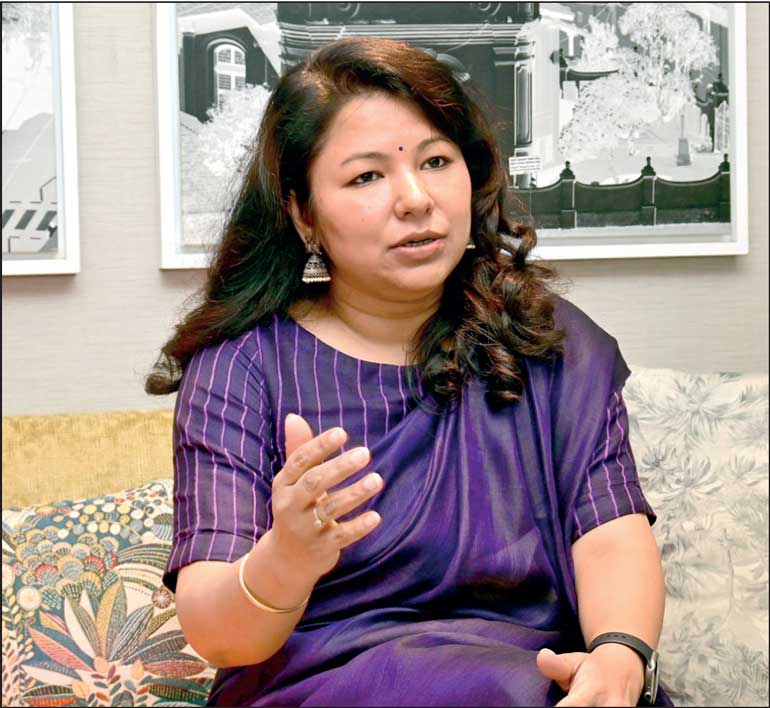
GITA Founding Partner Priya Rawat
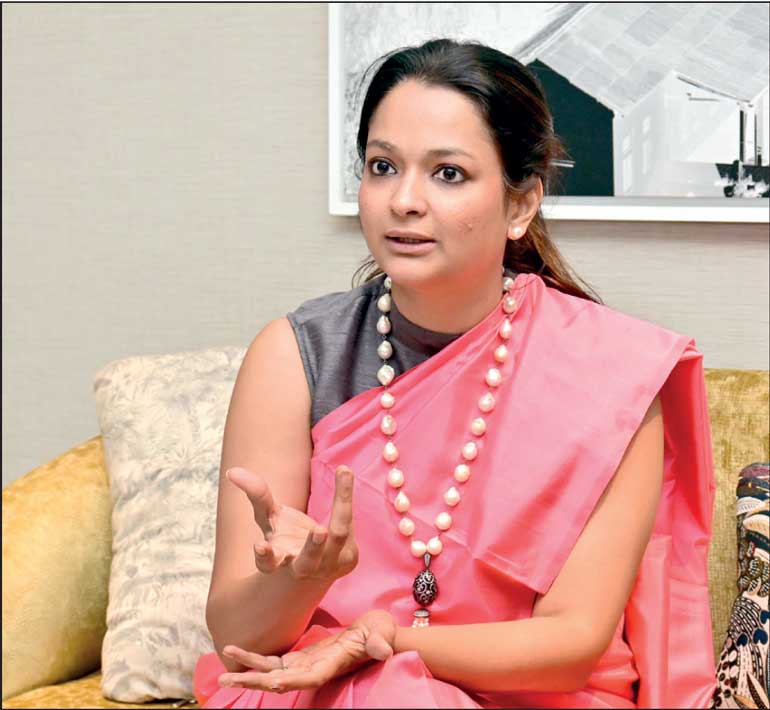
India Fintech Foundation CEO Sai Sudha Chandrasekaran
India may be one of the world's fastest-growing economies, but for many Sri Lankan businesses, it remains an intimidating market to enter. Its size, diverse regulatory landscape and regional differences often discourage companies, particularly small and medium-sized enterprises (SMEs), from exploring opportunities across the Palk Strait. Seeking to bridge that gap, Global Investment and Trade Advisors (GITA), in partnership with the Indo-Lanka Chamber of Commerce and Industry (ILCCI), has launched the India Trade Desk in Colombo. The initiative is designed to provide end-to-end advisory and market-entry support for Sri Lankan companies looking to expand into India, while also encouraging Indian investments into Sri Lanka.
Founded by former senior officials of Invest India, the Government of India's national investment promotion agency, GITA specialises in investment promotion and investor facilitation. Its founders have advised multinational corporations and investors on establishing and expanding operations across India, experience they now hope to bring to Sri Lankan businesses.
In this interview with Daily FT, GITA Founding Partner Priya Rawat and GITA Adviser Sai Sudha Chandrasekaran explain why India should no longer be viewed as a single market, why SMEs require a different level of support than large conglomerates, and why they believe now is the right time for Sri Lankan businesses to expand into India.
Below are excerpts of the interview:
By Charumini de Silva
Rawat:
GITA is an investment promotion and investor facilitation organisation that supports businesses throughout their investment journey in India, from evaluating opportunities and identifying suitable sectors, states and partners, to navigating regulations, engaging with Government agencies, implementing projects and supporting future expansion. Both Saisudha and I previously worked at Invest India, advising global investors and CEOs on entering the Indian market. We established GITA to provide that same strategic expertise to businesses seeking opportunities in India. The India Trade Desk, launched with the Indo-Lanka Chamber of Commerce and Industry (ILCCI), was created because India and Sri Lanka have highly complementary economies, yet commercial engagement remains well below its potential. Many Sri Lankan businesses, particularly SMEs, view India as a complex market and lack the networks or resources to enter confidently. The Trade Desk provides practical, confidential and personalised guidance rather than simply organising networking events. ILCCI serves as the Sri Lankan partner, while GITA brings India-based expertise, helping businesses navigate the market from initial exploration through long-term expansion.
Rawat:
India is undergoing a profound economic transformation. It remains one of the world’s fastest-growing major economies, attracting large scale foreign direct investment (FDIs) in recent years, as investors increasingly see it as a manufacturing base, consumer market and strategic platform. Around 64% of India’s population is of working age, supported by a rapidly expanding middle-class and rising consumption. Growth is no longer limited to major metropolitan areas; Tier-2 and Tier-3 cities now produce nearly 60% of India’s graduates and are emerging as important centres for entrepreneurship and innovation. At the same time, reforms such as GST, Production Linked Incentive (PLI) schemes, industrial corridors, PM Gati Shakti, the National Logistics Policy and India’s digital public infrastructure, including Aadhaar and UPI have significantly improved ease of doing business, logistics and supply-chain efficiency. For investors today, the question is no longer whether India offers demand, but how best to access its opportunities efficiently.
Chandrasekaran:
The biggest misconception is looking at India as one massive market. India consists of 28 states and eight Union Territories, each with distinct industries, consumer preferences, policies and business ecosystems. Therefore, companies should avoid trying to enter the entire country at once. Successful businesses identify the state most relevant to their sector, establish themselves there and expand gradually. India’s diversity should be viewed as an opportunity rather than an obstacle. The most important first step is finding the right local partner, whether that is a business partner, adviser or an organisation like the India Trade Desk. Access to reliable local knowledge helps businesses avoid costly mistakes, identify opportunities faster and significantly shorten the learning curve.
Chandrasekaran:
Success depends on matching the right sector with the right State. Gujarat offers strengths in manufacturing, ports and logistics, Maharashtra is India’s financial and corporate hub, while Tamil Nadu leads in manufacturing, automobiles and electronics, and Karnataka remains a technology and innovation centre. Therefore, the right choice depends entirely on the company's objectives. A business manufacturing for exports will have different priorities from one serving India's domestic market. Some companies need access to ports, while others may prioritise skilled labour, industrial ecosystems or Government incentives. However, opportunities for Sri Lankan businesses are particularly strong in apparel and textiles, food processing, ICT and BPM services, tourism and hospitality, pharmaceuticals, logistics, automobile components manufacturing, supply-chain services and value-added agriculture. Government priorities also provide clear direction. India is investing heavily in sectors supported by PLI schemes, including textiles, electronics, semiconductors, renewable energy equipment, electric vehicles, automotive manufacturing, white goods and food processing. Initiatives such as PM MITRA Mega Textile Parks are creating integrated manufacturing ecosystems supported by world-class infrastructure and logistics.
Rawat:
Supply-chain integration offers enormous potential. Rather than entering India individually, Sri Lankan companies, particularly SMEs can collaborate as industry clusters or joint ventures, supplying components or specialised products into India’s growing manufacturing ecosystem. India provides scale, infrastructure and market access, while Sri Lanka contributes specialised industries, skilled talent and strategic advantages. Together, businesses can build globally competitive value chains serving not only India, but also international markets.
Rawat:
Traditional trade bodies perform an important role by organising exhibitions, forums and networking events. Our focus begins after those events. Every company has different objectives; some require distributors, others manufacturing partners, acquisitions or greenfield investments. We at India Trade Desk provide confidential, one-to-one advisory services tailored to each business, supporting them throughout the entire investment journey rather than ending our engagement after an event.
Chandrasekaran: We also customise our support according to the size of the business. Large corporations often need engagement with policymakers, Government agencies and discussions on incentives or regulations. SMEs usually require much more practical assistance, such as introductions to buyers, distributors, suppliers and local partners, as well as guidance on regulations and market research. Many SMEs cannot afford to maintain teams in India to conduct market research or navigate regulations. Our role is therefore much more hands-on. We provide the kind of personalised support that smaller businesses need to confidently enter a new market, while also helping larger investors engage effectively with the relevant institutions. That flexibility is one of the biggest advantages of the India Trade Desk.
Chandrasekaran:
Supply-chain diversification accelerated significantly after the COVID-19 pandemic, with companies seeking alternatives to relying on a single manufacturing location. India has emerged as one of the biggest beneficiaries because of its long-term economic prospects, expanding manufacturing capabilities, improving infrastructure and growing network of free trade agreements (FTAs). Companies are increasingly manufacturing in India not only for its domestic market, but also to export to Europe, Africa and the Middle East. Sri Lankan businesses therefore can become valuable participants in these regional and global value chains by combining their specialised expertise with India’s manufacturing scale and market access.
Rawat:
Yes. Sri Lanka was one of our first priorities because of the natural economic relationship between our countries. We have also launched a similar platform with Nepal and work closely with the Government of Oman under the India-Oman Comprehensive Economic Partnership Agreement. Our objective is to establish dedicated investment corridors tailored to individual markets rather than generic trade promotion platforms, recognising that every bilateral relationship has unique requirements.
Rawat:
Bilateral trade has grown steadily, but investment remains well below its potential. India offers scale, infrastructure, manufacturing capability and one of the world’s largest consumer markets, while Sri Lanka contributes specialised industries, skilled talent and strategic advantages. Both countries stand to benefit from stronger investment partnerships. During our first year at India Trade Desk, assisting between 20 and 30 Sri Lankan companies would represent an excellent beginning. However, our long-term goal is to build a sustainable India-Sri Lanka investment corridor measured not simply by the number of companies we advise, but by the quality of investments, partnerships and long-term commercial relationships that emerge.
Chandrasekaran:
Don’t wait. India today is very different from what it was five or 10 years ago. Manufacturing, logistics and digital infrastructure have advanced significantly, while State governments actively compete to attract investment. The response to the India Trade Desk has already demonstrated strong interest, with over 30 Sri Lankan companies requesting one-to-one discussions within days of the launch.
Rawat:
The time is now. India is simply too large and too important a market to ignore. Businesses that begin building relationships today will be best positioned to benefit from future opportunities. Our role is to simplify that journey, reduce uncertainty and help companies move from exploring India to successfully operating there. The future of the India-Sri Lanka economic partnership will not be driven by Government announcements alone. It will be driven by businesses that are willing to explore opportunities, build partnerships, and create value across borders. The next chapter of India-Sri Lanka relations must be about converting shared history into shared economic prosperity.




