Tuesday Sep 15, 2026
Tuesday Sep 15, 2026
Friday, 20 February 2026 00:03 - - {{hitsCtrl.values.hits}}
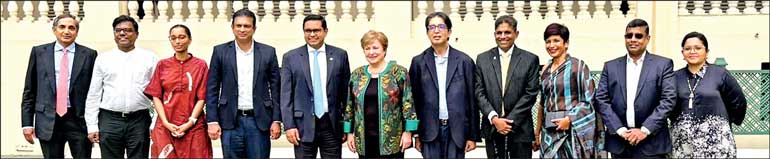
International Monetary Fund (IMF) Managing Director Dr. Kristalina Georgieva during her visit this week met with several private sector leaders.
The meeting reflected on the progress of the IMF-supported reform programme, its impact on businesses and households, and importantly, what must come next.
According to Selyna Peiris, Director & Chief Growth Officer at Selyn Group of Impact Companies and one of the attendees: “The shared message was clear: Stabilisation is only the first step. Strategic growth must follow. And that requires a holistic, coordinated vision, now.”
In a post on her Facebook, Selyna said her particular intervention focused on the role of SMEs in this next phase.
Acknowledging her gratitude for the opportunity to contribute to this important dialogue with the IMF Chief, Selyna’s post also said the following:
If Sri Lanka is to move into sustained recovery and strategic expansion, we must intentionally mainstream SMEs into sectoral growth policies. SMEs are not peripheral to our economy, they are central to employment, value creation, and resilience. Yet too often, they remain outside the core of export and industrial strategy.
A sharper export strategy is critical, and in my view, one of the lowest hanging opportunities before us. We must:
When SMEs grow, they create jobs, particularly for women and rural communities across Sri Lanka. When exports expand, incomes rise. And when incomes rise, the ripple effect strengthens communities, stimulates domestic demand, and builds long term economic stability.
The next chapter must therefore focus on capability, competitiveness, and coordination, ensuring that reform translates into inclusive, private sector led growth.




