Friday Oct 02, 2026
Friday Oct 02, 2026
Friday, 2 October 2026 00:00 - - {{hitsCtrl.values.hits}}
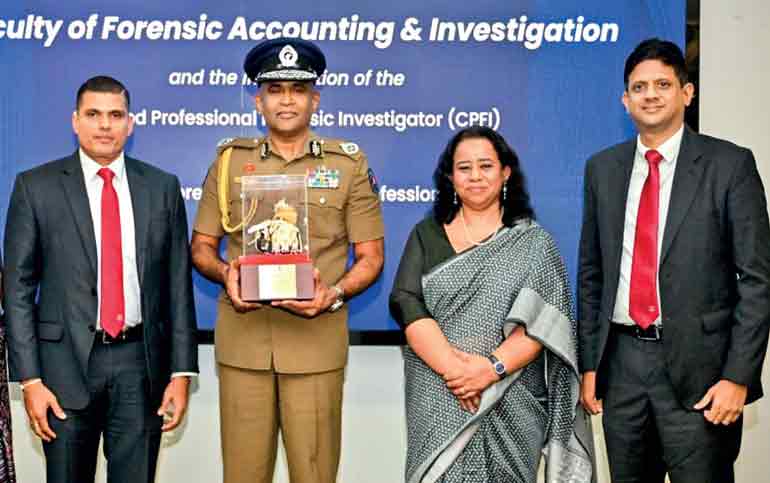
From left: CA Sri Lanka President Tishan Subasinghe, Inspector General of Police Priyantha Weerasooriya, CA Sri Lanka Vice President Anoji de Silva and Forensic Accounting and Investigation Committee Chairman Ashane Jayasekera
The Inspector General of Police (IGP) Priyantha Weerasooriya last week commended the Institute of Chartered Accountants of Sri Lanka (CA Sri Lanka), highlighting that the newly launched specialised Faculty of Forensic Accounting and Investigation was a timely national initiative.
Speaking at the launch ceremony held at the Institute, IGP Weerasooriya, who was the Chief Guest at the occasion, said: “Law enforcement agencies, including the Sri Lanka Police, require strong collaboration with highly trained professional accountants and forensic experts. By building specialised human capital, expertise and modern investigative competencies, CA Sri Lanka is directly contributing to strengthening our nation’s resilience against economic crimes.”
He also said modern financial crimes, cyber fraud, money laundering and complex corporate irregularities are no longer confined within local boundaries. They have become sophisticated, highly networked and highly globalised.
“In our present Sri Lankan context, as our country moves steadily towards economic recovery and long-term financial stability, safeguarding our financial infrastructure is paramount. Criminal activities such as financial fraud not only drain economic resources but also damage institutional integrity and investor confidence.”
He made these comments in the presence of Guest of Honour Deputy Inspector General of Police (DIG), Financial Crimes Investigation Division (FCID), M. D. P. Dayaratne, as well as CA Sri Lanka’s President Tishan Subasinghe, Vice President Anoji de Silva, Forensic Accounting and Investigation Committee Chairman Ashane Jayasekera among others.
Speaking further Weerasooriya said that traditional investigative methods are no longer sufficient to tackle these intricate financial crimes. From an operational perspective within the Sri Lanka Police, law enforcement officers face mounting contemporary challenges when investigating modern financial crimes. “Without rigorous forensic accounting capabilities integrated at the early stage of an investigation, crucial evidence may be overlooked or rendered inadmissible,” the IGP explained.
“I am warmly commending CA Sri Lanka for taking this forward-thinking approach to create a platform dedicated to fostering expertise, knowledge sharing, and professional collaboration in Forensic Investigation. May this initiative play an important role in ensuring transparency, accountability, and financial security across Sri Lanka,” the IGP added.
As part of its inaugural offering, the Faculty will introduce two programs in October 2026: the Certified Professional Forensic Investigator (CPFI) and Digital Forensics for Finance Professionals, both designed to build specialised capabilities in investigating financial crime and addressing the growing complexity of digital evidence.
CA Sri Lanka President Tishan Subasinghe described the launch of the Faculty as one of the Institute’s most significant recent milestones.
“For decades, our profession has stood as the custodian of financial integrity in this country. Today, that responsibility has grown more complex because fraud no longer confines itself to ledgers and invoices but moves through networks, mobile devices, cloud systems and cross-border transactions more rapidly than controls can contain it. This faculty is our answer to that shift as it brings together the technical, legal, behavioural and ethical disciplines required to investigate financial crime with rigour and credibility, producing professionals capable of standing before a court, a regulator or a tribunal with evidence that holds,” he said.
Subasinghe also emphasised that CA Sri Lanka has a social responsibility, being the premier national accounting body, to provide the platform for this. “By upskilling and reskilling our own members and other stakeholders who are interested in following these particular programs and developing the required expertise. We are sure that they will fight against corporate fraud and corruption, with the technical know-how that they are going to gain by following our programs.”
Ashane Jayasekera said that the need of the hour is for professionals who can go beyond traditional accounting and auditing. “We need professionals who can analyse financial statements, identify anomalies, investigate suspected wrongdoing, evaluate evidence, follow the money trail, and communicate their conclusions with clarity and credibility. This is the role of the modern forensic accountant.”
Speaking about the programs the Faculty offers, he explained that the Certified Professional Forensic Investigator qualification, which is a three-level qualification covering Foundation, Corporate and Professional levels, is designed to develop precisely these capabilities.
He noted that modern financial investigations increasingly rely on digital evidence found across computers, mobile devices, email systems and cloud platforms. Against this backdrop, the second program, Digital Forensics for Finance Professionals programme will provide practical exposure to the fundamentals of digital forensics, helping bridge the gap between financial investigations and digital forensic capabilities.
Alternate Chairman of the Faculty Dr. Mudith Sujeewa highlighted the impact of employee fraud and the importance of behavioural red flags and forensic accounting education in strengthening fraud prevention. He outlined the CPFI qualification, designed to build capabilities in fraud detection, compliance and ethical practice through a three-level curriculum covering investigative accounting, forensic psychology, legal aspects and practical training.



