Tuesday Oct 06, 2026
Tuesday Oct 06, 2026
Tuesday, 6 October 2026 04:48 - - {{hitsCtrl.values.hits}}
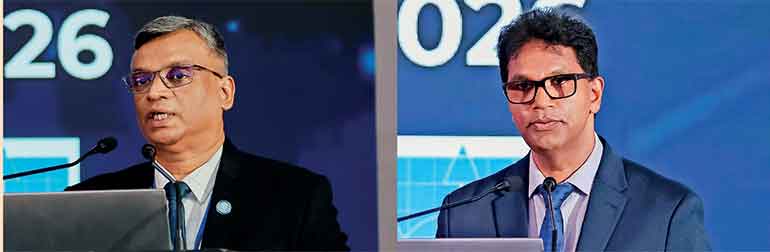
IESL President Eng Kosala Kamburadeniya, NEC 2026 Conference Chairman Eng Manjula Samarasinghe
The Institution of Engineers, Sri Lanka (IESL) held its National Engineering Conference 2026 (NEC 2026) bringing together the engineering profession, policymakers, Government institutions, regulators, academia, industry and other stakeholders to discuss four areas of critical importance to Sri Lanka’s national development.
The conference was organised as a national policy dialogue with the objective of moving beyond discussion towards practical, evidence-based and implementable policy recommendations. The four key areas addressed were Engineering, Technology and Technical Education; Energy Transition and Power Sector Reforms; Transport Sector Development; and National Building Fire Safety.
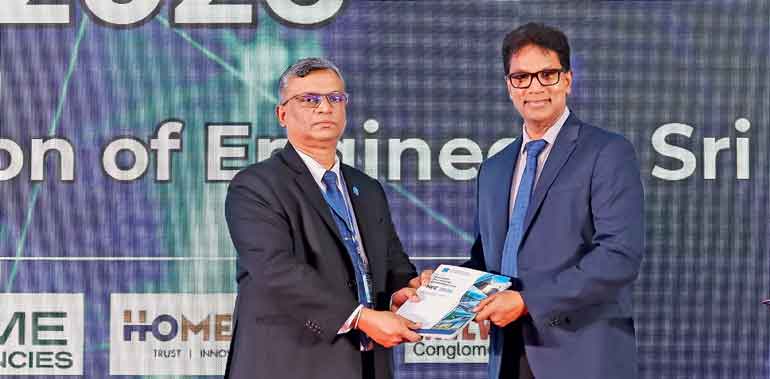
Presenting the NEC 2026 Engineering Policy Compendium, IESL emphasised that engineering has a responsibility extending beyond professional practice and must contribute to national productivity, public safety, economic confidence, environmental sustainability and the quality of life of citizens. The conference sought to strengthen collaboration between the engineering profession and the institutions responsible for national policy and implementation.
The National Engineering Education Policy proposed at the conference seeks to align engineering, engineering technology and technical education with national requirements while maintaining internationally recognised standards. The proposals include clearly defining the roles and competencies of Engineers, Engineering Technologists and Engineering Technicians, establishing transparent academic and professional progression pathways, strengthening accreditation and recognition mechanisms, and developing a national engineering workforce planning framework.
The policy also proposes reviewing the Engineering Council Act to establish a modern regulatory framework aligned with internationally recognised engineering practice categories. Greater coordination between Government, professional institutions, universities, technical institutes and industry has been identified as essential for developing the engineering workforce required for Sri Lanka’s future.
In the area of Energy Transition and Power Sector Reforms, IESL has highlighted the need to close the gap between policy commitments and actual implementation. The proposals address institutional reform, electricity market development, long-term planning, tariff and investment frameworks, grid development, renewable energy integration, energy storage, smart metering and demand-side management.
The policy proposals recognise that Sri Lanka’s energy transition is not only an environmental issue but also has implications for economic development and national energy security. A phased implementation approach has been proposed to strengthen the electricity sector while supporting greater efficiency, reliability, sustainability and investor confidence.
The third major area was Transport Sector Development. The IESL proposal calls for an integrated national multimodal transport system in which rail serves as a strategic backbone, supported by buses, roads, expressways and multimodal transport hubs. The proposals include integrated ticketing, digital mobility services, improved railway infrastructure, better bus services, first- and last-mile connectivity and stronger coordination among transport institutions.
The proposed approach seeks to move away from planning individual modes of transport in isolation and towards a single integrated national mobility system. The policy also identifies the need for transport investment to support regional development, improve passenger experience, enhance road safety and reduce environmental impacts.
The fourth policy area, National Building Fire Safety, focuses on strengthening Sri Lanka’s institutional and legislative arrangements for building fire safety. The proposed framework calls for a National Building Fire Safety Act and an independent National Fire Safety Authority with national jurisdiction.
The proposal seeks to establish a comprehensive and enforceable national framework covering fire prevention, technical standards, compliance, inspection, enforcement and institutional coordination. It also recognises the need for stronger arrangements to address fire safety in high-rise, public, industrial, healthcare, hospitality and other high-risk buildings.
A central message emerging from NEC 2026 was that the value of engineering must ultimately be measured through its contribution to society. The IESL policy compendium presents engineering as a link between professional competence and public value, with stronger engineering practice contributing to stronger institutions, infrastructure and industry, and ultimately to public safety, resilience and prosperity.
IESL presented the four policy papers as a basis for continued dialogue with Government and other stakeholders. The Institution invited relevant Ministries and implementing agencies to review the proposals, identify responsible institutions and decision-making pathways, and establish focused technical engagement where further development is required.
The NEC 2026 policy handover therefore marks not an end to the discussion, but the beginning of a continuing process of policy refinement, technical engagement and implementation, with the engineering profession offering its expertise to support national development.
The conference demonstrated the role of IESL as a professional institution contributing engineering knowledge and expertise to matters of national importance and reaffirmed the need for coordinated action among Government, industry, academia, professional institutions and wider society to translate sound policy into sustained national progress.



