Tuesday Oct 13, 2026
Tuesday Oct 13, 2026
Tuesday, 13 October 2026 00:33 - - {{hitsCtrl.values.hits}}
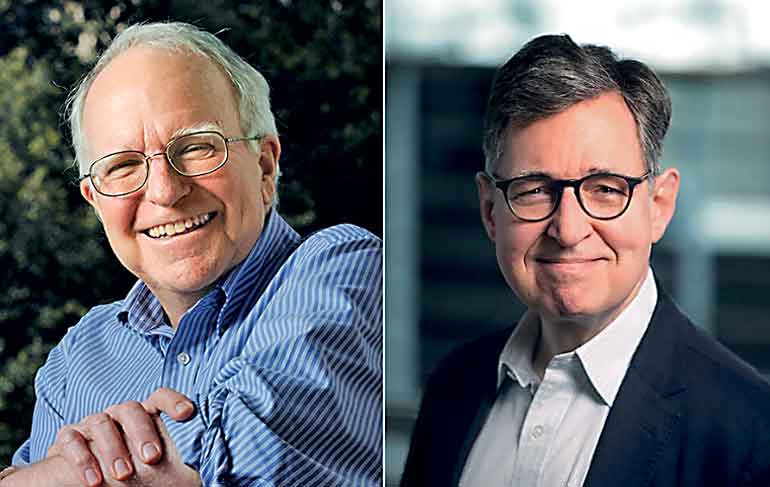
Robert E. Hall (left) and Michael Woodford
American economists Robert E. Hall and Michael Woodford won the 2026 Sveriges Riksbank Prize in Economic Sciences in Memory of Alfred Nobel yesterday, for work on economic stabilisation policy that underpins the models used by central banks and governments around the world.
Stanford University’s Hall and Columbia University’s Woodford developed new macroeconomic models showing that well-timed fiscal and monetary policy measures can reduce the peaks and troughs of the economy, the Royal Swedish Academy of Sciences said.
Central to their models is the idea that households and businesses look ahead when deciding how much to save or what prices to set. By communicating their policy plans, governments and central banks can shape these expectations about the future and steer the economy in the desired direction.
“The laureates’ work has provided us with a stable theoretical foundation for the models that are now used by central banks and governments around the world. With them, we are better equipped to deal with shocks in the economy, such as energy crises or sudden changes in how much households consume,” Committee for the Prize in Economic Sciences Chair John Hassler said.
The models have since helped policymakers deal with a range of downturns, including the shocks from the pandemic and the energy crises of recent years. While recessions and bouts of high inflation have not disappeared, they now tend to be shorter-lived, the Academy said.
Hall is Professor of Economics at Stanford University and the Robert and Carole McNeil Senior Fellow at its Hoover Institution. He holds a BA in economics from the University of California, Berkeley, and a PhD in economics from the Massachusetts Institute of Technology (MIT), and taught at both institutions before joining Stanford in 1978.
Woodford is the John Bates Clark Professor of Political Economy at Columbia University. He holds a BA from the University of Chicago, a JD from Yale Law School and a PhD in economics from MIT, and has been named both a MacArthur Fellow and a Guggenheim Fellow.
The prize, worth SEK 12 million, or about $ 1.2 million, will be shared equally between the two laureates, who will also receive a diploma and a medal. It has now been awarded 58 times to 101 laureates.
Last year’s prize went to Northwestern University’s Joel Mokyr, the London School of Economics’ Philippe Aghion and Brown University’s Peter Howitt.
The economics prize was established in 1968 by Sweden’s central bank and is not one of the five original Nobel Prizes in physics, chemistry, physiology or medicine, literature and peace, which Alfred Nobel, the Swedish industrialist and inventor of dynamite, created through his 1895 will. The first Nobel Prizes were awarded in 1901.
Yesterday’s announcement concluded this year’s Nobel season. Karl Deisseroth, Peter Hegemann and Georg Nagel shared the Nobel Prize in Physiology or Medicine, University of Wisconsin Professor Francis Halzen won the physics prize, and Henri Kagan and Kenso Soai shared the chemistry prize. Canadian writer Anne Carson won the literature prize, while international jurist Navanethem ‘Navi’ Pillay was awarded the Nobel Peace Prize.
The awards will be presented at a ceremony in Stockholm in December, on the anniversary of Alfred Nobel’s death.




