Thursday Oct 22, 2026
Thursday Oct 22, 2026
Thursday, 22 October 2026 00:01 - - {{hitsCtrl.values.hits}}
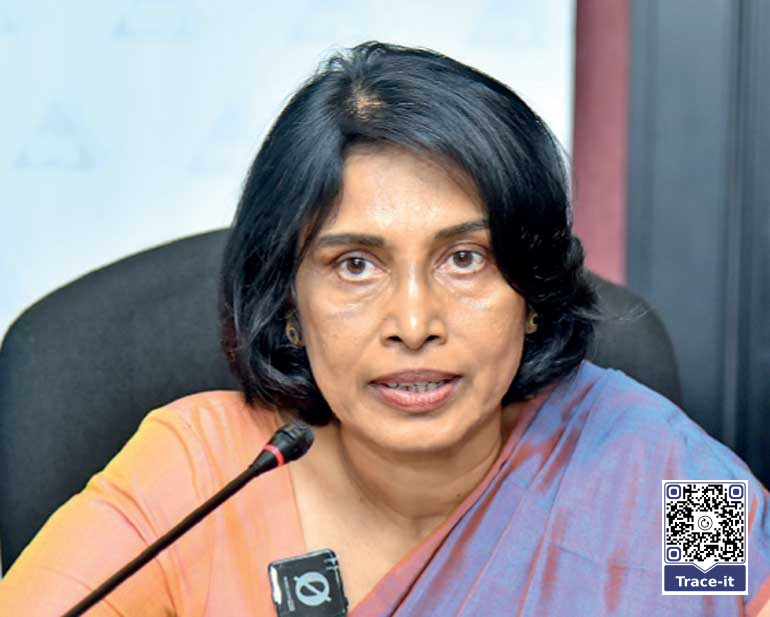
IPS Research Director Dr. Nisha Arunatilake -Pic by Ruwan Walpola
Sri Lanka has expanded tertiary education without a clear strategy. Growth has concentrated at first-degree level, while the technicians, associate professionals and postgraduates that a productivity-led economy needs remain in short supply, the Institute of Policy Studies (IPS) said.
IPS Research Director Dr. Nisha Arunatilake presented the findings at a roundtable on Tuesday (20), on the IPS flagship report, Sri Lanka State of the Economy 2026. The report’s theme is ‘Durable Growth: Advancing Human Capital for Inclusive Prosperity’.
According to census data, the share of tertiary-educated people rose from 4% in 2012 to 6.8% in 2024. Over the same period, the STEM share (science, technology, engineering and mathematics) rose from 27% in 2016 to 31% in 2023. Dr. Arunatilake said the headline numbers hide four structural weaknesses.
The first is speed. Sri Lanka, now an upper-middle-income country, compares poorly with both established upper-middle-income economies and lower-middle-income countries on tertiary enrolment. In the comparison group, it ranks above only Pakistan, and its progress has been slow. She said the sector, now expanding at about 1%, would need to grow at around 4% to reach the levels of upper-middle-income peers. “We are, at the end of the day, a small economy competing with these countries,” she said.
The second is composition. Most of the increase has come from first degrees. The economy also needs postgraduates and short-cycle tertiary graduates, who are trained for practical, technical roles.
This gap is clearest in the workforce itself. Under international occupational classifications, knowledge workers are professionals, managers, technicians and associate professionals. The International Labour Organisation says these roles ideally require tertiary education. Sri Lanka’s share of knowledge workers compares reasonably with other countries. However, only about one-third of them are tertiary educated. Among technicians and associate professionals, the share is below a quarter.
The third weakness is gender. Women account for 57% of the tertiary educated and 59% of first-degree holders. Dr. Arunatilake said this was not a straightforward gain for equality. Women graduates are highly selective in their choice of jobs and are concentrated in teaching. Few women work in other professional fields, while male professionals are spread more evenly across occupations. She said the pattern shows the shortage of knowledge workers is partly a labour market problem, not only an education problem.
The labour market already rewards the skills in short supply. Compared with workers educated only to secondary level, STEM graduates find jobs faster and earn higher wages than non-STEM graduates. Dr. Arunatilake said this premium is likely to widen as technology advances, with renewable energy, data science and biotechnology growing faster than other fields.
She said skilled workers drive long-term total factor productivity, which is output growth not explained by more labour or capital. They do this by using resources more precisely. Precision farming is one example: it adjusts water and fertiliser inputs to raise yields. Skilled workers also drive innovation and help firms adapt to economic shocks.
The IPS recommended better information on which types of tertiary graduates the economy needs, so that supply matches demand. It also called for faster expansion of the sector, and for job creation to retain graduates lost to brain drain.
Dr. Arunatilake said the response must address both sides of the market. Policymakers need to understand why male students are not entering tertiary education, and why women prefer teaching. Better social protection and working conditions could draw more women into other professions, she added.



