Saturday Sep 19, 2026
Saturday Sep 19, 2026
Friday, 19 June 2026 00:05 - - {{hitsCtrl.values.hits}}

Industry and Entrepreneurship Development Deputy Minister Chathuranga Abeysinghe
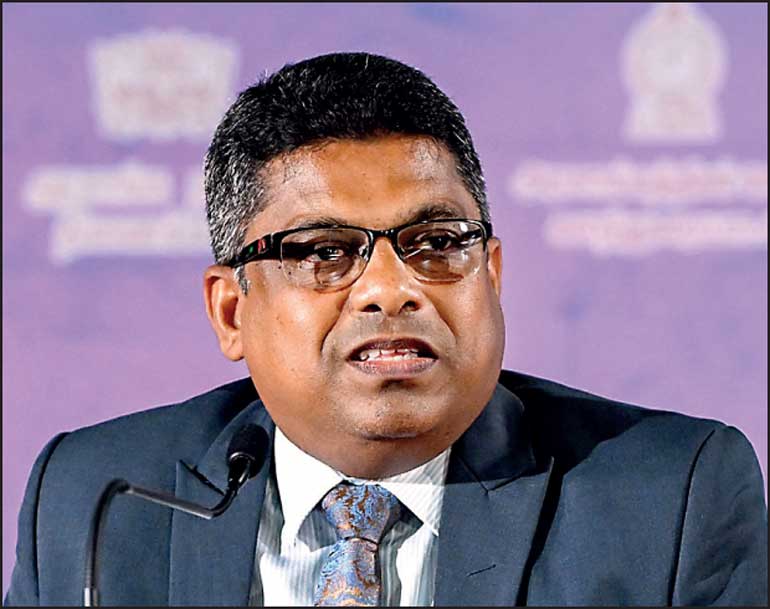
National Gem and Jewellery Authority Chairman Dr. S. P. Chaminda
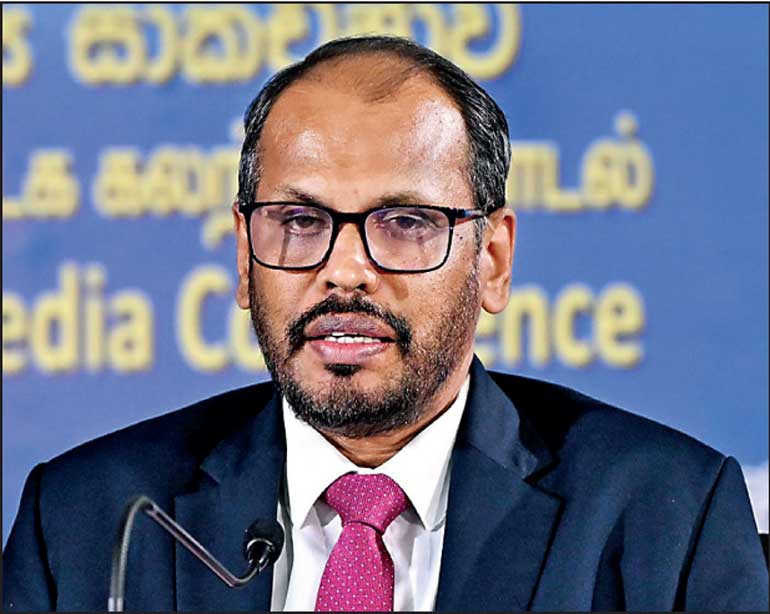
Export Development Board Chairman Mangala Wijesinghe
By Charumini de Silva
Sri Lanka is seeking to transform its centuries-old gem and jewellery industry into a billion-dollar export sector and position the country as a global trading hub, with the Government pledging reforms to tackle smuggling, improve value addition and attract international buyers through a more structured industry framework.
The ambitious agenda was outlined yesterday as authorities announced the Gem City Ratnapura Exhibition 2026, amid broader efforts to raise gem and jewellery exports from the current $ 300 million level and integrate the sector into the country’s wider export expansion strategy.
Addressing the media, Industry and Entrepreneurship Development Deputy Minister Chathuranga Abeysinghe said the Government views gems and jewellery as one of Sri Lanka’s most strategic export industries and is pursuing reforms across the entire value chain to improve competitiveness and global positioning.
“At present, Sri Lanka’s gem and jewellery exports generate around $ 300 million annually, and the sector continues to grow,” he said. “Fundamental changes are taking place across the entire value chain to improve competitiveness and position Sri Lanka as a global hub for gems and jewellery.”
The announcement comes just days after the launch of the National Export Development Plan (NEDP), which targets a sharp increase in export earnings by 2030 and identifies high-value sectors capable of driving the country’s next phase of growth.
Abeysinghe acknowledged that Sri Lanka’s biggest challenge is not the quality of its gemstones, but the country’s inability to effectively market itself internationally.
“Sri Lanka has not been branded properly or even positioned properly for tourism, and the same challenge exists in how we position the country as a gem hub,” he said.
He argued that achieving hub status would require deeper structural reforms, including changes to regulatory frameworks, stronger industry formalisation and coordinated efforts among multiple institutions.
Abeysinghe said the Government is already working with the Finance Ministry, the Export Development Board, the Tourism Ministry and the National Gem and Jewellery Authority (NGJA) to develop a comprehensive strategy aimed at transforming Sri Lanka into a regional gem and jewellery centre.
A key component of that strategy is a proposal to establish a dedicated Gem and Jewellery Experience Centre, bringing the industry’s various elements under one roof and linking gemstone trading with tourism.
“We have submitted a proposal to establish a Gem and Jewellery Experience Centre because that experience cannot be delivered through temporary or rented facilities,” Abeysinghe said.
The Deputy Minister also revealed concerns about a significant gap between officially recorded exports and actual gemstone production, suggesting that smuggling and informal trade remain major obstacles to sector growth.
On an average gem and jewellery exports stand at roughly $ 300 million annually. However, Abeysinghe noted that mining licence data indicates substantially larger volumes of gemstones are being extracted than reflected in export statistics.
“To address this, we are strengthening the surveillance and monitoring capabilities of the NGJA,” he said.
The Government is also enhancing cooperation between the NGJA, Customs and law-enforcement agencies while investing in technology to improve detection and enforcement capabilities.
While acknowledging that gemstone smuggling is a global challenge, Abeysinghe said Sri Lanka must improve institutional coordination if it is to retain more export earnings within the formal economy.
NGJA Chairman Dr. S.P. Chaminda said Sri Lanka has an advantage to uniquely position itself as a global hub because of its reputation for environmentally sustainable mining and the strong heritage associated with its gemstones.
He noted that discussions are continuing with Sri Lankan diplomatic missions and leading international buyers to strengthen market access and increase global visibility for Sri Lankan gems.
However, Dr. Chaminda stressed that administrative bottlenecks, tax issues and the need to formalise the industry remain critical challenges if the sector is to realise its estimated $ 1 billion potential.
Export Development Board (EDB) Chairman Mangala Wijesinghe defended the export targets contained in the newly launched NEDP, insisting they are supported by sector-specific growth plans and extensive consultations with industry stakeholders.
“The plan focuses on both product diversification and market diversification as we believe gem and jewellery exports can reach $ 1.2 billion within the next five years from $ 388 million in 2025,” he said.
He also outlined that Sri Lanka posted a 8.7% year-on-year (YoY) growth in gem and jewellery exports during the first four months of 2026.
According to Wijesinghe, while traditional export earners such as apparel and tea will continue to expand, future growth is expected to come from sectors including automotive components, mineral industries, food and beverages, advanced rubber products, transport and logistics services, ship repair, ICT and spices.
He said each sector has been assigned individual export targets developed jointly with industry participants, while parallel reforms in logistics, trade facilitation, finance, innovation and skills development are being implemented to support growth.
“Stakeholders themselves have indicated that these targets are achievable, provided the necessary reforms are implemented,” Wijesinghe said.
The announcement of the Gem City Ratnapura Exhibition, scheduled for 31 August to 2 September 2026, forms part of that broader export strategy. Organisers have deliberately aligned the event with the global jewellery exhibition calendar in a bid to attract international buyers travelling to major trade fairs in East Asia.
Held under the theme “Home to the Finest,” the exhibition will feature more than 80 exhibitors showcasing gemstones, jewellery, craftsmanship, machinery and industry technologies, while offering overseas buyers direct access to Ratnapura’s renowned gemstone industry.




