Tuesday Jul 28, 2026
Tuesday Jul 28, 2026
Thursday, 8 January 2026 00:02 - - {{hitsCtrl.values.hits}}
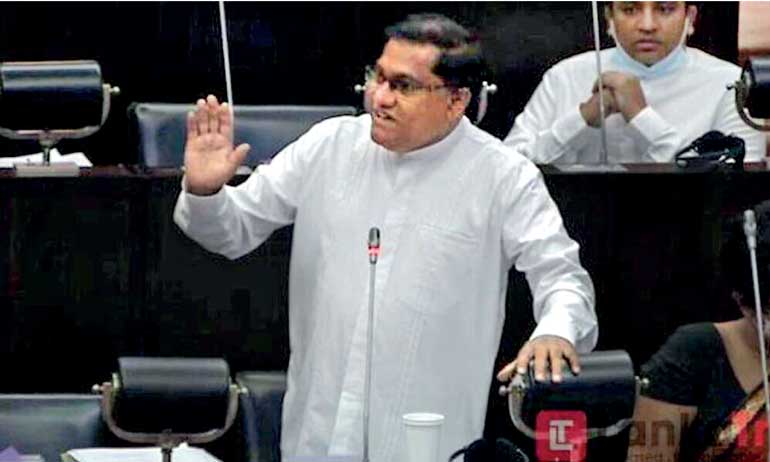
Foreign Affairs, Foreign Employment and Tourism Minister
Vijitha Herath
The Government yesterday acknowledged a steady decline in foreign employment opportunities in the Republic of Korea over the past three years, citing policy shifts, employer concerns and illegal overstays as key factors, while outlining ongoing diplomatic efforts to secure relief for more than 10,000 Sri Lankan job seekers awaiting placement.
Responding to a question raised by Opposition Leader Sajith Premadasa under Standing Order 27(2), Foreign Affairs, Foreign Employment and Tourism Minister Vijitha Herath provided a detailed breakdown of bilateral employment arrangements, job categories, trends and challenges facing Sri Lankan workers seeking overseas employment.
The Minister said Sri Lanka currently has bilateral Government-to-Government (G2G) employment agreements with Israel and the Republic of Korea. Under the Korean Employment Permit System, the maximum number of jobs allocated to Sri Lanka in the manufacturing sector for 2025 stands at 6,800, while job quotas for other sectors have not been formally specified.
He said approved job categories for Sri Lankan workers under Korean-linked recruitment schemes include manufacturing, fishing, construction, shipbuilding and service sectors.
Presenting data from the Sri Lanka Bureau of Foreign Employment, the Minister revealed that total departures for Korean jobs peaked in 2022 at over 16,000, before declining to 10,202 in 2025. Government-facilitated departures fell from 6,639 in 2022 to 3,712 in 2025, while those leaving through private agencies and other means declined from 9,745 in 2023 to 6,490 in 2025.
The Minister said that while no formal studies have been conducted, the Bureau has identified several contributing factors for the decline, including political and economic changes in South Korea, instability affecting labour demand, the number of Sri Lankan workers overstaying illegally, and negative employer perceptions linked to frequent job changes by Sri Lankan workers.
Addressing concerns over job seekers automatically being removed from the Korean recruitment website after two years, Herath said the process is governed by the 2004 Memorandum of Understanding between the two countries. The two-year retention limit applies uniformly across 17 labour-sending countries, and registration does not guarantee job placement. Despite repeated discussions, Sri Lanka has been unable to secure Korean agreement to extend the retention period.
However, he said diplomatic-level discussions are continuing. Talks with the Director of the Korean Human Resources Development Institute (HRDI) have focused on the sharp fall in employment contracts in 2025, particularly in the service sector. As an interim relief measure, authorities have agreed to explore placing qualified service-sector candidates under the manufacturing category.
The Minister also disclosed that only 32 shipbuilding contracts were issued in 2025, while 1,391 candidates remain registered under that category as of 1 January 2026. Given the low probability of placement, steps have been taken to migrate eligible shipbuilding candidates to the manufacturing category within the next month.
As of January 2026, the total number of Sri Lankan job seekers registered on the Korean HRDI website stands at 10,122, including 5,820 in manufacturing, 2,518 in services, 1,391 in shipbuilding, 343 in fishing and 50 in construction.
Herath said the Government has intensified engagement with Korean authorities, including a recent high-level Sri Lankan delegation visit to South Korea, to increase job allocations in the first quarter of 2026. Planned initiatives include employment promotion programmes in collaboration with the Sri Lankan Embassy in Korea, factory-level outreach and direct engagement with employers to showcase the skills and reliability of Sri Lankan workers.
On diversification of overseas employment markets, the Minister said details of new G2G agreements signed by the current Government have been provided in a separate annexure.
Responding to a separate query on Sri Lankans who passed the 2014 examination under the Italy G2G agreement signed in 2011, Herath said placements have stalled due to a lack of Italian organisations willing to recruit Sri Lankan workers. He said Sri Lanka is now working towards a fresh Memorandum of Understanding with Italy and continues to engage potential employers through the Sri Lankan Embassy in Rome, though placements so far remain extremely limited.




