Sunday Oct 25, 2026
Sunday Oct 25, 2026
Friday, 22 May 2026 00:00 - - {{hitsCtrl.values.hits}}
 By Charumini de Silva
Sri Lanka must urgently pivot from chasing tourist numbers to building a high-value, experience-driven tourism economy backed by stronger branding, infrastructure, and storytelling, global tourism experts said during a panel discussion at Sancharaka Udawa 2026.
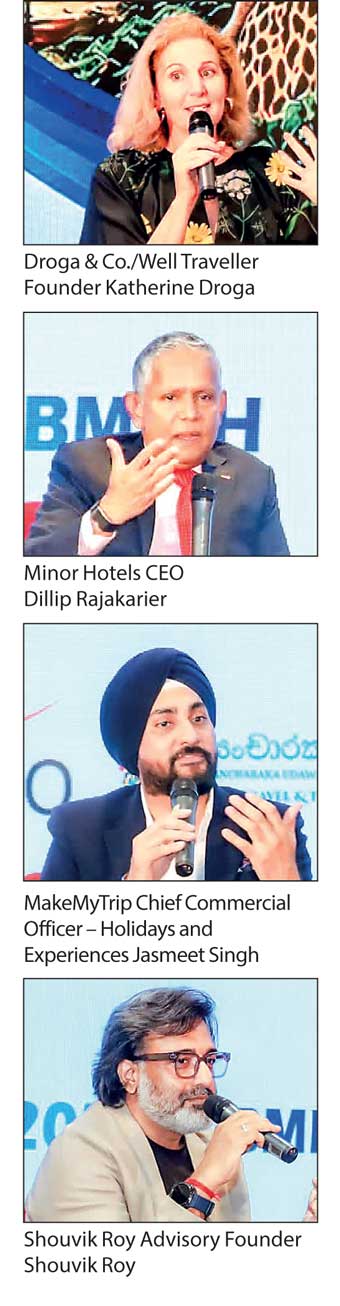
The session, titled ‘Sri Lanka Tourism: What’s next… What’s missing?,’ featured MakeMyTrip Chief Commercial Officer – Holidays and Experiences Jasmeet Singh, Droga & Co./Well Traveller Founder Katherine Droga, Minor Hotels CEO Dillip Rajakarier, and branding strategist Shouvik Roy.
A major theme of the discussion was the need for Sri Lanka to focus on high-value tourism instead of mass arrivals.
Droga stressed that high-value travellers are not necessarily luxury tourists, but visitors who stay longer, spend more, and engage more deeply with local communities and experiences.
She pointed to Australia’s tourism strategy, where visitor spending has risen 23% above pre-COVID levels despite visitor numbers remaining relatively unchanged.
Rajakarier said investors today prioritise destinations offering policy stability, governance, infrastructure, safety, environmental sustainability, and skilled talent.
He insisted that sustainable growth, seamless infrastructure, and an easy business environment are key to attracting investment, while also creating jobs and supporting long-term economic development.
“If sustainability and investment do not go hand in hand, then don’t invest in Sri Lanka,” he said, stressing that investors are ultimately driven by “return on equity, not return on ego.”
Rajakarier argued Sri Lanka continues to market itself through tourist arrival numbers instead of focusing on premium tourism experiences and economic value creation.
Drawing comparisons with Thailand, he said successful destinations increasingly focus on curated tourism experiences such as wellness, culinary tourism, cruises, and experiential travel.
He also warned Sri Lanka faces a serious hospitality talent drain, with many skilled tourism professionals migrating overseas.
“If you don’t have the people who can create those experiences, your returns are going to suffer,” he cautioned.
Rajakarier was particularly critical of Sri Lanka’s branding strategy, warning that repeatedly calling the island nation as the “pearl of the Indian Ocean” without building a coherent premium tourism ecosystem risks diluting the message.
“If you keep it as the best-kept secret, saying it’s a pearl, it’s a pearl, very soon it will become a stone,” he said.
The experts also warned that global tourism trends have changed dramatically after COVID-19, with travellers now prioritising personalised experiences over destinations themselves.
Singh said travellers no longer search simply for ‘Sri Lanka packages,’ but instead seek curated experiences such as wellness escapes, honeymoon retreats, wildlife adventures, and immersive travel.
“They don’t really care what destination to start with. What they care about is the kind of experience they’re going to get,” he said.
He also highlighted the growing influence of Gen Z travellers and artificial intelligence (AI) in shaping tourism demand, warning destinations and tourism operators must rapidly build strong digital content to remain visible on AI-driven platforms.
Brand strategist Roy said Sri Lanka’s biggest challenge may be the lack of a clear tourism narrative, despite possessing extraordinary diversity.
He described Sri Lanka as a ‘concentrated world’ containing beaches, wildlife, mountains, tea estates, culture, and heritage within a compact geography.
However, he argued global travellers still do not clearly understand what Sri Lanka represents compared with destinations such as Thailand, Bali, or Vietnam.
Roy stressed that modern destination branding depends on consistent storytelling through films, documentaries, food culture, and creators rather than slogans alone.




