Thursday Oct 22, 2026
Thursday Oct 22, 2026
Wednesday, 13 May 2026 11:49 - - {{hitsCtrl.values.hits}}
By Safna Malik
ANC Campus recently hosted an exclusive industry dialogue titled “Impact of the Current Geopolitical Climate: Strategic Insights for Sri Lanka's Private Sector in 2026.” This event served as a significant milestone to mark the announcement of the University of West England's first UK branch campus in Sri Lanka. Set to open in June, the campus aims to establish the nation as a premier education hub for the South Asian region.
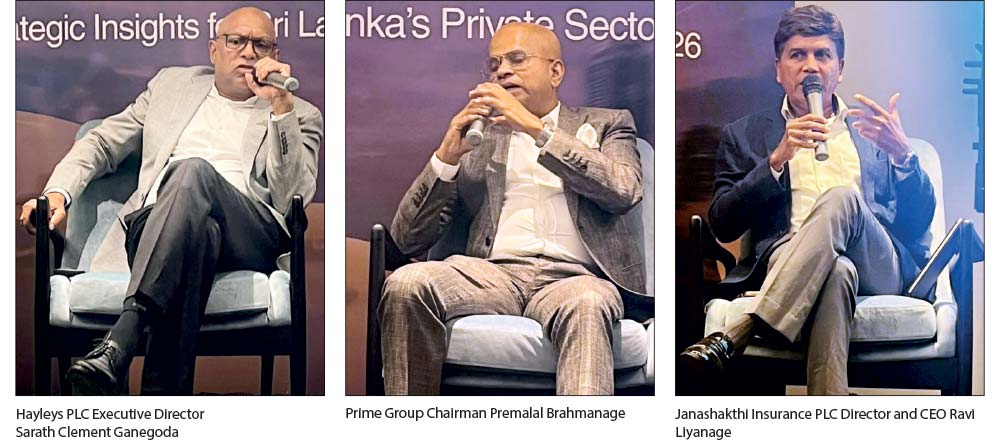
The panel brought together Hayleys PLC Executive Director Sarath Clement Ganegoda, Prime Group Chairman Premalal Brahmanage, and Janashakthi Insurance PLC Director and CEO Ravi Liyanage for a discussion focused on how the local private sector should navigate an increasingly volatile global environment.
Defining business resilience
Brahmanage opened the session by looking back at the economic crisis of 2022. During this period, the country faced its worst conditions, with inflation hitting 80% and interest rates reaching 30%. Despite these challenges, the economy showed a recovery within ten months, which is a rare occurrence on a global scale. Brahmanage noted that this recovery was possible because the government and the private sector worked together. He stated that entrepreneurs must act with a sense of urgency instead of waiting for a perfect plan. He suggested using practical methods like value engineering, careful cash flow management, and offering a wider range of products. He believes that if the state and private businesses continue to cooperate, they can turn current challenges into future progress.
Ganegoda noted that the nation recently reached a $5,000 per capita income level for the first time. He linked this to the natural strength of the people and the business community. Ganegoda argued that the strength of the nation is tied directly to the private sector, which provides 85% of the GDP. If private companies are not resilient, the nation cannot be resilient as well. He shared that Hayleys has maintained a 9% growth rate in real dollar terms by looking at markets outside the country. With a total turnover of around $1.8 billion, more than half of which comes from outside Sri Lanka, the company's strategy involves building factories in Indonesia, Thailand, and the Philippines. They have also made recent investments in Africa and opened offices in Italy and Poland. By moving closer to global consumers and spreading out their risks, they aim to keep growing at a fast pace.
Liyanage observed that traditional theories about keeping a business running must be changed for the modern world. He said that companies are no longer just trying to survive; they are now focused on moving forward even during difficult times. He pointed to the growing Electric Vehicle industry and the insurance sector, which saw a 40% growth rate, as proof of this trend. Smart companies are now protecting themselves by expanding into other countries and buying stocks or bonds when prices are low. Liyanage believes the local mindset is unique because people are willing to start over after a loss. He said that the most important part of being resilient today is learning how to do well during chaos and uncertainty rather than just waiting for it to end. This strength comes from a focus on new ideas. When faced with a difficult situation, leaders are forced to think differently about how they manage money and find new ways to fund their operations.
Geopolitical shifts and export strategy
When discussing the impact of global shifts on exports, Ganegoda said that the country must change because it relies on an outdated list of export products. He expressed a lack of interest in Free Trade Agreements, stating that they can sometimes kill open trade by giving too much of an advantage to one country over another. He pointed out that thirty years ago, garments were the top export in Sri Lanka, and today they still are, bringing in about $5 billion with a relatively small amount of value added locally. Tea was the second largest export back then and remains so today. He noted that the primary export crops, tea, rubber, and coconut, have remained the same for decades.
Ganegoda sees a major opportunity in services, especially in the IT sector and the changes brought by artificial intelligence. He explained that AI is changing every part of the business world. His advice to young professionals and students is to embrace these changes to avoid falling behind. He also said that the Indian market is too big to ignore. While India is currently the fifth largest economy, he predicts it will become the next major market after the US and China within the next ten years. Companies must keep this in mind when designing new products. The strategy for the future involves setting up production and marketing offices closer to the people who buy the products. To stay competitive, using AI and getting closer to the consumer are the most important steps.
Caution and opportunity in the real estate market
Brahmanage discussed the current state of the real estate market, noting that while high costs and energy prices suggest a need for caution, there is also a lot of hidden opportunity. He explained that many investors are looking for alternatives to what was once called a safe haven like Dubai. He described Port City Colombo as a gateway to South and West Asia that is perfectly placed to attract investment. However, he warned that this potential is not being seen or shared with the world effectively. For example, a new project at Port City received over 270 inquiries within just two weeks, yet many people do not know about the ten-year investment visa program available for a $ 200,000 investment. He said the government has not marketed these benefits well enough.
Brahmanage further remarked that having potential is not enough if investors are turned away by slow rules and too much paperwork. He pointed to Malaysia and Vietnam as examples of countries that grew quickly because the government and private sector worked together to make approvals fast and simple. He argued that the private sector cannot grow the economy alone; the government must provide the necessary systems and support.
He also mentioned that India's middle class, which includes 200 to 300 million people, is a massive group of potential investors. If the country can attract even a tiny part of that market, the impact would be huge. To reach a level of success similar to Singapore, the nation must increase its growth rate, and the government must show the same willingness to take risks as private business leaders.
Reshaping the risk landscape
Liyanage explained that the way insurance companies look at risk is changing. It is moving from a simple technical check to a more complex look at global events. He said that experts who can correctly predict how global politics will affect business are now in high demand. This is a new and vital profession. To stay safe, companies are no longer relying on just one supplier. They are also spreading their insurance coverage across different parts of the world to make sure they are not hurt by an issue in just one region.
The 2022 economic crisis created a specific setback for the insurance industry. By law, these companies must keep 30% of their money in government bonds. When the government could not pay its debts, the value of those bonds dropped instantly. Liyanage noted that while other countries allow insurance companies to invest in real estate as a safe, long-term asset, local policies do not yet support this. This leaves insurers with fewer options to protect their funds.
He also mentioned that bad road conditions are causing losses for insurers, and the cost of shipping insurance is becoming too high. However, he identified cyber risk as the biggest change that many companies are ignoring. For businesses that handle a lot of data, such as banks and telecom companies, the threat of a digital attack is a major concern. With new data protection laws coming soon, any loss of personal information could lead to very large fines. Liyanage pointed out that talking about how to price and manage cyber risk is a conversation that all companies must join to keep their assets safe.
Strategic mindset for the future
In their final thoughts, the speakers focused on the mental approach needed to succeed. Ganegoda pointed to technology as the most important factor. Since AI is changing everything from making goods to providing services, he urged leaders to keep learning about these developments. He believes a positive outlook is a practical tool for staying ahead of the competition.
Brahmanage stated that while business leaders cannot control global disasters, they can always control how they react. He emphasised that the speed of a response is much more important than trying to find a perfect solution. He encouraged leaders to adapt their actions and never give up when things get difficult.
Liyanage suggested that disruption is not an occasional event but the normal state of affairs in the country. He described the local business journey as a roller coaster rather than a smooth path. He argued that every crisis and every moment of uncertainty has an opportunity hidden inside it. The most successful companies are those that find those opportunities and move forward without waiting for the trouble to pass.
The ANC Campus officials noted that this dialogue was only the first in a planned series. They intend to hold more events like this to keep the conversation going between industry leaders. By discussing the challenges and opportunities ahead, they hope to help the private sector prepare for the future.




