Wednesday Nov 18, 2026
Wednesday Nov 18, 2026
Wednesday, 18 November 2026 00:00 - - {{hitsCtrl.values.hits}}
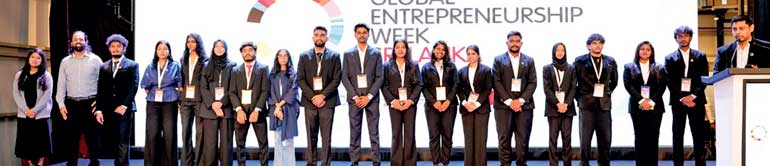


Digital Economy Deputy Minister Eng. Eranga Weeraratne (second from left) speaks at the panel. Others from left: MayaHive Co-Founder LMS, AI and SaaS Consultant Sanjaya Elvitigala (Moderator), NGage Strategic Alliance Managing Director Sheron Jayasundara, Global Entrepreneurship Network National Ambassador for Sri Lanka and Lanka Fishing Flies Managing DirectorSuresh de Mel and Kapruka Holdings Founder and Chairman Dulith Herath
By Safna Malik
Global Entrepreneurship Week (GEW) Sri Lanka 2026 was launched with a renewed focus on strengthening the country's entrepreneurial ecosystem, bringing together aspiring entrepreneurs, startups, small and medium enterprises (SMEs), business leaders and innovators to explore new pathways for growth and innovation.
Organised by the Global Entrepreneurship Network (GEN Global) in collaboration with the Ministry of Digital Economy, the Ministry of Industries and Entrepreneurship Development and the Ministry of Science and Technology, the initiative aims to connect entrepreneurs, businesses and ecosystem stakeholders across all 25 districts. The launch took place during Science Week, with the national campaign set to commence symbolically during Global Entrepreneurship Week from 16 to 22 November before continuing throughout the year through workshops, networking sessions, business exhibitions and entrepreneurship-focused events.
A key feature of the initiative will be the Entrepreneurship Marathon, which will bring together government institutions, private-sector organisations, academia, ecosystem enablers and bilateral and multilateral organisations to help entrepreneurs develop and scale their businesses.
Digital Economy Deputy Minister Eng. Eranga Weeraratne said entrepreneurship would play an important role in Sri Lanka's economic development, particularly in transforming innovation into products and services capable of reaching international markets.
“Entrepreneurship is vital to Sri Lanka's economic development, and we need entrepreneurs who can transform innovative ideas into products and services, access global markets and generate foreign exchange,” he said.
Weeraratne noted that Sri Lanka had secured fourth place globally for its implementation of Global Entrepreneurship Week initiatives and said the program provides opportunities for students, innovators and entrepreneurs to access knowledge, guidance and local and international business networks.
GEW Sri Lanka 2026 Program Director Charith Kandamulla said organisers hope to build on the momentum generated over the past year and expand support for entrepreneurs nationwide. “In 2025, we conducted 1,864 events nationwide, and GEN Global ranked Sri Lanka fourth among more than 200 countries for its active engagement in entrepreneurship. This year, we aim to build on these achievements by delivering 2,500 events, engaging 100,000 participants and supporting 5,000 entrepreneurs,” he said.
He added that the Entrepreneurship Marathon would serve as a platform for stronger collaboration across the entrepreneurial ecosystem, helping local businesses access the support, networks and opportunities required to grow.
Industry and Entrepreneurship Development Deputy Minister Chathuranga Abeysinghe stressed the need for stronger policy support to nurture entrepreneurship and innovation. “Entrepreneurship is a key requirement. We must recognise it, categorise it, and develop the policy framework necessary to build an ecosystem that enables it to move forward,” he said.
A panel discussion held alongside the launch explored the opportunities and challenges facing entrepreneurs in an increasingly digital and globally connected economy. The discussion featured Digital Economy Deputy Minister Eng. Eranga Weeraratne, Global Entrepreneurship Network National Ambassador for Sri Lanka and Managing Director of Lanka Fishing Flies Suresh de Mel, Kapruka Holdings PLC Founder and Chairman Dulith Herath, and NGage Strategic Alliance CEO Sheron Jayasundara.
How can innovators turn research into successful businesses?
Addressing the challenge of commercialising innovation, Weeraratne said many promising ideas struggle to progress beyond the research stage because founders often focus on technology rather than market demand. He stressed the importance of shifting from an engineering mindset towards building products that solve clearly defined problems and create value for customers.
According to Weeraratne, entrepreneurs must understand the markets they are targeting, develop multidisciplinary teams and think beyond local opportunities if they hope to attract investment and compete internationally. He warned that competing solely on price is rarely enough for long-term success and encouraged founders to identify gaps in existing industries where they can deliver something distinctive. “First, identify the problem you are going to solve. Then identify the resources you need to solve it.”
He added that innovators must also consider how they will access customers, investors and strategic partners as they move from concept to commercialisation.
What should entrepreneurs preserve as brands evolve?
Discussing branding in an era shaped by digital platforms and artificial intelligence, Jayasundara said the channels used to communicate with customers may have changed dramatically, but the foundations of strong brands remain the same.
She argued that credibility, trust and consistency continue to be the most valuable assets a business can build. While technologies evolve, successful brands are those that remain clear about who they are and what purpose they serve.
Jayasundara noted that businesses must continue communicating a consistent story while adapting to changing consumer expectations and technological shifts.
“Embrace the changes around your brand, but remain clear about its identity, its personality, and the need it fulfils.”
She said this clarity enables entrepreneurs to respond to new opportunities while maintaining the trust they have built with customers.
What does it take to build an export-oriented business?
Reflecting on his own entrepreneurial journey, de Mel spoke about the importance of understanding both products and markets before pursuing growth opportunities.
He explained how entering the fishing-flies business required learning about customers, supply chains, international markets and industry trends. That process, combined with active engagement in business organisations and industry networks, provided valuable knowledge and confidence as the company expanded.
De Mel said one of the most important decisions made during the company's growth journey was moving away from competing primarily on price and instead focusing on specialised, higher-value products capable of serving niche markets.
“Never give up, and build relationships with the partners in your ecosystem. Networking was key for me.”
He encouraged entrepreneurs to seek guidance, build relationships and learn from others rather than trying to navigate business challenges alone.
How is AI changing the way entrepreneurs build businesses?
Looking at the impact of artificial intelligence, Herath said today's entrepreneurs have advantages that previous generations did not enjoy.
He argued that AI-powered tools have lowered barriers to entry, reduced costs and made it easier for entrepreneurs to test ideas, launch products and learn from failures more quickly than before. “The cost of failure is much lower now. You can afford to experiment, fail, and try again.”
Herath noted that many of the capabilities that once required significant resources are now readily accessible through digital tools, making entrepreneurship more accessible to aspiring founders.
What support do startups need to grow internationally?
Turning to the broader startup ecosystem, Weeraratne said Sri Lanka needs policies and institutional support mechanisms that make it easier for startups to scale and attract investment.
He highlighted the importance of improving access to investors, strengthening innovation frameworks and creating pathways for startups to secure their first major customers.
“Funding is important, but so is the value investors can bring through market access and connections.”
Weeraratne also pointed to ongoing discussions around procurement reforms, innovation-focused investment mechanisms and greater access to data, which could help entrepreneurs develop and demonstrate new products and services.
How should startups communicate their value?
Jayasundara said entrepreneurs often make the mistake of focusing on their product before fully understanding the problem they are trying to solve.
She argued that effective communication begins with a clear understanding of customer needs and pain points. Rather than simply promoting a product, businesses should explain why it exists and how it addresses a specific customer challenge. “Here is the pain point, here is the problem, and here is my solution.”
According to Jayasundara, these considerations should form part of product development from the beginning rather than becoming an afterthought once a marketing campaign begins.
What should entrepreneurs consider before entering international markets?
Discussing international expansion, de Mel stressed the importance of market research, preparation and adaptability.
He noted that different markets often require different pricing strategies, product variations and approaches to customer engagement. Entrepreneurs must therefore invest time in understanding customer expectations and market conditions before pursuing growth overseas.
“It is very important to understand your market before entering it.”
He added that creativity, branding and product differentiation are increasingly important in helping businesses command stronger prices and compete effectively in crowded global markets.
How can AI create new opportunities for businesses?
Herath said artificial intelligence is also transforming how consumers discover businesses and products online.
As AI-powered search and recommendation tools become more widely used, entrepreneurs need to think about how their businesses are represented within these emerging digital ecosystems.
“Entrepreneurs should think about how their businesses can be represented in these new channels.”
He suggested that businesses that successfully adapt to new discovery mechanisms could benefit from increased visibility and access to new customers.
How can Sri Lanka prepare its workforce for an AI-driven future?
Looking ahead, Weeraratne said Sri Lanka must focus on both adopting new technologies and preparing people for the changes they will bring.
He noted that future workforce requirements will extend beyond technical expertise and include entrepreneurship, management and organisational change capabilities.
“We need people who can develop and implement solutions within organisations.”
According to Weeraratne, practical learning opportunities and industry exposure will be essential in helping individuals develop the skills required in an increasingly technology-driven economy.
How can startups compete with established brands?
Addressing competition, Jayasundara said startups should avoid trying to become smaller versions of already established brands.
Instead, entrepreneurs should identify underserved customer needs and market gaps where they can create meaningful differentiation and deliver greater value. “Learn from the leading brands, but find your own niche.”
She argued that smaller businesses often possess greater agility and can use closer customer relationships to develop solutions that larger organisations may overlook.
What should entrepreneurs keep in mind when expanding globally?
Returning to the subject of international growth, de Mel encouraged entrepreneurs to adopt a global mindset and make better use of available networks.
He said entrepreneurs should actively seek support from mentors, investors and ecosystem partners capable of helping them navigate unfamiliar markets and access new opportunities.
“Find your niche, then identify the stakeholders who can help you develop it.”
The ability to build relationships and remain connected to global entrepreneurial communities, he added, can significantly improve the prospects of long-term growth.
What role can digital public services play in entrepreneurship?
Weeraratne also outlined efforts to modernise public services and improve digital interactions between citizens, businesses and government institutions.
He said the objective is to reduce friction by enabling more services to be accessed online while creating opportunities for private-sector innovation through digital platforms and safe testing environments.
“The direction is towards connected platforms that allow institutions to make services available digitally.”
He added that more efficient digital services and payment systems could support broader economic participation and entrepreneurship.
Why does trust matter from day one?
Jayasundara highlights the importance of credibility and customer trust.
She said entrepreneurs themselves often become the face of their businesses, making reputation and customer relationships particularly important during the early stages of growth.
“Building trust and credibility is one of the most important things you can do.”
As customer feedback becomes increasingly visible through social media and digital platforms, he said businesses must be willing to listen, engage and respond constructively.
How can entrepreneurs make better use of networks?
Speaking on the importance of entrepreneurial networks, de Mel reiterated that building strong connections can play a critical role in business growth. He encouraged entrepreneurs to build their visibility, connect with peers locally and internationally, and remain open to learning from the experiences of others. “I have gained a great deal through networking and through the relationships I have built.”
As GEW Sri Lanka 2026 unfolds over the coming year, organisers hope the initiative will strengthen collaboration across the entrepreneurial ecosystem and help more Sri Lankans transform innovative ideas into sustainable businesses capable of competing on a global stage.




