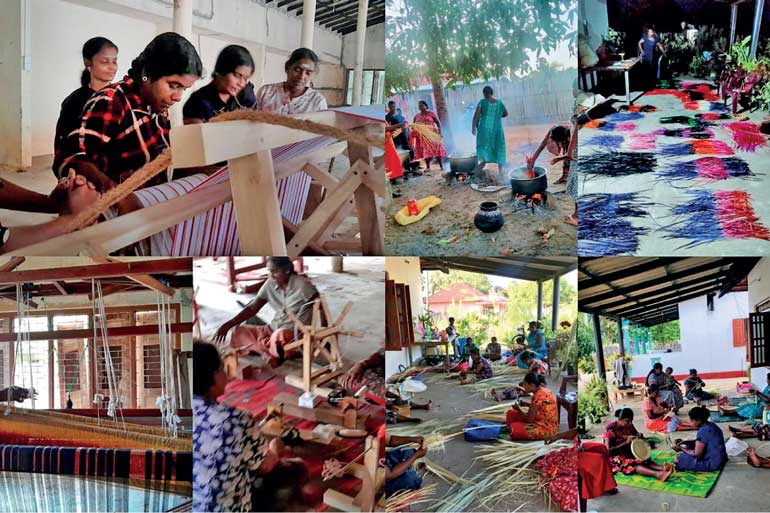
Women artisans participating in Palms Together, Sivan Arul Hope's women's empowerment programme, carry out handloom weaving, yarn preparation, palmyra dyeing and basket weaving. Connecting these traditional skills with wider markets is central to the program’s work in
Sri Lanka's North and East Photo credit: Courtesy of Sivan Arul Hope / Palms Together
- Johnny Fernando and Anil Koswatte help open doors for SMEs in Sri Lanka’s north and east
- Business connections, retail expertise and a shared interest in supporting SMEs—particularly in the war-affected North and East—offer new possibilities for women artisans
A beautifully woven palmyra basket or handloom textile represents skill, patience and knowledge passed between generations. But craftsmanship alone does not guarantee a livelihood. Someone must connect the artisan with the customer, explain what the market wants and help turn an occasional sale into a continuing business relationship.
For Palms Together, the women’s empowerment program of Sivan Arul Hope, the interest shown by International Chamber of Commerce Sri Lanka Chairman Johnny Fernando and Lakarcade CEO and Managing Director Anil Koswatte, offers an opportunity to strengthen precisely these connections.
ICC Sri Lanka and Lakarcade are keen to promote small and medium-sized enterprises, particularly those in the war-affected North and East. For Palms Together, this shared interest opens a conversation about how rural women’s skills can find a stronger place in Sri Lanka’s commercial economy.
Their potential contributions are distinct but complementary: business networks and institutional facilitation on one side; practical knowledge of handicraft retail, regional artisan development, product presentation and customer expectations on the other. Together, these could help bring rural producers closer to Colombo’s commercial life—not simply as recipients of assistance, but as suppliers with something valuable to offer.
Two connections that could make a lasting difference
The next stage for Palms Together is not only about helping women make more products. It is about helping them understand where those products can sell, what buyers expect and how to develop relationships that lead to repeat orders.
This is where the engagement of Johnny Fernando and Anil Koswatte could be particularly valuable.
The International Chamber of Commerce is an international business organisation concerned with trade and enterprise, with ICC Sri Lanka (ICCSL) serving as its national committee.
Fernando’s interest, alongside the focus of the Chairman and members of the ICCSL SME Facilitation Subcommittee, provides an opportunity to explore connections with businesses and institutional channels that might otherwise remain beyond the reach of village-based producers.
For a woman working from home in Mannar, access to a corporate buyer, retailer or experienced business mentor is not straightforward. An informed introduction can help bridge that distance. It can create a conversation about product requirements, pricing, delivery and the possibility of a continuing commercial relationship through structured SME support.
The opportunity is therefore wider than finding individual supporters. Through dialogue with ICCSL leadership, Palms Together hopes to explore how business connections could help rural enterprises become more visible and better prepared to serve new customers.
Koswatte brings a complementary understanding through Lakarcade’s work with Sri Lankan gifts, souvenirs and handicrafts.
Guided by Koswatte, alongside COO–Commercial Kelum Jayawardane and Project Director – Regional Arts and Crafts Development Dammika Jayawardane, the Lakarcade’s team brings both commercial retail discipline and dedicated experience in working with regional craft producers.
That experience could help the program consider a vital set of practical questions: Which products appeal to contemporary customers? How should they be finished, packaged and presented? Which regional designs have commercial potential, and what adjustments are necessary before a villagemade product is ready for competitive retail shelves?
For both palmyra artisans and handloom weavers, such guidance could connect traditional regional skills with urban and tourist demand without compromising the cultural authenticity of their craft.
These discussions are developing; they are not formal institutional commitments already concluded. Their significance lies in the opportunity to bring commercial understanding and regional craft development closer to the women who produce the goods.
Craftsmanship and responsible business
Lakarcade’s wider institutional connections add context to this engagement.
The Daily FT reported in June 2026 that Lakarcade had been appointed a National Entity Member of the World Crafts Council AISBL. In October, the newspaper also reported that Lakarcade had been accepted as a participant of the UN Global Compact Network Sri Lanka, reaffirming its commitment to sustainable and responsible business practices.
For Palms Together, the relevance is practical. The program seeks to connect traditional craftsmanship with commercially viable opportunities while keeping women’s livelihoods at the centre. Engagement with a retailer whose leadership encompasses regional craft development and responsible business standards offers a useful basis for that conversation.
The challenge is to translate shared interests into achievable steps: informed feedback, suitable product selections, introductions and, where commercially appropriate, orders.
From a small stall to two international grants
Palms Together began in 2025 with a small stall at Colombo’s Good Market, bringing palmyra handicrafts and handloom products to new customers.
Since then, the program has secured two international grants: support from the Avery Dennison
Foundation in September 2025, followed by the Government of Japan’s Grant Assistance for Grassroots Human Security Projects program in October 2026.
The Japanese grant agreement, signed on 29 October 2026, provides $97,371—approximately Rs. 32 million—for a manufacturing and sales centre in Mannar. Details are available through the Embassy of Japan.
This support provides an important foundation. Yet the next challenge is clear: investment in production must be matched by investment in relationships with buyers.
A centre can provide a place to work and sell. Business connections can help ensure that what is produced has somewhere to go. That is why the interest of Fernando and Koswatte matters at this stage of the program’s development.
Local leadership is the starting point
Palms Together’s approach rests on women who already possess the skills, local knowledge and confidence to lead others.
Nearly three decades of civil war disrupted education and livelihoods across the North and East. Nevertheless, women in these communities have retained considerable expertise in palmyra craft and handloom weaving.
The program works through experienced women leaders, including skilled teachers and award winning artisans. They understand the language, culture and circumstances of their communities. They communicate with government officials and local organisations, learn about exhibitions and opportunities, and share that information with other women.
Some women are willing to produce but remain reluctant or unable to travel, negotiate with buyers or sell independently. The leadership model allows them to participate through home-based work while gradually building confidence through encouragement and dialogue.
In Thalaimannar, Kavitha, one of the program’s key leaders, has built a team of more than 40 workers supporting her business. Her experience illustrates why local leadership matters: an opportunity reaching one capable woman can extend to many others.
The role of Colombo’s business community is not to replace this leadership. It is to connect it with markets, knowledge and relationships that can help it grow.
Palmyra and handloom need customers, not only appreciation
Traditional crafts are often praised as part of Sri Lanka’s heritage. But appreciation alone does not pay the producer.
Palmyra weaving and handloom production require time and skill. If these traditions are to remain viable, the women practising them need customers who value the work and commercial relationships that make continued production worthwhile.
This is where Lakarcade’s retail and regional craft development perspective could be especially useful. Feedback on design, finishing, colour, presentation and product selection can help artisans understand how their work is received beyond their immediate communities.
Business connections explored with Fernando and ICCSL’s SME initiatives could complement that guidance by opening conversations with prospective buyers.
The two contributions belong together. Market access is more useful when a producer understands the buyer’s requirements; product development is more worthwhile when there is a realistic route to customers.
For Palms Together, this is the connection between empowerment and enterprise.
The supporters who opened doors early
The program’s progress has already shown how much practical support can achieve.
Thamby Navaratnam, an entrepreneur whose business background includes his role as a key promoter of Apollo Hospital in Colombo, now Lanka Hospitals, has supported Palms Together from the beginning. His professional profile records his involvement in establishing the hospital with India’s Apollo Hospitals Group.
Navaratnam used a Royal College get-together to introduce and promote Palms Together products, bringing the women’s work to his network. It was a practical example of an established businessperson using personal connections to create visibility for rural producers.
Mr Stephen Samuel was the catalyst for orders from Barefoot, helping connect the program’s products with an established Colombo retailer. His contribution demonstrates the difference one person can make by bringing producers and buyers together.
Barefoot and 1948 Shop have helped introduce the products to Colombo markets.
Ariff Sinna Lebbe, whose FCC Mall sells Sivan Arul products, offered to purchase products upfront. For small producers, receiving payment rather than waiting for an eventual sale can make a meaningful difference to their ability to continue working.
Jekhan Aruliah MBE has offered gallery space at the Arc in Jaffna, free of charge, for an exhibition of products made through the program.
These contributions differ in form, but share a principle: access matters. A purchase, an introduction or a place to exhibit can bring an artisan closer to a customer she could not otherwise reach.
The developing connections with Fernando and Koswatte offer an opportunity to build on this foundation with greater commercial reach and practical market knowledge.
A business relationship that works both ways
The argument for collaboration is not simply that rural women need help. It is that they have products, skills and knowledge that businesses and customers can value.
Colombo’s retailers gain access to distinctive Sri Lankan goods. Prospective corporate buyers can explore locally made products. Artisans gain feedback, market information and opportunities to build more dependable income.
This is a different relationship from that of benefactor and recipient. It is an exchange in which each side brings something useful.
The program’s wider story also crosses religious and community boundaries. Muslims, Buddhists, Catholics and Hindus are contributing to a shared effort to improve women’s livelihoods. In a country shaped by a long civil war, such cooperation gives reconstruction a practical meaning.
It does not require forgetting the past. It requires creating relationships through which people can build a future together.
The next chapter
For Palms Together, the grants are an important achievement—but they are not the end of the story.
The next chapter depends on connecting women’s production with sustained demand. Mr Johnny Fernando’s business connections through ICCSL and Mr Anil Koswatte’s retail and regional crafts expertise could help the program move towards that goal, working alongside the women leaders who have brought it this far.
Their interest in supporting SMEs, particularly in the war-affected North and East, offers a basis for cooperation that recognises both the difficulties these communities face and the commercial potential they possess.
For Colombo’s business community, the invitation is practical: consider the products, share informed feedback, explore a purchase or make a useful introduction.
A grant can help build a centre. Local women can organise production. The right business relationships can help turn both into lasting livelihoods.



