Tuesday Oct 20, 2026
Tuesday Oct 20, 2026
Tuesday, 20 October 2026 06:18 - - {{hitsCtrl.values.hits}}
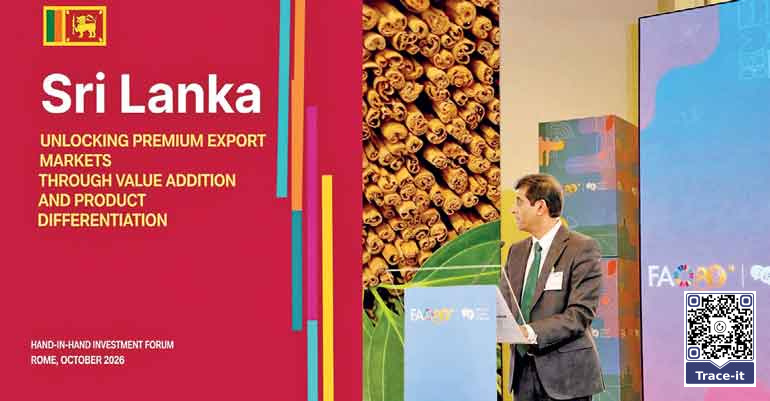
BOI Chairman Duminda Hullangamuwa
The Board of Investment of Sri Lanka (BOI) has presented Sri Lanka’s flagship agri-food investment opportunities at the Hand-in-Hand Initiative Investment Forum 2026, convened by the Food and Agriculture Organisation of the United Nations (FAO) in Rome from 13 to 16 October.
Chairman Duminda Hulangamuwa led the BOI delegation, accompanied by Director General Dr. Sulakshana Jayawardena.
Sri Lanka’s presentation, “Unlocking Premium Export Markets through Value Addition and Product Differentiation”, framed a new pitch: the future of traditional trade lies in the global botanical market, where science reveals what makes Sri Lankan spices unique and turns that knowledge into products that heal, nourish and care. The world already values the Ceylon name; the next stage of growth lies in capturing more of that value at home.
Premium quality, limited returns
The Chairman recalled that Sri Lanka has stood at the centre of the global spice trade for centuries, and its smallholder farmers still produce some of the world’s most recognised agri-food products. Yet much of that value is captured overseas, because Sri Lanka exports raw commodities rather than value-added products. The binding constraints, he said, are access to capital, technology and premium markets, which are exactly what international investors can bring.
From red ocean to blue ocean
Exporting spices in bulk is a classic “red ocean”: a crowded market where many origins compete on volume and price, and margins are steadily squeezed. That is not where Sri Lanka’s future lies.
Instead, the BOI is turning to a “blue ocean” of high-value, botanical extract-based markets built on properties unique to Sri Lankan produce. Ceylon Cinnamon is true cinnamon (Cinnamomum verum), naturally very low in coumarin compared with the cassia that dominates world trade. Ceylon black pepper is prized for its pungency and piperine content, and centuries of Ayurvedic knowledge add a provenance that global brands increasingly seek.
Global Market Insights values the botanical extracts market at about $ 30 billion in 2024, rising to $ 64.6 billion by 2034. The Global Wellness Institute puts the wider wellness economy at $ 6.8 trillion, forecast to reach $ 9.8 trillion by 2029.
Four high-value export opportunities
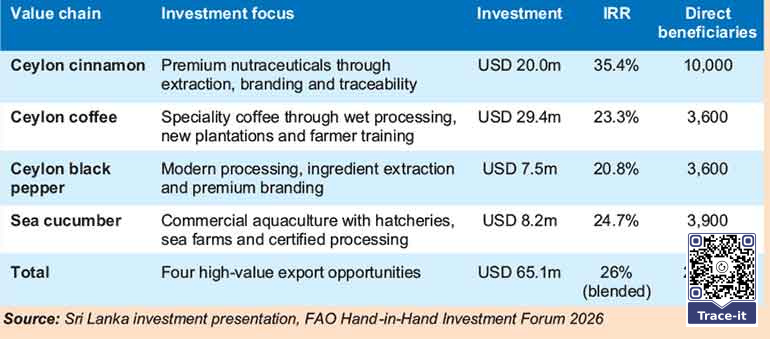
The BOI presented four investment-ready value chains worth $ 65.1 million, expected to reach some 21,100 direct and more than 84,000 indirect beneficiaries.
Cinnamon offers the highest projected return, building a premium nutraceutical industry around a spice Sri Lanka already exports at around $ 250 million a year. Sea cucumber offers the largest income gain, an estimated $ 4,800 per person, while coffee would revive a crop for which Ceylon was once among the world’s leading exporters.
Spice science: Technology meets tradition
The future of traditional trade lies in the laboratory as much as on the plantation. DNA barcoding can authenticate true Ceylon Cinnamon and distinguish it from cassia, protecting its origin and its premium. Chemical profiling can identify the active constituents that give each spice its character, such as cinnamaldehyde and eugenol in cinnamon and piperine in black pepper. Building on centuries of Ayurvedic use, research into these compounds can create evidence-based applications in health, wellness and beauty care: in effect, healing people with spices.
The BOI’s pitch is aimed squarely at technology-driven companies: extraction and biotechnology firms, nutraceutical and pharmaceutical formulators, and beauty and wellness brands. Genomic authentication, supercritical CO₂ extraction, standardisation of bioactive compounds, clinical validation and precision formulation can unlock the medicinal, wellness and beauty value already present in Sri Lankan produce:
n Ceylon Cinnamon: standardised low-coumarin extracts, oils and natural actives for nutraceuticals, functional foods, oral care and cosmetics, moving from a price per kilo to a price per gram.
n Ceylon black pepper: high-purity oleoresins and piperine for supplement and pharmaceutical formulators.
n Sea cucumber: marine collagen, peptides and bioactive compounds for premium beauty and skincare.
n Ceylon coffee: speciality-grade coffee alongside green coffee extracts and coffee-cherry ingredients.
n Ayurveda and provenance: traceability, geographical indications and certification that turn Sri Lankan origin into brand equity.
In this model, investors bring technology, research and access to global brands, and Sri Lanka brings unique raw materials, heritage and communities ready to supply them. More of the value is created and kept in Sri Lanka.
Why invest in Sri Lanka
Investors gain up to 100% foreign ownership, backed by 26 investment protection agreements; free trade agreements with India, Pakistan and Singapore, and preferential access to the European Union and the United Kingdom; the Port of Colombo at the heart of East–West shipping routes; a reduced 15% corporate income tax rate for services exports; and an educated, English-speaking workforce.
Next steps for investors
The BOI invited investors to explore the investment note on Sri Lanka’s Hand-in-Hand country page and request bilateral meetings. It will follow up with investors met in Rome and actively target technology-driven companies to establish value-added operations in Sri Lanka, positioning the country as a source of unique, high-value natural actives rather than a bulk commodity supplier.




