Thursday Oct 15, 2026
Thursday Oct 15, 2026
Thursday, 30 April 2026 00:00 - - {{hitsCtrl.values.hits}}
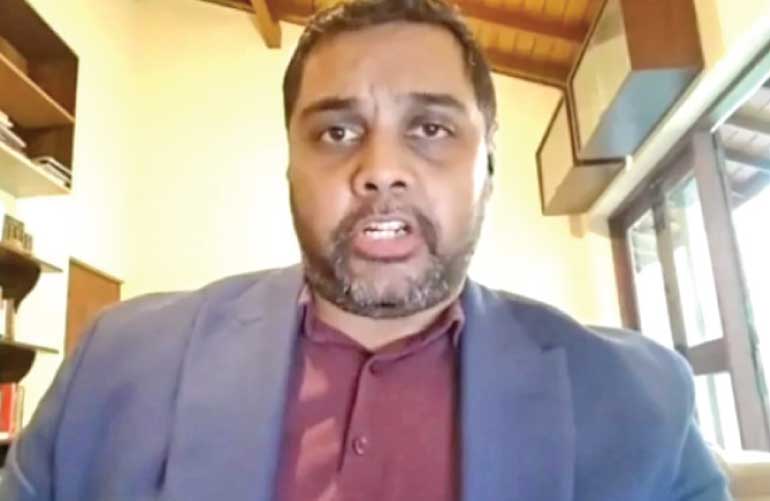
Geopolitical Cartographer Chief Research Officer Dinouk Colombage
Sri Lanka must move beyond passive non-alignment and anchor itself within regional alliances while reducing energy dependence, or risk being exposed to intensifying great-power rivalry, Geopolitical Cartographer Chief Research Officer Dinouk Colombage said.
Speaking at the ICCSL–Daily FT–ACCA webinar on ‘Crisis or Opportunity: Sri Lanka’s Path During the Middle East Crisis,’ Colombage said the country’s non-aligned policy, shaped in 1961 in a bipolar world, is misaligned with today’s fragmented geopolitical landscape.
“Now, 65 years later, it’s no longer a two power bloc or even a single power bloc, but we now see regional power blocs emerging, bilateral power blocs emerging. So Sri Lanka’s non-aligned stance and non-aligned policy also has to evolve and we no longer have the luxury in many ways of just burying our head in the sand and ignoring issues that are taking place around us,” he said.
He said non-alignment should be reframed to protect national interests while aligning with regional dynamics, particularly within the Indian Ocean and broader Asian region, noting that individual positioning by smaller States has limited impact.
“We also need to understand that we have to be able to ensure that there is security and stability in our economy and our geopolitical stance to ensure that we are guarded against big power rivalries,” he said.
Colombage said energy dependence remains a central vulnerability, arguing that reliance on imported fossil fuels exposes the economy to external shocks and geopolitical pressure.
“We are focused so much on fossil fuels and where our oil is coming from, where our petrol is coming from. We’re not realising that Sri Lanka has in excess of 60 to 70 gigawatts of solar and wind energy in the country. This is more than enough to power us and to export to India. So that’s how Sri Lanka becomes a renewable energy hub for the region,” he said.
He said strengthening renewable energy capacity would provide a more stable economic base, allowing Sri Lanka to maintain its non-aligned stance while navigating an increasingly competitive global environment.




