Monday Oct 19, 2026
Monday Oct 19, 2026
Monday, 19 October 2026 04:49 - - {{hitsCtrl.values.hits}}
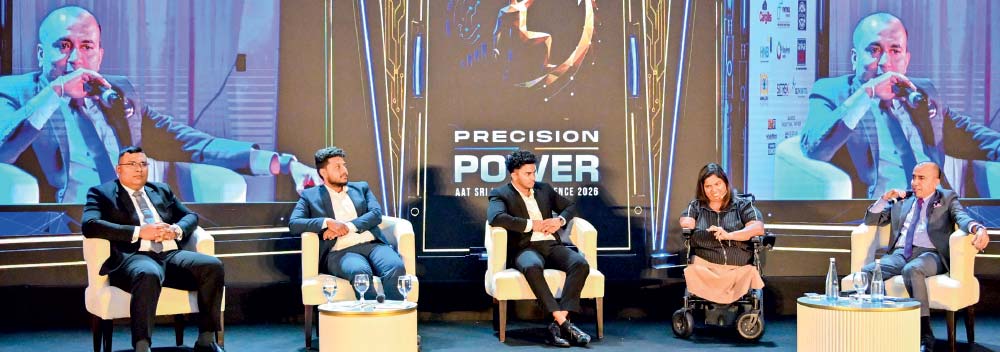
From left: Vito Pizza Group Managing Director Ranil Goonatilleke, Jack Fruit Ceylon Managing Director Dulanjana Vithanage, Wild Cookbook culinary content creator Charith N. Silva, Castoranets Singapore Vice President of Finance and Administration Bhagya Senevirathne and AAT Sri Lanka President by Dr. Chamara Bandara
Businesses are rarely built according to plan. Sometimes the turning point is a crisis, a failed experiment, a lost job or simply the decision to take a calculated risk.
That reality came through in very different ways as entrepreneurs and corporate leaders shared their personal journeys at the closing leadership panel of the AAT Sri Lanka Conference 2026, offering lessons in discipline, resilience, adaptability and ownership.
The session, Transformative Leadership: Lead to Inspire, was moderated AAT Sri Lanka President by Dr. Chamara Bandara and held on the final day of the conference, themed Precision of Power, at Waters Edge, Battaramulla, on 8 and 9 September.
The panel featured chef and Wild Cookbook culinary content creator Charith N. Silva, Jack Fruit Ceylon Managing Director Dulanjana Vithanage, Vito Pizza Group Managing Director Ranil Goonatilleke, and Castoranets Singapore Vice President of Finance and Administration Bhagya Senevirathne. A recorded address by Araliya Group of Companies Chairman Dudley Sirisena was also screened after he was unable to attend in person.
Entrepreneurship beyond necessity
Opening the session, Dr. Bandara said his own entrepreneurial outlook had been shaped early in his career after questioning why so many graduates sought jobs rather than creating them.
He noted that developing countries recorded higher rates of entrepreneurship than developed ones, although this was largely driven by necessity rather than scalable market opportunity.
“In developing countries, entrepreneurship is mostly driven by necessity and unemployment,” he said, citing Sirisena’s rise from a small village rice business to a large corporate enterprise as an example of scaling beyond necessity-driven beginnings.
Discipline as the foundation of leadership
In his recorded address, Sirisena said leading a disciplined personal life was the most fundamental requirement for becoming a leader in business or society.
“Before becoming a social leader, the most appropriate way to gain experience is to become a leader to yourself,” he said, recalling that he had grown up without discipline but corrected his path through life experience and guidance.
Sirisena said accounting and commerce education formed a core foundation for structured business planning, while a disciplined lifestyle could help entrepreneurs overcome early capital constraints by building trust with family, friends and financial institutions.
He recalled washing dishes at wealthier friends’ functions during his early years to remain close to networks that could help him access capital.
He also warned against dishonesty in business. “Dishonesty destroys all growth and eventually reduces a person to the lowest social tier, regardless of their education level,” he said.
When crisis forces a business to change
For Ranil Goonatilleke, crisis became the catalyst for changing the direction of his business.
He said Vito Pizza began almost by accident, evolving from wood-fired pizza served to foreign guests at his family’s hotel in Kandy. The Easter Sunday attacks and later COVID-19 brought foreign arrivals to a halt, forcing the business to reconsider its market.
“We asked ourselves, ‘What do we do now? Who do we cater to?’” he said.
The company launched a delivery service within three days of the lockdown, at one point delivering pizza from Kandy to Galagedara.
Goonatilleke credited his accounting background, gained while working at two hotels in Kandy, with giving him the financial literacy and banking exposure needed to later secure funding for his first property.
“Accountants handle bank loans and documentation for chairmen every day, so why can’t we do it for ourselves?” he said.
The business has since expanded to Colombo, Peradeniya, Galle and Negombo.
Turning an unwanted crop into an export business
Dulanjana Vithanage’s journey with Jack Fruit Ceylon began far from any early entrepreneurial ambition.
Growing up in a remote village in Galle, he recalled fallen jackfruit routinely obstructing footpaths. “As a child, the tree I hated most was the jackfruit tree,” he said.
After abandoning early ambitions in medicine and law, he pursued Commerce. An experience observing a hospital finance manager directing the work of doctors and engineers later shaped his interest in management.
Vithanage described mobilising university students across faculties to survey why communities avoided eating jackfruit and eventually developing high-protein jackfruit-based noodles and pasta with support from a small government grant and self-funded machinery.
“We built machinery, failed at candy making, and once dimmed the entire village’s lights when turning on our machine,” he said.
The business has since grown into an ISO-standard factory employing 30 people and supported by 406 rural suppliers, with exports reaching international markets.
From hospitality to 20 million followers
Charith N. Silva, who spent seven years in the hotel industry before pursuing content creation full-time, said he began publishing short-form culinary videos in 2019 after losing his hospitality job to the pandemic.
He later resigned from full-time employment after recovering from COVID-19 to pursue the venture entirely.
“You must have a Plan B when taking risks,” he said, adding that managing younger staff required leaders to set aside ego.
Silva said his content now reaches more than 20 million followers globally, a following that came with a responsibility not to influence audiences negatively.
Creating ownership within organisations
Bhagya Senevirathne, who lost the use of both legs and her right hand in an accident at age 16, said she completed her Ordinary Level examinations the same year and later graduated with first-class honours from Rajarata University, despite employers initially doubting her physical capacity for certain roles.
She joined MAS Holdings as an intern and later led a SAP system implementation and supported data migration during pandemic lockdowns, before leaving after fourteen years to start her own venture.
Senevirathne described intrapreneurship as treating one’s workplace as a second home and taking full ownership of organisational growth.
“Education is the foundation, but experience shapes our journey. Not everyone can be a founding entrepreneur, but we can work alongside one and add value,” she said.
“Since people spend much of their lives at work, entrepreneurs must create a sense of belonging. Even after starting my own business, I still feel that MAS is mine because its culture gave me that feeling.”
Leadership that inspires action
Summarising the session, Vithanage said education remained a full foundation for both entrepreneurs and intrapreneurs, while Silva said a business depended entirely on its staff and required treating them with respect.
Senevirathne said creating a workplace where employees felt ownership was central to sustained success.
Closing the panel, Dr. Bandara urged attendees to apply the lessons shared.
“When you act as a leader, you inspire followers. Transform yourself and transform those around you,” he said.




