Thursday Oct 22, 2026
Thursday Oct 22, 2026
Friday, 22 May 2026 00:05 - - {{hitsCtrl.values.hits}}

From left: EDB Director – Industrial Development Division Manoja Dissanayake, Additional Director General (Development) Kumudinie Mudalige, Foundry Industry and Services Institute Chairman Melvin Samarasinghe, EDB Chairman/CEO Mangala Wijesinghe, Government Factory Department Additional Director General Padmasiri Sri Narayana, and Faculty of Engineering, Department of Materials Science and Engineering Senior Lecturer S.P. Guluwita
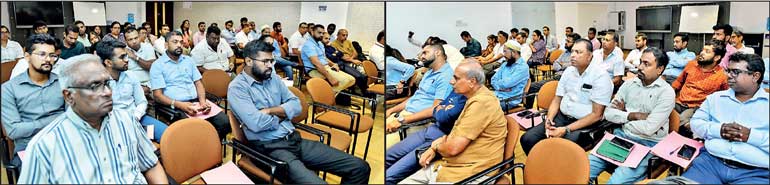
With the aim of strengthening the export competitiveness of Sri Lanka’s light engineering industry, the Industrial Products Division of the Export Development Board (EDB) inaugurated a special awareness program for exporters and potential exporters in the light engineering sector at the EDB headquarters in Colombo. The inauguration program was held at the EDB on 19 May 2026.
The program was conducted jointly with the Foundry Development Services Institute (FDSI) and the Department of Government Factory, targeting both current and potential exporters in the light engineering sector. The program was developed in direct response to calls from industry stakeholders for a more practical and technically grounded initiative capable of addressing the competitive pressures of the prevailing global manufacturing landscape.
The training program covered nineteen key areas structured under two main themes. The first, covering the export and business dimension, included sessions on global market opportunities, the strategic role of foundry technology, and the application of modern technologies such as simulation (Simulation) in product development. Sessions also addressed energy efficiency, international testing standards, green manufacturing processes, and sustainable production practices.
The second, more technically intensive phase was conducted at the premises of the Department of Government Factory and FDSI, where participants received hands-on training in pattern-making technology, melting and casting processes, and moulding techniques. This phase also provided participants with a thorough understanding of casting defect identification and remediation, modernisation of foundry operations, pollution control measures, and quality assurance systems.
In today’s global context, environmentally friendly manufacturing processes and pollution control have become essential prerequisites for accessing European and Asian export markets. Recognising this reality, the inclusion of dedicated sessions on environmental sustainability and quality assurance (Quality Assurance) was highlighted as a particularly significant feature of the program.
Based on the outcomes of this program, the Export Development Board has indicated plans to implement further capacity-building initiatives covering the broader engineering export sector.
Sri Lanka’s light engineering products export revenue stands at $ 205 million in 2025, with plans in place to increase it to $ 400 million by 2030.




