Thursday Oct 22, 2026
Thursday Oct 22, 2026
Wednesday, 1 July 2026 00:00 - - {{hitsCtrl.values.hits}}
Sri Lanka’s external current account remained under pressure in May, recording a second consecutive monthly deficit as a sharp rise in import expenditure due to the Middle East war, led by fuel and vehicles, outpaced robust export growth and offset continued strength in workers’ remittances.
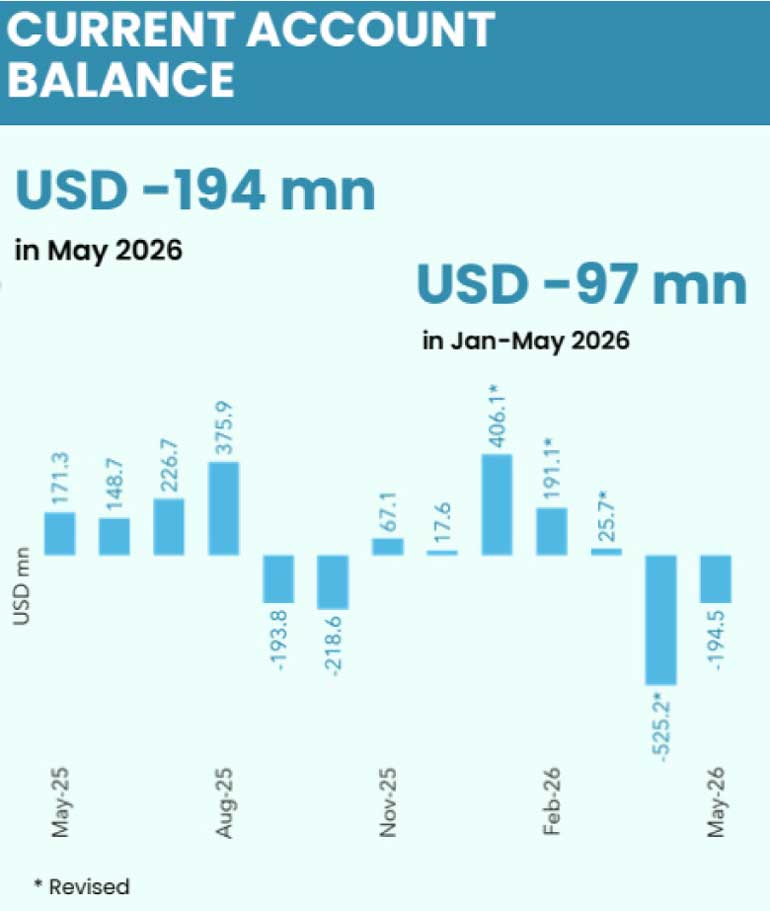
According to the Central Bank’s latest External Sector Performance report, the current account recorded a deficit of $ 194.5 million in May, following April’s return to deficit, bringing the cumulative balance for the first five months of 2026 to a deficit of $ 96.7 million, down from a $ 1.29 billion surplus a year ago.
The Central Bank attributed the latest outturn mainly to a widening merchandise trade deficit and a contraction in the services surplus despite stronger remittance inflows.
The merchandise trade deficit widened to $ 967.9 million in May from $ 472.5 million a year earlier as import expenditure rose 45.4% year-on-year to $ 2.19 billion, significantly outpacing the 18.3% increase in merchandise exports to $ 1.22 billion. Over January to May, the trade deficit expanded to $ 4.66 billion from $ 2.73 billion in the corresponding period of last year.
The import bill was driven largely by higher fuel and motor vehicle imports. Fuel import expenditure more than doubled, rising 112% year-on-year to $ 536 million in May amid higher oil prices and import volumes, although it declined 39.5% compared with April.
Meanwhile, expenditure on imported motor vehicles, including personal and commercial vehicles, rose 20% month-on-month to $ 250 million, lifting cumulative vehicle imports during the first five months of the year to $ 1.07 billion.
The Central Bank also said Sri Lanka’s terms of trade deteriorated both in May and over the January-May period as import prices increased faster than export prices.
The services account continued to weaken. Its surplus contracted 36.8% year-on-year to $ 143.2 million in May as services outflows grew faster than inflows, while the cumulative surplus for the first five months declined 20.8% from a year earlier. Total services exports edged up 2.5% year-on-year to $ 475.3 million in May but remained 2.9% lower over the first five months of the year.
Tourism presented a mixed picture. Tourist arrivals increased 9.6% year-on-year in May to 145,745, taking arrivals past the one million mark during January-May. However, estimated tourism earnings declined 5.1% year-on-year to $ 155.7 million in May, while cumulative earnings fell 11.9% to $ 1.36 billion. The Central Bank noted that the Sri Lanka Tourism Development Authority revised its methodology for estimating tourism earnings in May and applied the new methodology retrospectively from January 2026.
Workers’ remittances remained the strongest support to the external account, increasing 32% year-on-year to $ 847 million in May and 26% over the first five months to $ 3.91 billion. The Central Bank noted that these figures may include other remittances, including those received following Cyclone Ditwah.
On the financial account, foreign investors recorded net outflows of $ 60.3 million from the Government securities market and $ 22.6 million from the Colombo Stock Exchange during May.
Gross official reserves stood at $ 6.9 billion at end-May, supported by the jointly disbursed sixth and seventh tranches under the IMF’s Extended Fund Facility despite sizeable external debt service payments and net foreign exchange sales by the Central Bank. The reserve stock provided an import cover of 3.5 months.
The Central Bank also noted that the rupee had depreciated by 7.9% against the US dollar on a year-to-date basis by end-June, reflecting external sector pressures arising from the conflict in the Middle East, while describing the movement as consistent with depreciation trends observed across peer economies.




