Thursday Oct 22, 2026
Thursday Oct 22, 2026
Wednesday, 22 April 2026 00:02 - - {{hitsCtrl.values.hits}}
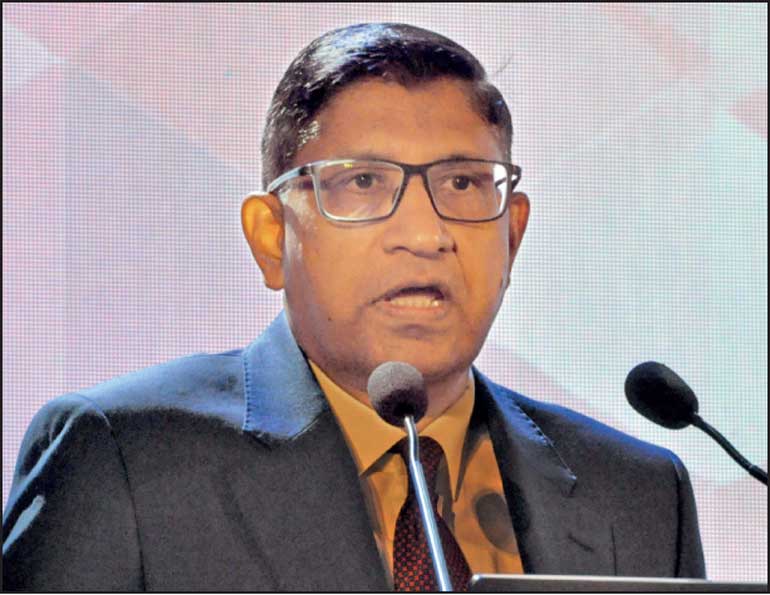
World Bank Group Senior Operations Specialist Asela Dissanayake
– Pic by Lasantha Kumara
By Charumini de Silva
Sri Lanka’s strong human development achievements have not translated into equal economic participation for women, with structural barriers, particularly unpaid care work, continuing to limit labour force entry, a senior World Bank Group official said yesterday.
Speaking at the South-4-Care Learning Hub in Colombo, World Bank Group Senior Operations Specialist and Acting Country Manager for Sri Lanka and the Maldives Asela Dissanayake noted that while Sri Lanka has built “strong foundations” in education, health and social protection, these alone are insufficient to ensure inclusive growth.
“Strong foundations do not automatically translate into full economic participation,” he said, stressing that there is more work to do, to convert human capital gains into labour market outcomes.
Dissanayake highlighted that Sri Lanka ranks among the strongest performers in South Asia on gender-related human development indicators, including: near universal literacy, gender parity in education and the lowest maternal mortality rates in the region.
He attributed these gains to the country’s long-standing investments in free education, universal healthcare and public infrastructure, which have expanded opportunities for women and girls across both rural and urban areas.
However, these achievements contrast sharply with labour market realities.
“Female labour force participation has stagnated at around 31% to 35% for over three decades,” he said, citing that women aged 25–49 are 2.6 times more likely to be unemployed than men, despite being at their most educated and productive stage.
He said the situation worsened during the 2022 economic crisis, with women experiencing 8.6% higher job losses than men, and recovery since then remaining uneven.
According to Dissanayake, the underlying constraint lies in the disproportionate burden of unpaid care work.
“Around 87% of women and girls above age 10 participate in household and care work, compared to 60% of men and boys,” he said, noting that this imbalance persists even when women are formally employed.
The most critical pressure point, he added, is motherhood.
“Women exit the workforce when they have children and do not return, not from choice, but because affordable, quality childcare is out of reach for most families,” he stressed.
He said childcare is only part of the challenge, with Sri Lanka’s population rapidly ageing, elder care is emerging as a parallel constraint.
“By 2041, nearly one in five Sri Lankans will be over 60. Elder care is an equally pressing and growing issue, one that falls disproportionately on women,” he warned.
Despite these challenges, Dissanayake pointed out that the care economy should not be viewed solely as a barrier, but also as a major growth opportunity.
“The care economy is not only a constraint to address, it might be an opportunity to invest in,” he said.
Globally, care services are among the fastest-growing employment sectors, with investments projected to generate 300 million of jobs by 2035. Sri Lanka, with its ageing population and expanding middle class, is well positioned to benefit.
He pointed to elder care services in particular as a largely untapped market, with potential for formal job creation, skills development and private sector participation.
“Decent work, fair pay and social protection in care jobs are exactly the kind of inclusive employment Sri Lanka needs,” he added, especially as the country seeks to absorb nearly one million new entrants into the labour market in the coming years.
Dissanayake stressed that addressing the care economy requires a shift in social norms, particularly around gender roles.
“Care cannot continue to be treated as women’s work alone. Men have a role, as caregivers at home, as workers in the formal care economy, and as champions of redistribution,” he said.
He described this shift as not just a matter of equity, but a precondition for expanding women’s participation in paid work.
The care economy agenda is embedded in the World Bank’s newly approved Country Partnership Framework for Sri Lanka, a five-year strategy focused on private sector-led job creation, skills development, inclusion of women, youth and vulnerable groups.
The framework recognises that achieving Sri Lanka’s 7% growth ambition will depend on removing structural barriers, including care responsibilities that keep educated women out of the workforce.
Dissanayake said the World Bank Group is supporting this agenda through research and evidence-building on childcare and elder care systems, engagement with the private sector via the International Finance Corporation (IFC) and financing and advisory support to scale care services.
He also highlighted ongoing collaboration with the International Labour Organisation (ILO) and other partners to strengthen policy, analytics and operational investments.
Dissanayake stressed on the importance of partnerships and evidence-based policymaking. “These issues are too often invisible in policy conversations,” he said, urging stakeholders to use platforms like the South-4-Care Learning Hub to generate actionable solutions.
“The solutions exist, and the moment to act on them is now,” he said.




