Friday Oct 23, 2026
Friday Oct 23, 2026
Tuesday, 8 September 2026 04:44 - - {{hitsCtrl.values.hits}}
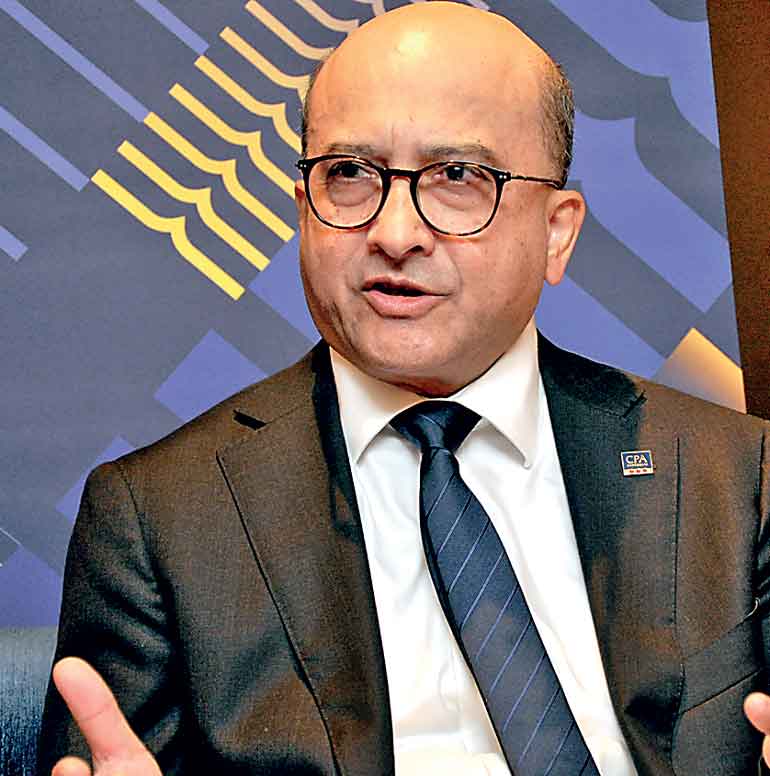
CPA Australia Board President and Chair Prof.Dale Pinto - Pic by Lasantha Kumara
By Nisthar Cassim
CPA Australia President Prof Dale recently identified Sri Lanka as one of its most exciting growth markets.
This assessment is based on the fact that the world famous CPA qualification has gained a lot of traction in Sri Lanka following the opening of the Sri Lanka Liaison Office as well as strong partnership with government, universities and employers as well as signing of pathway agreements with both the CA Sri Lanka and the CMA Sri Lanka.
CPA Australia is a professional accounting body in Australia, originally founded as the “Incorporated Institute of Accountants” in 1886. CPA Australia is one of the world’s largest accounting bodies, with a global membership of over 176,000 members across over 100 countries. One third of the membership is outside Australia.
“We have built a vibrant member community. We have gone from 400 members two years ago to 600 which is a 50% growth in a short period of time,” explained Dale in an interview with the Daily FT along with CPA Australia’s Country Representative in Sri Lanka Dinuk Hettiaratchchi.
“When I first became CPA Australia President and visited Sri Lanka, what really struck me was not just the numbers of members, but the quality of the members that were. These were people who were not just concerned about accounting, but how to become better accountants and how to grow Sri Lanka. This optimism gives me tremendous confidence,” said Dale, who was in Sri Lanka recently to participate in CPA’s 140th anniversary celebrations.
Sri Lanka has exceptional talent and CPA Australia is committed to helping that talent succeed not only here but across the Asia Pacific region and the world
CPA Australia is optimistic about Sri Lanka given the quality of the talent in the country. “Sri Lanka’s strength in many ways is its people. The people there have got a thirst for knowledge. They have got a global mindset, and they want to make the world a better place, and that sounds a bit cheesy, but it is actually true because I hear it from enough people that they can’t be all colluding with each other.”
President Dale said Sri Lanka has an excellent opportunity to become a regional hub for finance, shared services and professional expertise. “High-quality finance professionals can help attract international investment through better governance and transparency,” CPA Australia President emphasised.
“Sri Lanka has exceptional talent and CPA Australia is committed to helping that talent succeed not only here but across the Asia Pacific region and the world,” Dale added.
Challenges to global accounting profession
In terms of challenges to the global accounting profession, CPA Australia President identified Artificial Intelligence and cyber security as the biggest ones facing not just accounting but everyone. Other challenges include talent attraction and retention; ethics, regulatory complexity where different rules apply in different jurisdictions; climate and sustainability reporting that many countries are requiring and geopolitical upheavals and resultant economic volatilities.
“With all of those challenges, people, and that is whether it is clients or businesses or government, look for trusted advisors. That is where the role of accountants comes in, not just to provide financial statements, but to help them navigate uncertainty, to help them understand AI, to help them decode regulatory complexity, to help them explain different cultures, and that’s where a body like CPA Australia comes in. Because we are in 100 countries, we can share what we know from our evidence works in each jurisdiction with our members,” emphasised President Dale.
“The future accountant will combine technical excellence with technology, ethics and leadership. Those who embrace lifelong learning will not simply adapt to change. They will lead,” said Dale adding “The accounting profession has evolved from bookkeepers to business advisers and now to architects of trust in a digital economy.”
High-quality finance professionals can help attract international investment through better governance and transparency
CPA Australia, which is a member of the International Federation of Accountants (IFAC), is expanding partnership with global and regional accounting bodies with South Asia Federation of Accountants (SAFA) being the most recent. “All of the challenges that we are facing now are external to all of our bodies. So whether it is AI, sustainability, regulatory complexity, geopolitical uncertainty, these are external forces, and when you are dealing with challenges in that context, you can’t solve them unilaterally. You have to collaborate.”
Dale also explained CPA Australia’s Thought Leadership initiative to develop future leaders. It does a number of reports including Asia Pacific Small Business Survey; Business Technology Report, ESG research and AI insights.
“Our priorities continue to promote regional mobility, and via Member Recognition Agreements (MRAs), CPA Australia fosters greater collaboration to help SMEs adopt digital technologies, to promote ethical use of AI, and to support sustainable economic growth.
MRAs is where members of the parties to the agreement can become members of the other. For example a member of CA Sri Lanka can join CPA Australia. They don’t have to do the CPA Australia program but as per the agreement, enjoys some reductions.
“We want to make sure that there is genuine mobility and there’s genuine benefits for both parties. So we don’t just do it to get members into our body. We do it so members from our body can also go there. Otherwise, we don’t go into the agreement if it’s one-sided,” Dale explained.
“We are not standing still. We are undertaking what’s called the Learning Evolution program, and that is a major change to our CPA program and it’s related to CPDs, that is to include things like AI, sustainability, and emerging things that business professionals need to know,” explained Dale.
He referred to CPA Australia’s value proposition “partners for progress” ensuring members have got the educational resources, practical toolkits and checklists to help them. “Because if you are a small business, for example, your main job is conducting a business, and so our job as a professional body is to help them in practical ways whenever they have an issue.”
Amidst multiple challenges, whether it is clients or businesses or government, look for trusted advisors. That’s where the role of accountants comes in, not just to provide financial statements, but to help them navigate uncertainty
CPA Australia has a very successful initiative called “Build Days” bringing members and partners together to develop solutions. The more recent one was held in Sydney on AI tools. CPA Australia is also planning to establish an AI hub, with resources and practical ideas.
Following are excerpts of the interview.
Q: AI is relatively new to professionals. What is the biggest drawback in terms of members adopting AI?
A: Members are more accounting driven, but they also may have been empowered by AI. We are trying to teach the responsible usage of AI, which is the ethical use of it. The second thing is to actually teach people how to use it in their business. I think the biggest fear is you know there’s a phrase called “AI where people think it’s going to replace me. So because of that, what do I do? I put the fence up. I don’t want to know about it, but in fact, what it does is it gets rid of all the routine tasks like invoice processing or data processing, and it frees up the accountant’s time to do analysis and also to become a strategic business partner to tell the story behind the numbers. So it is a higher level of thinking, but that is a different mindset. So accountants are going from being bookkeepers to being business advisors. That’s a big change. So we have to bring people on the journey and tell them, look, you don’t have to worry. Your work will change, but you are going to do more interesting work in a more valuable way. But that’s a journey. Technology may replace tasks. It will not replace trust.
Q: What’s the real advantage a company would have if you have a CPA member, What’s the value they bring in?
A: I think my simple phrase would be, it is a recognition of being a trusted advisor who is educated in the current rules, but also the ethical practice of those rules. So we pride ourselves. We got one word in our crest, which is integrity. So to me, if you look at a CPA Australia, you should think of a trusted advisor.
Q: How do you respond to some of the failures by accounting professionals and firms?
A: The first line of defence is obviously education. We try to educate people on doing the right thing. But if people don’t do the right thing, we have got a very strong and robust professional conduct regime, and we have penalties that can go up to $100,000 in Australia, and you can lose your membership and right to practice. So that can be an existential threat. Now we don’t like to use that, but in cases where people have been behaving egregiously, you have to because otherwise all the people who are doing the right thing get tarred with the same brush. This always happens in any big community.
Technology may replace tasks. It will not replace trust
You are always going to have outliers, so you have to deal with them. We are doing our best to do that. We have had well publicised cases in Australia of big firms, which, although they are not our members, still impacts the profession. When you are dealing with trust, it is an easy thing to lose and it is a hard thing to regain. On our website we regularly update all the professional conduct actions. So that’s visible for people to see. Once a year, we have to appear before Parliament, and they ask us questions, and that’s on the public record on how many people we have sanctioned, how many people we have terminated, what fines were imposed. So in that sense, there is transparency and accountability. There will be some cases where, because of the nature of the people involved, the names won’t be published, but the general trends and the cases and the incidents and how we are going about it-that is all transparent.
Q: Where do you see the world is heading?
A: The world’s in a very volatile and dynamic phase. Volatile because of geopolitical considerations. Dynamic because of rapidly evolving phenomena like AI. We have got almost like the perfect storm at the moment, but like any storm, I think the weather passes, and then you have got to make sure that you ride with the waves as they are passing you and try to negotiate as best you can. You stay true to your principles such as integrity, professional standards, and acting in the public interest. Those for us are the three features which define a profession. Now, if we lose that, then we won’t exist, no matter what the conditions are outside. We have to stay true to that. But we have to respond to all of these things because we have obviously got members and the public to serve. So that philosophy is applicable whether you are dealing with a global economy or a regional economy.
I came across two things. One was AI dread, where people thought the world’s going to end.
and another one was called apocalypticist, which combines apocalypse with optimists. So it’s like glass half full, and I’m that person. Whether you are talking globally or whether you are talking regionally or whether you’re talking nationally, it is the same thing manifested in different ways, and there might be different aspects of it. But ultimately, you know the world changes, the world pivots. So I’m one of the apocalyptomists. You have to continually change.
Q: What’s your kind of advice for emerging economies like Sri Lanka?
A: One is to foster this professionalism and profession and also to get things right.
There are a number of things. One is obviously learning from the lessons of others, collaborating with others where it makes sense to do that. There’s basic principles of trust, which include transparency. I call it “my five”, which is simplicity, keeping things as simple as you can, so you don’t overcomplicate laws. For example, certainty would be my second thing, where you know businesses need certainty to invest and foreign direct investment, same thing. Then I call it equity. There needs to be a sense of fairness, so that’s important. The fourth one is neutrality, where I think there shouldn’t be any distortions. So you know it shouldn’t produce incentives for me to behave in a certain way. The last one comes back to the government, which is efficiency. So making sure administration costs are minimised and compliance costs to businesses, therefore, are minimised. Now that all sounds very obvious and simple, which it is conceptually, but to do it practically is very challenging.
The future accountant will combine technical excellence with technology, ethics and leadership. Those who embrace lifelong learning will not simply adapt to change. They will lead. The accounting profession has evolved from bookkeepers to business advisers and now to architects of trust in a digital economy
Q: What’s coming ahead for CPAs for the entire region as an organisation?
A: We are embarking on a major project called Learning Evolution. Yeah. So that’s evolving our educational offerings. That is the biggest investment we’ve got at the moment. Okay. The second thing is AI. AI is really how we adopt it within the organisation, but how do we deploy it to our members, so they can help their clients as well. The third big one for us is actually the future of the profession. We are making sure we can continue to attract and retain the next generation of accountants. Accounting is seen as not being exciting, not paying a lot, and going to be replaced by AI. The demand for accountants is still high because machines can’t sign off. So humans are still accountable. So paradoxically, demand’s up, but supply’s going down because people are going away from accounting. So I think they would be the three big challenges we’ve got amongst those other things of sustainability, reporting, and geopolitical. But they’re second order compared to these first three.
Q: How do you be relevant to or attractive to the younger generation?
A: CPA has got a campaign called “Three Letters to Limitless” which is CPA. The Three Letters to Limitless is trying to explain to people the limitless careers a course in accounting can give. Not just financial accountant or management accountant or auditor or tax-they are the traditional ones but forensic accountant, data analyst, sustainability accountant. We have developed 24 of these exciting careers. We are trying to sell that to show people, and some of them haven’t even got the word accountant in it, which actually helps. There’s a stigma with being an accountant is boring. We are showing people how technologies like AI can actually free them from doing the routine work and get them involved in more strategic value adding.




