Thursday Oct 22, 2026
Thursday Oct 22, 2026
Tuesday, 21 April 2026 02:38 - - {{hitsCtrl.values.hits}}
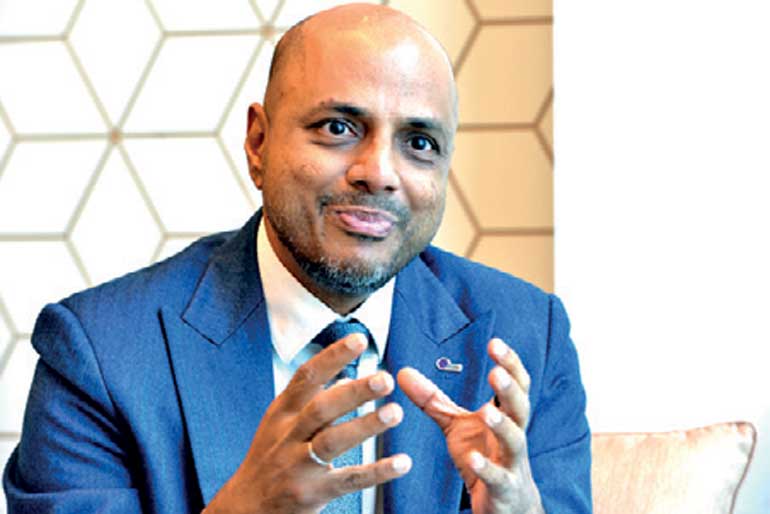
AICPA and CIMA Vice President for Asia Pacific Venkkat Ramanan — Pic by Lasantha Kumara
By Charumini de Silva
As the role of finance continues to expand beyond traditional accounting functions, the demand for professionals who can combine technical expertise with strategic insight, digital fluency, and leadership has never been greater.
Against a backdrop of rapid technological change and persistent economic uncertainty, the CGMA qualification, offered by the Association of International Certified Professional Accountants (AICPA and CIMA) is positioning itself as a critical enabler of this new breed of finance professionals.
AICPA and CIMA Vice President for Asia Pacific Venkkat Ramanan, in an exclusive interview with the Daily FT, highlighted the evolution of the qualification, and the CGMA pathway designed to equip professionals to navigate complexity with resilience to guide strategy, manage risk, and drive sustainable growth.
Below are excerpts of the interview:
Q: CIMA has evolved over time. How has the CGMA qualification changed, and what makes it different from traditional accounting qualifications?
A: The CGMA qualification has always been built differently, it is not a recent shift. If we look back over the past 20 to 30 years, there have been multiple waves of transformation. Technology-led change is not new; what we are seeing today with AI is simply an acceleration, a force multiplier. What sets the CGMA qualification apart is its consistent focus on employability and value creation. Continuous improvement is embedded in our DNA. The syllabus evolves constantly to reflect what businesses need, ensuring that members bring relevant and forward-looking skills. In the past, finance professionals were primarily assessed on technical capabilities, such as knowledge of accounting standards, preparing financial statements, or handling reconciliations. While these remain important, they are no longer sufficient.
Today, the qualification develops what we call “T-shaped professionals.” Previously, the emphasis was on deep technical expertise, the vertical part of the “T.” Now, the horizontal dimension has expanded significantly. CGMA professionals combine three foundational pillars: digital and AI capability, strong technical grounding, and, most importantly, trust. The trust dimension is what differentiates the profession, as finance professionals provide assurance and credibility to stakeholders. Beyond this, the qualification builds broader competencies such as strategic thinking, critical analysis, and collaboration. This shift makes CGMA distinct from traditional accounting qualifications, which tend to focus more narrowly on technical expertise.
Q: Finance roles now go beyond numbers. How has CIMA updated its curriculum to stay relevant for areas like AI, digital transformation, and strategy?
A: Finance roles today extend far beyond traditional number-crunching. The curriculum has evolved to reflect this reality by integrating digital, strategic, and business-oriented capabilities. AI and digital transformation are now central enablers. While many people use AI tools, the real value lies in how effectively they are applied. Finance professionals with strong domain knowledge can interpret outputs and apply them contextually, which is critical. At the same time, technical skills remain essential.
However, they are complemented by a broader set of capabilities, including strategic thinking, the ability to understand long-term value creation, and critical thinking, which enables professionals to solve complex problems in uncertain environments. Uncertainty itself is not new; it has always been a constant in business.
What matters is the ability to navigate it effectively. The curriculum therefore focuses on equipping professionals to make informed decisions, even in rapidly changing conditions. Equally important are collaboration and communication skills. Finance is no longer a back-office function. It must actively engage with other parts of the business, understand their needs, and add value. This transformation is central to how the CGMA qualification prepares professionals for modern roles.
Q: Given Sri Lanka’s current economic challenges, which parts of the CIMA qualification are most useful for local professionals today?
A: Sri Lanka has faced a series of shocks over the years, from conflict and terrorism to the COVID-19 pandemic, the recent economic crisis, natural disasters, and global geopolitical tensions. These events highlight the reality that businesses operate in an environment of constant disruption. In such a context, resilience is the most critical capability.
Businesses cannot continue operating in the same way and expect different outcomes. They must adapt, innovate, and evolve. The CGMA qualification equips professionals with the skills needed to drive this resilience. Strategic thinking, critical analysis, and the ability to adapt business models are particularly relevant.
Finance professionals must lead conversations within organisations on how to respond to changing conditions and build more sustainable operations. Ultimately, all aspects of the qualification; from technical knowledge to digital capabilities and leadership skills, contribute to helping professionals navigate uncertainty and support business continuity and growth.
Q: CIMA marks 60 years in Sri Lanka. What does this milestone say about the link between finance education and the country’s economic growth?
A: Reaching 60 years in Sri Lanka reflects a deep and enduring connection between finance education and the country’s economic development. Over the decades, CGMA professionals have played a critical role across industries, supporting businesses, strengthening governance, and contributing to economic progress.
Finance education has been a key enabler of this growth. By equipping individuals with the right skills, it has helped build a strong talent base capable of supporting both the public and private sectors. This milestone also highlights the trust placed in the qualification. Organisations recognise the value that CGMA professionals bring, not only in terms of technical expertise, but also in driving strategy, ensuring transparency, and supporting sustainable growth.
Q: What is your message to CIMA students and members in Sri Lanka, and what is your vision for the future?
A: The message is simple: embrace continuous learning and remain adaptable. The pace of change in the business environment is only accelerating, and professionals must evolve alongside it. Students and members should focus not only on technical excellence, but also on developing broader skills such as; digital literacy, strategic thinking, and collaboration. These are the capabilities that will define success in the future.
The vision is to see CGMA professionals at the forefront of business leadership; driving innovation, enabling growth, and contributing meaningfully to society. The qualification provides a strong foundation, but individuals must take ownership of their development and actively apply their skills in real-world contexts.
Q: What real value does AICPA & CIMA membership offer finance professionals in Sri Lanka today?
A: Membership offers both credibility and opportunity. It signals to employers and stakeholders that an individual meets globally recognised standards of competence and professionalism. Beyond that, it provides access to a global network, continuous professional development resources, and insights into emerging trends.
This is particularly valuable in a rapidly changing environment where staying updated is essential. In addition, membership reinforces the trust dimension of the profession. Being part of a recognised global body enhances credibility and positions professionals as trusted advisors within their organisations.
Q: Many students complete exams but don’t become members. What would you say to them, and how is CIMA making membership more accessible?
A: Completing exams is a significant achievement, but it is only part of the journey. Membership represents the full professional qualification and carries substantial value in terms of recognition and career progression. Those who have completed exams should consider the long-term benefits of membership, including enhanced credibility, access to resources, and professional recognition.
CIMA continues to work on making membership more accessible by streamlining processes, providing guidance, and supporting candidates through the final stages of qualification. The goal is to ensure that more individuals can transition from exam completion to full membership.
Q: What role can CGMA professionals play in Sri Lanka’s economic recovery and long-term growth?
A: CGMA professionals have a critical role to play in both recovery and long-term development. As finance leaders, they are uniquely positioned to influence decision-making, allocate resources effectively, and ensure organisational resilience. They can support businesses in rebuilding aftershocks, identifying new opportunities, and driving sustainable growth. Their ability to combine technical expertise with strategic insight makes them valuable contributors to economic progress. In addition, they play a key role in maintaining transparency and trust, which are essential for attracting investment and fostering confidence in the economy.
Q: We’ve seen partnerships in other countries like Malaysia. Do you see similar opportunities for Sri Lanka?
A: There is strong potential for partnerships in Sri Lanka, particularly in areas such as education, skills development, and industry collaboration. As the economy evolves, there will be increasing demand for professionals with the right capabilities.
Collaborations between professional bodies, educational institutions, and industry can help bridge skills gaps and create new opportunities. Sri Lanka has a strong foundation of talent, and with the right partnerships, this can be further developed to meet both local and global demands.
Q: In one sentence, why does the CGMA qualification matter for both individual careers and Sri Lanka’s future?
A: The CGMA qualification matters because it equips individuals with the skills, credibility, and adaptability needed to succeed in their careers, while enabling businesses, and the broader economy, to navigate uncertainty and achieve sustainable growth.




