Thursday Oct 22, 2026
Thursday Oct 22, 2026
Monday, 7 September 2026 05:18 - - {{hitsCtrl.values.hits}}
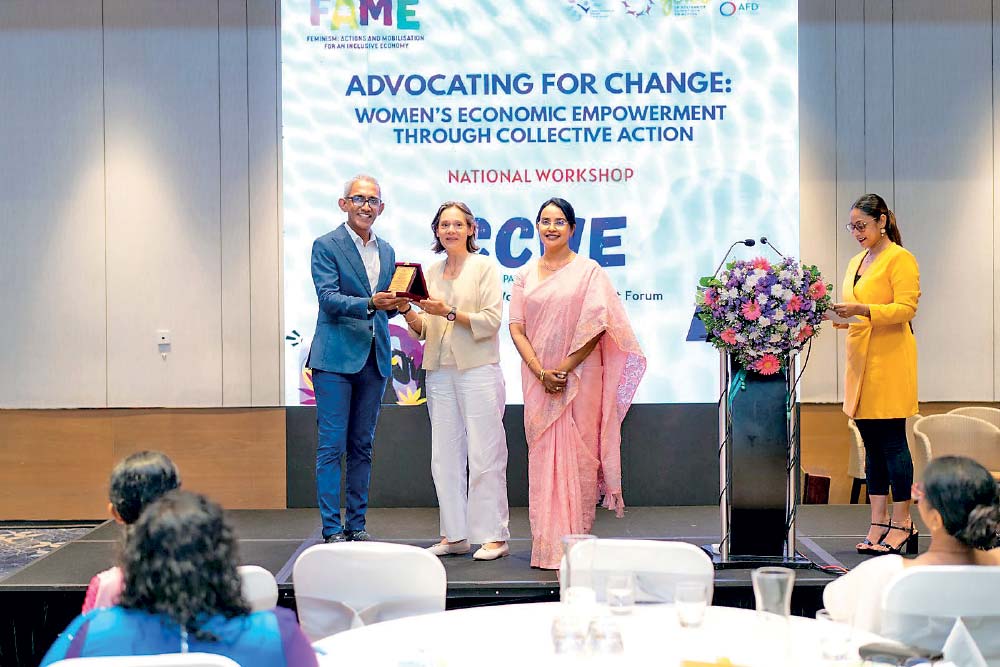
Industrial Development Board Chairman Yasas Hewage (left) with AFD Deputy Director for Sri Lanka Amelie July and Ceylon Chamber of Women Entrepreneurs President Dr. Ayanthi Gurusinghe
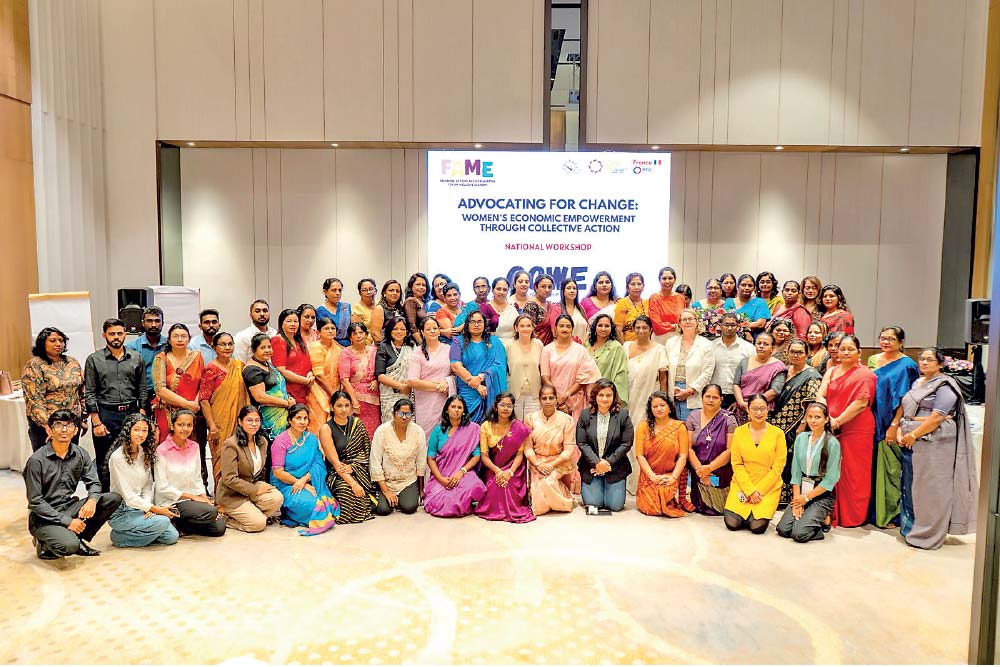
The Ceylon Chamber of Women Entrepreneurs (CCWE), in collaboration with the University of Kelaniya, brought together policymakers, development partners, private-sector leaders, academics, civil society organisations and women entrepreneurs at the National Workshop “Advocating for Change: Women’s Economic Empowerment through Collective Action.”
The workshop formed part of the FAME – Feminism: Action and Mobilisation for an Inclusive Economy Project, supported by the Agence Française de Développement (AFD), and focused on identifying practical pathways to create a more inclusive and enabling entrepreneurial ecosystem for women in Sri Lanka.
The national dialogue provided a platform to bring together policy-level perspectives with the experiences of women entrepreneurs and grassroots organisations, while presenting research evidence on the barriers, opportunities and institutional changes required to strengthen women’s participation in entrepreneurship and economic development.
Welcoming participants, Ceylon Chamber of Women Entrepreneurs President Dr. Ayanthi Gurusinghe emphasised that women’s economic empowerment cannot be achieved through isolated interventions or training programs alone. She highlighted the importance of connecting women entrepreneurs with finance, technology, markets, knowledge, networks and policy-making institutions, while ensuring that the voices of women at community level are represented in national discussions. She noted that the purpose of “Advocating for Change” is to bring these different voices together and move from identifying challenges towards practical and sustainable solutions.
Dr. Gurusinghe further stressed the importance of collective action among government institutions, development partners, academia, the private sector, women’s chambers and community organisations to create meaningful economic opportunities for women across Sri Lanka.
Partnerships for progress – France’s continued support for women’s economic empowerment
Embassy of France Deputy Ambassador Matthieu John highlighted the importance of partnerships in advancing inclusive economic development and reflected on the contribution of the FAME partnership in Sri Lanka.
He emphasised the value of strengthening women’s participation in economic decision-making and creating opportunities that enable women not only to establish enterprises but also to build sustainable businesses capable of contributing to employment, innovation and economic growth. The participation of France and AFD in the program reinforced the importance of international development partnerships that support locally led initiatives, research, advocacy and collective action for women’s economic empowerment.
Creating an enabling ecosystem for women entrepreneurs
Delivering the keynote address, Industrial Development Board (IDB) Chairman Yasas Hewage, focused on the importance of creating an enabling ecosystem in which women entrepreneurs can move beyond micro and livelihood-based enterprises towards sustainable, growth-oriented businesses.He highlighted the role of enterprise-development institutions in providing entrepreneurs with access to technical knowledge, technology, productivity improvement, business-development services, finance and markets.
Hewage also emphasised that strengthening women-owned enterprises should be viewed not merely as a gender or social-development intervention, but as an important component of Sri Lanka’s wider industrial and economic development
Panel 1 – From Policy to Progress: Building an enabling ecosystem for women entrepreneurs
This brought together government, development partners, the private sector and women entrepreneurs to examine how Sri Lanka can create a stronger enabling environment for women-owned businesses. The discussion featured Women and Child Affairs Ministry Deputy Director - Development Jayanthi Hewakuruppu, IAS Holdings Ltd., Group Managing Director Tania Polonnowita Wettimuny, DAZZLE Founder and CEO Niluka Weligamage, and Agence Française de Développement (AFD) Gender Specialist Juliette Van Wassenhove.
The first panel brought together representatives from the Industry and Entrepreneurship Development Ministry, Women and Child Affairs Ministry, private sector and Agence Française de Développement (AFD) to examine how policy and institutional mechanisms can better support women entrepreneurs.
The panel called for a shift “from policy to progress”, with stronger coordination between government, development partners, financial institutions and the private sector. The key outcome was the need to ensure that policies and programs deliver measurable results for women entrepreneurs—particularly improved business sustainability, income, productivity, employment creation, market access and opportunities to scale from micro enterprises into competitive and sustainable businesses.
Panel 2 – Voices from the ground: Women leading change through collective action
This panel brought grassroots realities into the national dialogue through CPWCIC President Kanthi Mdagammana, DDS President Nilanthi Perera, RRWO President Daya Dadallage, and KNDS President Ramya Kumuduni. The speakers shared the experiences of women entrepreneurs working at community and provincial levels, particularly outside Sri Lanka’s main commercial centres.
The panel strongly called for a bottom-up approach to policy development, ensuring that the voices and lived experiences of women entrepreneurs from different provinces are directly reflected in national decision-making. A central outcome was the recognition that women entrepreneurs should not simply be beneficiaries of programs, but active partners in designing, implementing and evaluating policies that affect their businesses and economic participation. Strengthening collective action and linking grassroots organisations more closely with national institutions were identified as essential to achieving sustainable change.
Evidence for change
Presenting the research findings, University of Kelaniya Department of Social Statistics Professor and Centre for Gender Studies Acting Director Prof. Sanika Sulochani Ramanayake, presented evidence on the barriers and opportunities affecting women entrepreneurs and the pathways required to strengthen women’s economic participation.
The findings highlighted the importance of moving towards an ecosystem approach in which access to finance, skills, technology, formalisation, markets, networks and institutional support are interconnected rather than delivered as isolated interventions.
The research also reinforced the importance of evidence-based advocacy and of ensuring that the experiences of women entrepreneurs from different regions and economic backgrounds are reflected in future policy discussions.
From dialogue to action
The National Workshop concluded with a call for stronger coordination and continued collective action among government, development partners, financial institutions, academia, the private sector, women’s organisations and entrepreneurs.
Among the broader priorities emerging from the dialogue were the need to strengthen access to finance and markets; improve technology, digital and business-development support; create stronger pathways from micro-enterprise to sustainable business growth; strengthen institutional coordination; improve access to opportunities for women outside Colombo; and ensure that women entrepreneurs have a stronger voice in policy and economic decision-making.
CCWE emphasised that the dialogue is intended to contribute to a wider process of evidence-based advocacy for women’s economic empowerment, ensuring that recommendations are informed not only by research and institutional perspectives but also by the lived experiences of women entrepreneurs themselves.
The workshop reaffirmed a central message: Women’s economic empowerment is not solely a women’s issue—it is fundamental to Sri Lanka’s inclusive economic growth, industrial development and long-term prosperity.
Through “Advocating for Change: Women’s Economic Empowerment through Collective Action,” CCWE and its partners will continue to work towards transforming dialogue and evidence into practical recommendations and stronger collective action for women entrepreneurs across Sri Lanka.




