Thursday Oct 15, 2026
Thursday Oct 15, 2026
Thursday, 14 May 2026 00:00 - - {{hitsCtrl.values.hits}}
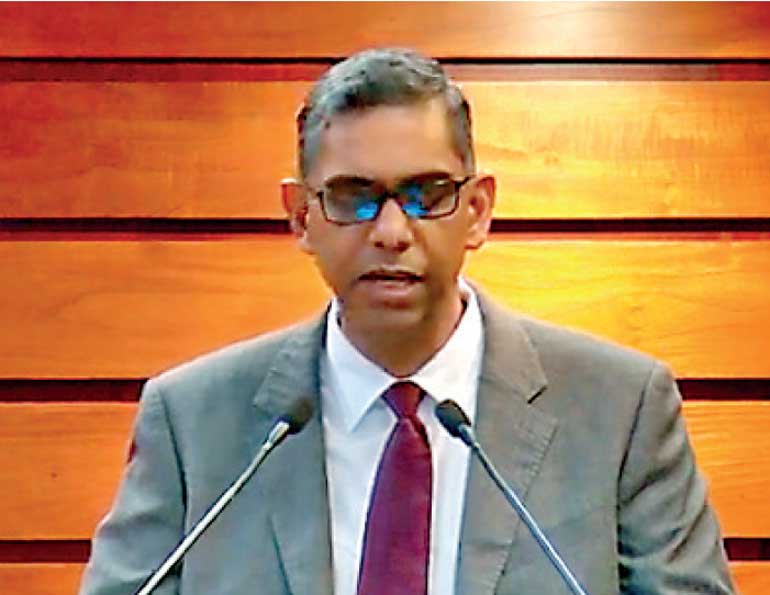
Economic Research Department Director
Dr. Lasitha Pathberiya
Central Bank of Sri Lanka (CBSL) Economic Research Department Director Dr. Lasitha Pathberiya yesterday stressed the need for Sri Lanka to sustain structural reforms and strengthen economic resilience, warning that rising global volatility and recurring shocks were becoming a permanent feature of the economic landscape rather than temporary disruptions.
Presenting the CBSL’s Sri Lanka Economic Review 2026, Dr. Pathberiya said maintaining macroeconomic stability and sustaining growth momentum would depend on how effectively the country improved competitiveness, diversified the economy, and raised productivity.
“We are operating in a more volatile and shock-prone global environment,” he said. “In this context, the ability to respond with timely, well-calibrated, and credible policy actions will be critical.”
The CBSL’s assessment comes as Sri Lanka continues its post-crisis stabilisation process under the International Monetary Fund (IMF)-supported reform program while confronting renewed external pressures from the prolonged Middle East conflict, weaker global demand conditions, and elevated geopolitical uncertainty.
Dr. Pathberiya said Sri Lanka’s external sector remained supported by services inflows and workers’ remittances, although the trade deficit was expected to widen in 2026 as import growth outpaced exports.
At the same time, he said the primary income deficit was expected to narrow due to lower interest payments following external debt restructuring, helping maintain a sustainable current account position.
He said maintaining a market-determined exchange rate and continuing reserve accumulation remained important for external sector stability. “Building reserves could remain critical for external stability,” he said.
Dr. Pathberiya also stressed the importance of reforms aimed at improving the investment climate and addressing longstanding structural weaknesses in Sri Lanka’s business environment to attract foreign direct investment (FDI).
“Reforms aimed at improving the investment climate and addressing longstanding business environment challenges are vital to enhance investor appetite,” he said.
On the domestic economy, Dr. Pathberiya said the financial sector had strengthened further in 2025, supported by improvements in credit growth, asset quality, and capital buffers following broader macroeconomic stabilisation.
However, he cautioned that vulnerabilities remained, particularly from external shocks.
“The CBSL continues to remain vigilant while advancing reforms to safeguard financial stability,” he said.
The review also projected continued prudent fiscal management with a focus on revenue-based fiscal consolidation to achieve medium-term targets, although the outlook remained vulnerable to external disruptions.
Dr. Pathberiya warned that the prolonged Middle East war could weaken economic activity and adversely affect Government revenue performance.
Reflecting on Sri Lanka’s recent economic experience, he said the country had endured successive shocks in recent years, including the COVID-19 pandemic, global supply chain disruptions, the domestic economic crisis, climate-related events, and rising geopolitical tensions.
“A key takeaway is that both the frequency and intensity of these shocks have increased over time,” he said. “In this context, uncertainty is no longer an exception. It is becoming the new normal.”
Against that backdrop, Dr. Pathberiya said strengthening fiscal and external buffers, improving policy frameworks, and enhancing crisis preparedness would remain central to Sri Lanka’s economic strategy.
“Ultimately, this is what will determine our ability to preserve macroeconomic stability and move towards a more resilient, inclusive, and sustainable growth path,” he said.
The economy grew by 5% in 2025, marking the second consecutive year of expansion, supported by macroeconomic stabilisation, lower interest rates, stronger private sector credit growth, improved labour market conditions, and ongoing structural reforms. Inflation returned to positive territory from August 2025 following a period of deflation, while the removal of vehicle import restrictions contributed to higher imports and increased credit demand.
The external sector recorded a current account surplus for the third consecutive year in 2025, supported by strong workers’ remittances and improved services exports despite a widening trade deficit.
On the fiscal front, the Government is targeting revenue above 15% of GDP, a Budget deficit below 5% of GDP, and a primary surplus of around 2.6% of GDP for 2027 as part of continued fiscal consolidation efforts. However, the fiscal outlook faces risks from higher energy costs, possible subsidy requirements, and slower vehicle imports following the surge recorded in 2025.
The CBSL also noted that a Supplementary Estimate of Rs. 500 billion had been approved to support recovery and reconstruction following Cyclone Ditwah, adding pressure on near-term fiscal balances.




