Thursday Oct 01, 2026
Thursday Oct 01, 2026
Monday, 16 March 2026 05:01 - - {{hitsCtrl.values.hits}}
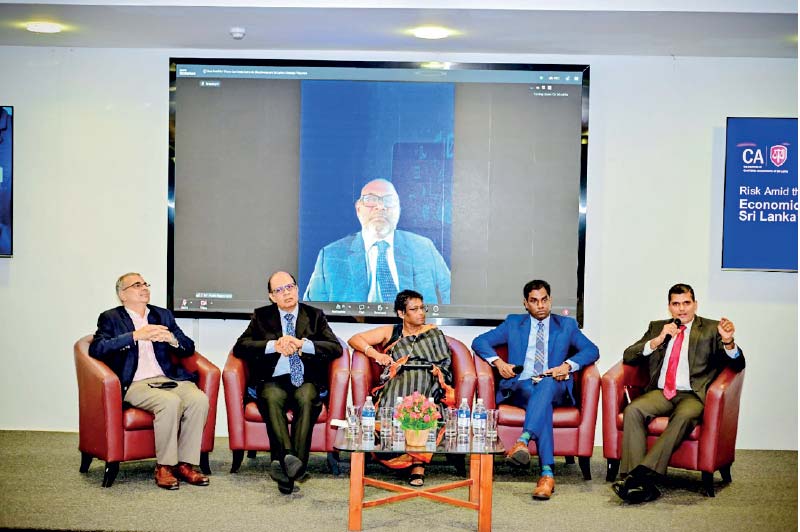
Demonstrating its commitment to thought leadership and national progress, the Institute of Chartered Accountants of Sri Lanka (CA Sri Lanka) recently organised a pivotal forum to examine the escalating geopolitical tensions in the Middle East and their profound implications for the nation’s fragile economic recovery.
The session, titled ‘Risk Amid the Middle East Crisis: Economic Shockwaves and Sri Lanka’s Strategic Response,’ brought together leading experts to evaluate potential scenarios and chart a course for enhanced national resilience.
Held at CA Sri Lanka, the forum featured a keynote address by Advocata Institute Chairman and JB Securities Ltd., Chief Executive Officer Murtaza Jafferjee. He was joined by panellists CA Sri Lanka Past President Arjuna Herath, economist and former Central Bank of Sri Lanka (CBSL) Director Dr. Roshan Perera, Capital Alliance (CAL) Chief Strategic Officer Udeeshan Jonas, and Qatar National Bank Kuwait Senior Vice President and Head of Finance Asoka Rupasinghe. The session was moderated by CA Sri Lanka President Tishan Subasinghe.
Delivering the keynote, Jafferjee set the stage by outlining the deep-rooted historical and political complexities of the Middle East conflict. He emphasised that the current tensions involving Iran, Israel, and the US are unlikely to be resolved quickly, suggesting that a period of prolonged instability is the most probable outlook.
He highlighted the critical strategic importance of the Strait of Hormuz, through which approximately 20% of the world’s oil supply passes.
“Any significant disruption in this narrow corridor, whether through mines, missiles, or naval tactics, would send shockwaves through global energy markets,” he warned, noting that oil prices have already shown volatility in response to the crisis.
His focus then turned to the specific vulnerabilities facing Sri Lanka. Jafferjee identified fuel imports as a primary concern, noting they account for around 15% of the country’s current account outflows. A sustained spike in global oil prices would directly inflate the national import bill and exacerbate domestic inflationary pressures.
He also highlighted the risk with remittances. “Sri Lanka receives over $ 8 billion annually in remittances, which constitutes approximately 8% of our GDP,” Jafferjee said. “With nearly 70% of these inflows originating from the Middle East, any economic downturn or reduction in employment opportunities in the Gulf region would directly impact household incomes and domestic consumption.”
Further vulnerabilities were identified in the tourism and trade sectors. With roughly 35% of tourists arriving via Middle Eastern aviation hubs, airspace disruptions could stifle the sector’s nascent recovery. Similarly, Sri Lanka’s crucial tea exports, which rely heavily on markets in Iraq, Iran, and the United Arab Emirates (UAE), face potential disruption from unstable trade routes and weakened demand.
Jafferjee also raised concerns about global food supply chains, given the Middle East’s role in fertiliser and chemical production.
Following the keynote, the panel discussion delved deeper into the practical implications and necessary responses. The panel agreed that accountants and business leaders must go beyond traditional roles and actively engage in scenario planning to navigate the uncertainty.
Providing a crucial on-the-ground perspective, it was highlighted that while the threat of missile attacks is real, daily life and business operations in many Gulf States continue with relative normality. The panellists also elaborated on potential financial sector risks, including liquidity stress, interest rate and exchange rate volatility, and a possible rise in non-performing loans. It was emphasised that Sri Lankan banks must strengthen their risk management frameworks and maintain close coordination with policymakers.
The discussion also highlighted the potential impact of rising oil prices. A 35-40% surge in oil prices could significantly inflate Sri Lanka’s $ 4 billion annual fuel bill, while increased freight and transportation costs alone could add 3-4% to domestic inflation if the crisis persists.
Despite these risks, the panel also identified strategic opportunities, particularly the potential for the Colombo Port to benefit from shifts in global shipping routes and increased cargo handling volumes. The crisis has also underscored the urgent need for Sri Lanka to diversify its energy infrastructure, including investments in oil refining, and to broaden its trade and tourism partnerships with Asian powerhouses such as India, China, and the Association of Southeast Asian Nations (ASEAN) bloc.
The panellists stressed that Sri Lanka must accelerate key structural reforms to strengthen economic resilience and competitiveness, particularly in areas such as State-Owned Enterprises (SOEs), trade liberalisation, energy sector restructuring, labour market reforms, and skills development. They noted that progress in these areas would help the country better withstand external shocks while supporting sustainable economic growth.
They also noted that the reforms implemented under the International Monetary Fund (IMF)-supported program have helped Sri Lanka build important economic buffers.
Measures such as greater fiscal discipline, exchange rate flexibility, and cost-reflective energy pricing have contributed to improved macroeconomic stability. However, the panellists cautioned that these buffers must be carefully managed, particularly if the crisis continues over a prolonged period.
The forum concluded with a key message highlighting that while countries cannot always avoid global shocks, they can strengthen their resilience through sound policies, structural reforms, and economic diversification.



