Sunday Oct 04, 2026
Sunday Oct 04, 2026
Tuesday, 18 August 2026 12:44 - - {{hitsCtrl.values.hits}}
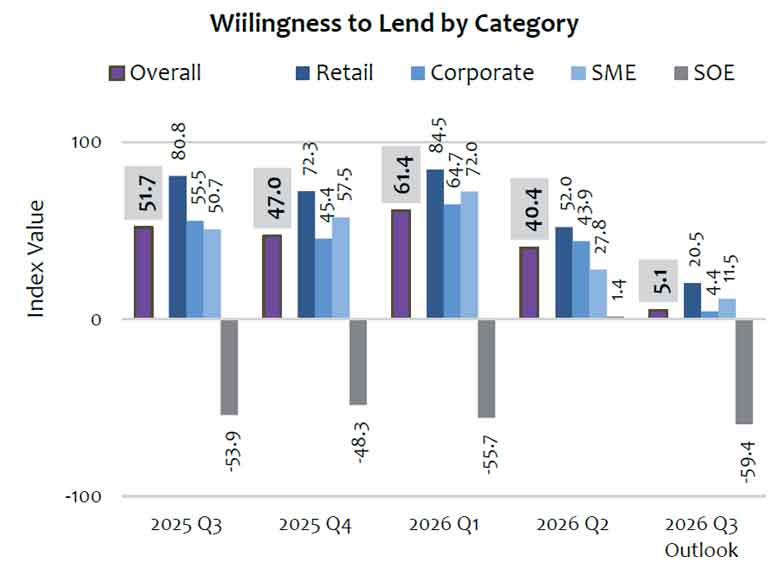
Sri Lanka’s banking sector recorded a slower increase in willingness to lend during the second quarter of 2026 amid tighter monetary conditions following the policy tightening in May, the Central Bank’s latest Credit Supply Survey showed.
The survey, covering Licensed Commercial Banks and Licensed Specialised Banks, found that banks’ willingness to lend increased across the retail, corporate, small and medium enterprise (SME) and State-Owned Enterprise (SOE) sectors during the quarter, although at a slower pace compared with the first quarter.
The Central Bank said improved economic conditions, policy stability, favourable liquidity conditions and enhanced asset quality contributed to the increase in banks’ willingness to lend.
However, banks expect lending appetite to expand at a slower pace in the third quarter, citing anticipated inflationary pressures, rising operating costs, exchange rate volatility and geopolitical uncertainties. Lending appetite towards the SOE sector is also expected to decline in the third quarter after a marginal increase in the second quarter.
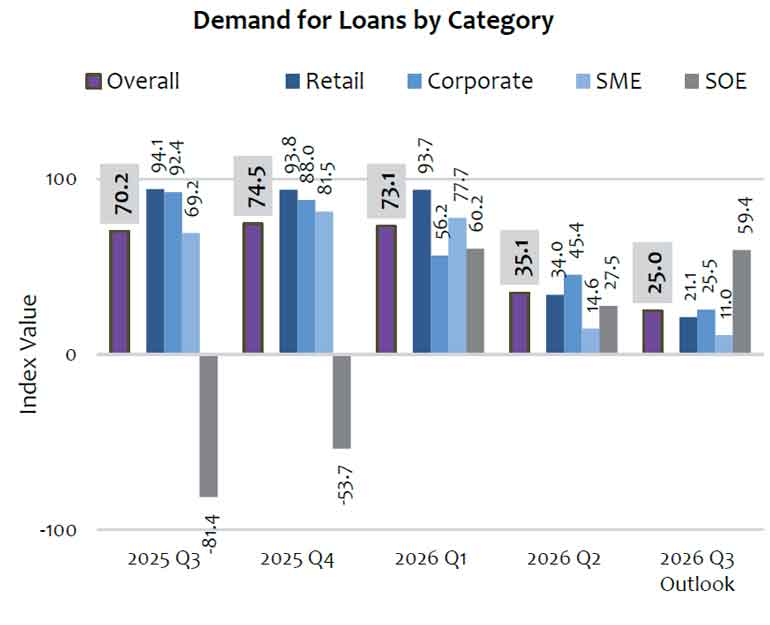
Loan demand increased across all four sectors during the second quarter, though at a moderated pace compared with the previous quarter. The increase was supported mainly by higher working capital requirements, demand for short-term loans and a revival of investment activity.
Demand from SOEs continued to rise, driven largely by financing requirements for ongoing investment projects, particularly strategic infrastructure and renewable energy projects.
For the third quarter, banks expect loan demand to increase across all sectors, supported by higher working capital requirements and expected improvements in macroeconomic conditions.
The survey indicated an overall decline in non-performing loans (NPLs) during the second quarter compared with the first quarter, mainly due to improvements in the retail sector. However, corporate, SME and SOE sectors recorded increases in NPLs according to survey responses.
The Central Bank attributed the rise in NPLs in these sectors to weakened borrower repayment capacity caused by cost pressures arising from exchange rate depreciation and external shocks linked to the Middle East crisis, as well as the migration of some exposures into Stage III.
Banks expect NPLs to decline across all sectors in the third quarter, supported by improving economic conditions, stronger borrower cash flows, recovery measures and loan restructuring.
Loan application rejections across the banking sector declined in the second quarter compared with the first quarter, driven mainly by lower rejection rates in the corporate and SOE sectors. In contrast, rejection rates increased in the retail and SME sectors.
The Central Bank said lower rejection rates in the corporate and SOE sectors reflected improved macroeconomic conditions and higher-quality loan proposals, while stricter credit assessment and risk management criteria contributed to higher rejection rates in retail and SME lending.
The Credit Supply Survey covers lending trends across retail, corporate, SME and SOE sectors, with indices calculated as diffusion indices based on responses from licensed banks weighted by their exposure to the banking sector’s total gross loan portfolio.