Tuesday Sep 15, 2026
Tuesday Sep 15, 2026
Thursday, 29 January 2026 05:05 - - {{hitsCtrl.values.hits}}
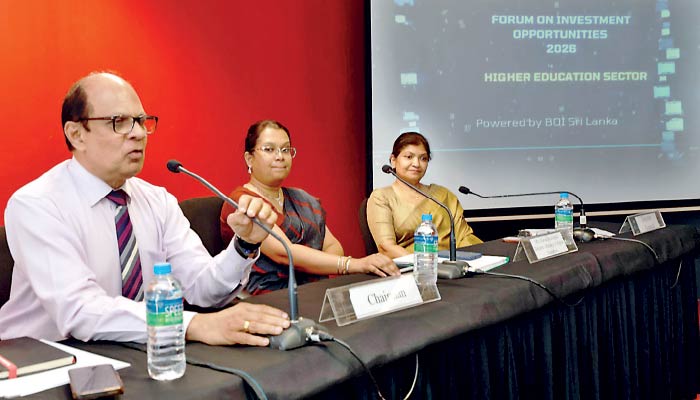 The Board of Investment of Sri Lanka (BOI) has intensified efforts to attract new local and foreign investments into the education sector, leveraging Sri Lanka’s longstanding reputation for a well-structured and inclusive education system.
The country’s high literacy rates—among the best in the region—are rooted in a strong foundation of early childhood education that extends through university and postgraduate studies, a legacy inherited from the British education framework.
Building on this foundation, ongoing education reforms are creating fresh opportunities for the expansion of the education services industry.
In this context, the BOI organised a dedicated investment forum to present compelling structured business opportunities identified in two locations: Keragala in the Gampaha District (Western Province) and Sooriyawewa in the Southern Province, positioning them as emerging University Towns. The forum brought together local and foreign investors to explore these prospects and engage in dialogue on the future of Sri Lanka’s education sector. Senior officials from the BOI and the Higher Education Ministry were also in attendance.
BOI Chairman Arjuna Herath emphasised the importance of presenting robust and attractive business propositions to draw investment into Sri Lanka. He noted that the two proposed University Towns offer distinctive advantages due to their strategic locations. “The Gampaha District is, by far, the largest student hub in Sri Lanka with proximity to an industrial zone for industrial training facilities, while Sooriyawewa, with well-established infrastructure in place and its strong entrepreneurial culture, is well-positioned to catalyse successful education-based ventures,” he said.
The forum, organised by the BOI Investment Promotion and Research Department, attracted participation from 16 local and international educational institutions, including C-suite executives. BOI officials presented detailed business cases outlining the investment potential of the proposed University Towns.
The Keragala University Town is envisioned as a world-class education ecosystem designed to host five leading universities within a 125-acre master-planned campus. Featuring shared student accommodation, faculty residences, laboratories, and modern amenities, the project offers structured investment opportunities with attractive returns.
The BOI anticipates an investment of $ 370 million, with an estimated internal rate of return (IRR) of 15-18% and a payback period of 6-7 years. Its strategic location provides convenient access to key infrastructure, including approximately 55 minutes to Bandaranaike International Airport and proximity to the Colombo Business District.
Sri Lanka’s first integrated university town has been structured to be located in Sooriyawewa, Hambantota, to attract global education providers, research institutions, and investors. The initiative will offer integrated academic programs and international-standard living facilities.
Spanning 250 acres, the project will encompass higher education and vocational institutes, industry-aligned R&D centres, innovation hubs to support startups, and digital learning platforms. Planned infrastructure also includes international conference facilities, health, and wellness centres. The BOI projects an investment of $ 640 million, with an expected IRR of 16-17% and a payback period of 7-8 years.
BOI Director General Renuka Weerakone said: “Today’s forum is both timely and strategic. Globally, higher education is no longer viewed solely as a social service; it is increasingly recognised as a vital economic driver—fuelling innovation, productivity, skilled employment, and long-term competitiveness. Sri Lanka is positioning itself to be an integral part of this global transformation.”
The forum also served as a platform for investors to share diverse perspectives on the opportunities presented. The proposals were well received, with significant interest in matters relating to local and foreign shareholding. BOI officials addressed these queries by highlighting key advantages, including incentives, fiscal concessions, and provisions for a higher percentage of foreign ownership.
Participants further expressed appreciation for the ongoing education reforms supporting investment in the sector, while emphasising the importance of swift and effective implementation.




