Monday Nov 16, 2026
Monday Nov 16, 2026
Monday, 16 November 2026 04:54 - - {{hitsCtrl.values.hits}}
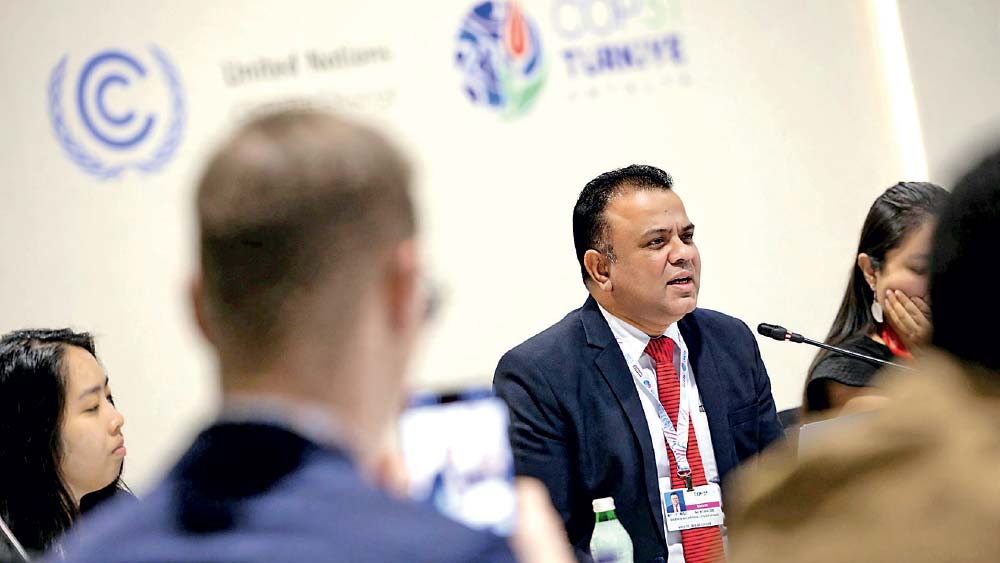
Director – Environment Management Asanka Welagedara represents the BOI at the UN Climate Change Conference in Antalya, Türkiye, calling for green industrialisation, circular economy and zero waste to become drivers of investment and export competitiveness
The Board of Investment of Sri Lanka (BOI) is participating in the 31st Conference of the Parties to the UN Framework Convention on Climate Change (COP31), taking place in Antalya, Türkiye, from 9 to 20 November.
Representing the BOI, Director – Environment Management Asanka Welagedara has set out how Sri Lanka’s industrial sector can decarbonise while continuing to attract foreign direct investment (FDI), generate exports, and create employment.
COP31 is framed around limiting global warming to 1.5°C, strengthening adaptation for vulnerable communities, and reaching net-zero emissions by 2050, with an emphasis on inclusive participation by business leaders, scientists, and civil society.
Last week also saw the launch, on 12 November, of the Net-Zero Recognition Framework, which recognises climate leadership by non-State actors, including companies, financial institutions, cities, and regions.
Against this backdrop, the BOI’s message is clear: sustainability is no longer only an environmental concern. It now shapes international trade, investor decisions, industrial productivity and national competitiveness.
“Climate change has become a defining factor in international trade, investment decisions, and economic competitiveness. Industrial decarbonisation should not be considered merely a compliance obligation. It must become an integral part of Sri Lanka’s export development and foreign investment promotion strategies,” said Welagedara.
Sustainable business as a competitive advantage
Global markets are placing growing weight on the carbon footprint of manufactured goods. Mechanisms such as the European Union’s (EU) Carbon Border Adjustment Mechanism, expanding sustainability-reporting requirements and the expectations of international buyers mean that low-carbon production, responsible resource management and credible environmental performance are increasingly commercial advantages.
Sri Lanka has made encouraging progress. Several leading export-oriented industries have already adopted renewable energy, cleaner production, wastewater recycling, energy-efficient technologies, and environmental management systems. Readiness, however, remains uneven, particularly among small and medium-sized enterprises (SMEs), which face barriers in accessing green finance, modern technology, technical expertise, and reliable carbon-accounting systems.
Sri Lanka’s Third Nationally Determined Contribution (NDC 3.0) aims to reduce greenhouse gas emissions by 20.09% against projected business-as-usual emissions over 2026–2035, with industrial efficiency, circular-economy development, and eco-industrial parks recognised as important components of the transition.
From industrial zones to low-carbon industrial ecosystems
The BOI sees a strategic opportunity to evolve its industrial zones from providers of land, power, water, and wastewater treatment into smart, integrated, resource-efficient, and low-carbon industrial ecosystems, guided by the Eco-Industrial Park concept and the principle of industrial symbiosis, under which waste materials, recovered energy, or treated wastewater from one enterprise become resources for another.
The Seethawaka Export Processing Zone offers potential for integrated resource management, improved common wastewater treatment, environmental monitoring, and industrial symbiosis.
The BOI’s work towards real-time effluent monitoring and improved wastewater and sludge management provides a foundation for stronger environmental performance and future resource recovery.
Proposed new industrial zones can integrate renewable energy, wastewater recycling, sustainable waste management, and climate-resilient design from the planning stage.
A proposed Green Investment Promotion Program would target international investors in clean energy, circular-economy technologies, industrial resource recovery, low-carbon manufacturing, and environmental infrastructure.
“Sri Lanka can promote not merely industrial land, but a sustainable industrial ecosystem capable of meeting emerging global investment expectations,” Welagedara said.
Investment opportunities for sustainable investors
COP31 offers Sri Lanka a platform to connect with technology providers, climate-finance institutions, development partners, and sustainable investors. The BOI has highlighted investment opportunities including:
The BOI also emphasised that successful international cooperation requires technically sound, financially viable, and investment-ready projects supported by credible institutional arrangements.




