Tuesday Sep 15, 2026
Tuesday Sep 15, 2026
Tuesday, 11 November 2025 01:40 - - {{hitsCtrl.values.hits}}
 |
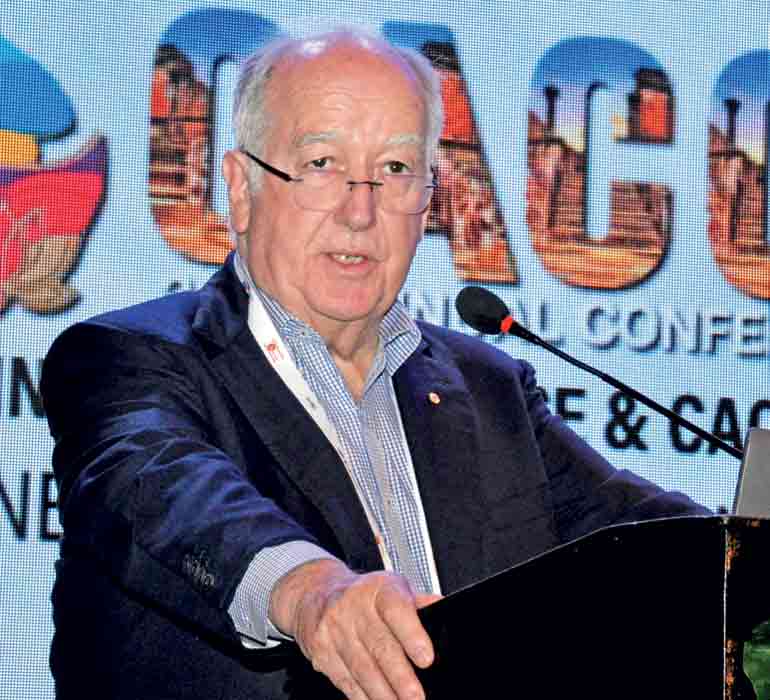 |
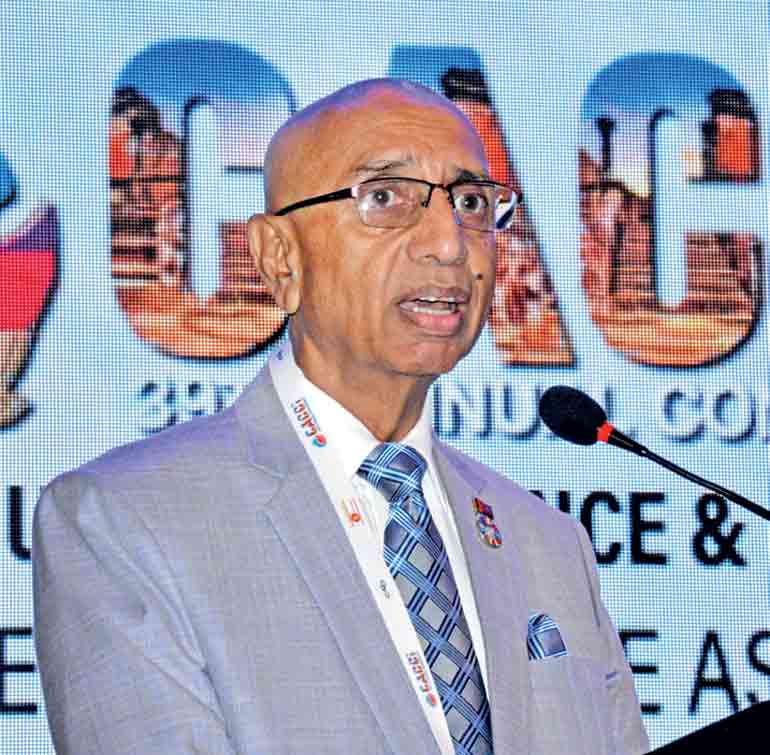
| FCCISL President Keerthi Gunawardane | CACCI President Peter McMullin AM |
The 39th Annual Conference and Expo of the Confederation of Asia-Pacific Chambers of Commerce and Industry (CACCI) opened in Colombo yesterday, bringing together business leaders, policymakers, and entrepreneurs from 28 member nations under the theme “Entrepreneurship in the Asian Century”.
Hosted by the Federation of Chambers of Commerce and Industry of Sri Lanka (FCCISL), the two-day event at Cinnamon Life City of Dreams marked the first time Sri Lanka has hosted the regional business summit, which has been held annually since 1966.
CACCI is a regional organisation spanning 28 member countries, including Australia, New Zealand, Japan, Korea, Taiwan, Singapore, India, Pakistan, Sri Lanka, and others across South and East Asia, Central Asia, and the Pacific.
As an umbrella network of national and regional chambers, CACCI works to strengthen private-sector collaboration across the Asia-Pacific, promoting trade, investment, and entrepreneurship. It serves as a platform for policy advocacy, training, and regional dialogue, complementing the work of its member chambers and helping businesses navigate globalisation.
Through its annual conferences, presidential visits, alliances with international institutions, and policy and research initiatives, CACCI positions itself as a steward of private enterprise, fostering cooperation among Asia-Pacific business leaders to drive sustainable and inclusive growth across the region.
CACCI brings together national chambers across Asia-Pacific, representing nearly three billion people and a combined GDP of approximately $ 18-20 trillion, positioning it as one of the largest regional private-sector networks in the region.

In his welcome address, FCCISL President Keerthi Gunawardane said the 21st century truly belongs to Asia, home to more than 60% of the world’s population and now contributing a similar share of global GDP.
“What drives this growth most powerfully is the entrepreneurial energy of our people, the small business owners, startup founders, and visionary enterprise leaders who are shaping industries and communities,” he said.
Gunawardane noted that Sri Lanka, situated at the crossroads of East and West, is well positioned to play a catalytic role in connecting regional markets and ideas.
“The conference provides an extraordinary platform to connect, collaborate and create, connecting nations through commerce, collaborating on new technologies, sustainable solutions, and creating opportunities for inclusive growth,” he said.
Speaking to the Daily FT at the side lines of the event, Gunawardane said hosting the annual CACCI conference was great opportunity to showcase what Sri Lanka has to offer and build collaborations across the region. “Such events can help local businesses build networks, explore new opportunities and brain-storm common challenges,” he said.
One such challenge was the absence of clear trade policy and capacity to negotiate bi-lateral and regional trade pacts to give Sri Lankan businesses access to bigger, lucrative markets in the region. Private sector initiatives such as this is the next best alternative.
Commenting on Sri Lanka’s trade outlook, Gunawardane stressed the need for a clear and pragmatic trade policy before signing bilateral or regional free trade agreements. “We often sign FTAs without proper study. We must identify sectors we can sustain and strengthen before entering such deals,” he said.
CACCI President Peter McMullin AM said the organisation’s founding principle that businesspeople should act as “merchants of peace” remained deeply relevant amid geopolitical uncertainty.
“This century belongs to the Asian communities,” he said. “We approach challenges as entrepreneurs, and we can resolve these issues by working together rather than sitting on our hands.”
McMullin noted that CACCI’s work since 1966 has focused on connecting Asia-Pacific economies through conferences, trade missions, and policy dialogue to strengthen collaboration and trust across the region.
The first day of the conference featured six sectoral plenary sessions focusing on key areas of regional growth and resilience.

The opening session on SME Development, moderated by FCCISL President Keerthi Gunawardane, addressed the theme “New Developments in Government Sector Cooperation with Chambers of Commerce and Industry for the Growth of SMEs in the New Era”.
Speakers Kowloon Chamber of Commerce Chairman Ernest Yuen, Global Understanding for Sustainable Development Consultant and Director – Projects Prof. Aparna Raman, and Sri Lanka’s National Enterprise Development Authority Chairman Lakshman Abeysekera examined how closer public-private cooperation could help small and medium enterprises adapt to post-pandemic disruptions, high inflation, and global supply-chain challenges while advancing the green and digital transitions.
The second session on Food and Agriculture, moderated by CACCI Asian Council for Food and Agriculture Chairman Pradeep Kumar Shrestha, carried the theme “Sustainable Innovation for an Inclusive Future”.
Speakers including Kowloon Chamber of Commerce Vice President Homer Yu, Philippine Chamber of Commerce and Industry President Consul Enunina V. Mangio, Taiwan Agricultural Research Institute Secretary-General Hui-Fei Hsu, FAO National Specialist Keerthi Mohotti, and National Institute of Fundamental Studies Senior Research Professor Gamini Seneviratne discussed integrating technology and traditional knowledge to make agriculture more resilient and inclusive, with a particular focus on empowering women, youth, and smallholder farmers.
The third session on ICT, moderated by CACCI Asian ICT Council Chairman Dr. Dennis Hu, explored “Regional Cooperation in Digital Innovation and Start-ups”.
Speakers Namastrend Business Services CEO Premjith Krishnan, British Computer Society Sri Lanka Section Past Chairman and APICTA Treasurer Ruwan Amarasekara, National Yang Ming Chiao Tung University Innovation and Entrepreneurship Centre CEO Dr. Michael Lin, and Solopreneur Launch Founder and CEO Michael Lim discussed how cross-border collaboration could foster innovation ecosystems, start-up financing, and digital entrepreneurship in the Asia-Pacific.
Tourism was the focus of the fourth session, themed “Tourism as a Catalyst for Economic Growth in the Asia-Pacific Region”.
Moderated by CACCI Asian Council on Tourism Chairman Anura Lokuhetty, the session featured World Rural Tourism Council Vice Chairman Rohantha Athukorala, University of Colombo Professor Suranga de Silva, Global Strategic Corporate Sustainability Chairman and CEO Dr. Ravi Fernando, and Pacific Asia Travel Association Chairman Peter Semone in a recorded address. The speakers discussed tourism’s dual potential as an economic engine and cultural bridge while stressing the need for sustainability to mitigate environmental and social risks.

The fifth session on Environment, titled “Renewable Energy and Environmental Resilience: Safeguarding South Asia’s Future”, was moderated by CACCI Asian Council on Water, Energy, and Environment Chairman Gyanendra Lal Pradhan. Speakers included WRI India Programme Associate Director Dr. Sneha Malhotra, Nordic Folkecenter for Renewable Energy Sri Lanka Country Manager Sarath Chandrasena, and Sri Lanka Sustainable Energy Authority Chairman Professor Wijendra Bandara. The session examined how South Asia could meet rising energy demand without reversing environmental gains, calling for greater investment in renewables and regional energy cooperation.
The sixth and final sectoral session focused on Entrepreneurship under the theme “Entrepreneurship in the New Asia-Pacific: Driving Innovation, Inclusion, and Integration”.
Moderated by CACCI Young Entrepreneurs Group of Asia Pacific Chairman Hiromi Aoki, the discussion featured Lhamour Founder and CEO Khulan Davaadorj, Solopreneur Launch Founder and CEO Michael Lim, and KES English School President Ekaterina Ueda. The session explored how Asia’s young entrepreneurs are redefining the region’s economic future through innovation, inclusive growth, and cross-border collaboration.
The second day of the conference today will include plenary sessions focused on emerging global trends, innovation, supply-chain resilience, and sustainable growth.
The first plenary session, “Global Market Trends: Navigating Uncertainties and Opportunities,” moderated by CACCI Vice President and Iran Chamber of Commerce Chief Adviser Dr. Alireza Yavari, examined how geopolitical shifts, trade liberalisation, and technological disruption are reshaping business strategies.
Speakers included Asia Decoded Director and Principal Economist Priyanka Kishore, CACCI Advisory Board Chairman Ambassador Benedicto V. Yujuico, Maliban Group CEO Ravi Jayawardena, and former Sri Lankan Ambassador to China Dr. Palitha Kohona.
The second session, “Transforming Business through Innovation and Technology”, moderated by CACCI Vice President Stuart Thomson, looked at how advances in AI, data analytics, and cloud computing are redefining competitiveness.
Speakers included Empasoft Institute of Technology Co-Founder Enkhsaikhan Nyamsuren, Namastrend CEO Premjith Krishnan, Foundation for Commerce and Culture Interchange President Dr. Dennis Hu, VeracityAI Founder Jeevan Gnanam, and Vision International Managing Director Wansapriya Gunaseela.
The third plenary, “Ensuring Resiliency in the Regional Supply Chain”, moderated by Federation of Pakistan Chambers of Commerce and Industry Vice President Aun Ali Syed, focused on strategies for supply-chain diversification and risk mitigation.
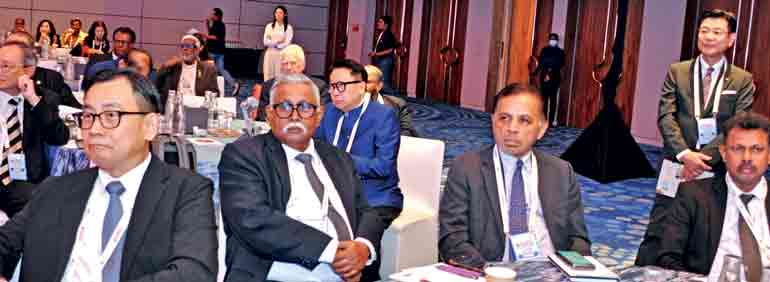
Speakers included Robert Bosch Lanka Sales and Marketing Manager Praseedh Philip, Asian Development Bank Senior Financial Sector Specialist Manohari Gunawardhena, and International Chamber of Commerce Sri Lanka President Shanil Fernando.
The final session, “Achieving Inclusive and Resilient Growth for a Sustainable Future”, moderated by Singapore Manufacturing Federation President Lennon Tan, explored how inclusivity, resilience, and sustainability can be built into economic systems.
Speakers included National University of Singapore Professor Aparna Uma Shankar Raman, CACCI Vice President Dr. Alireza Yavari, Bangladesh Women Chamber of Commerce and Industry President Selima Ahmad, NSBM Green University Dean Thilini de Silva, and Sri Lanka Convention Bureau Chairman Dheera Hettiarachchi.
Setting the tone for the two-day conference, FCCISL President Gunawardane in his inaugural session address said Asia’s next decade would define how the region leads the world. “It must be through responsible entrepreneurship, innovation, and partnership,” he said.
CACCI President McMullin said that business cooperation across borders was essential not only for prosperity but for peace. “Our mission is not only to do business,” he said. “It is to build understanding, collaboration, and shared progress.”
Pix by Lasantha Kumara




