Friday Oct 23, 2026
Friday Oct 23, 2026
Monday, 29 December 2025 05:16 - - {{hitsCtrl.values.hits}}

By Charumini de Silva
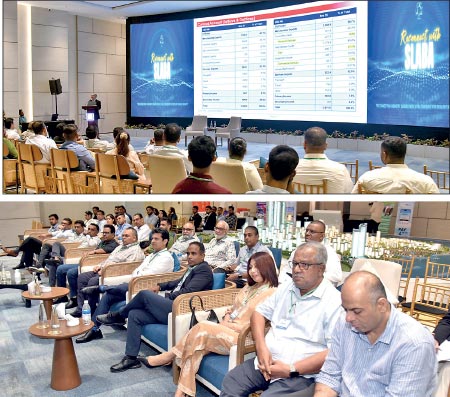 Sri Lanka’s domestic apparel industry gathered at a critical moment in the country’s economic recovery as the Sri Lanka Apparel Brands Association (SLABA) hosted its annual flagship event recently at Port City, bringing together leading apparel brands, suppliers, and industry partners for an evening of strategic reflection, data-driven analysis, and forward-looking dialogue.
The event, titled ‘Reconnect with SLABA—Exclusive Evening with Industry Knowledge,’ marked a milestone for the Association as it reinforced the growing maturity of Sri Lanka’s homegrown apparel brands and their increasing engagement with broader macroeconomic and policy debates.
The discussions underscored an industry at a crossroads, facing fragile economic stability, but also a rare opportunity to reposition itself through reform, innovation, and global competitiveness.
Of the evening’s key features were two keynote addresses under the theme ‘The Real Economy: What Every Apparel Entrepreneur Should Expect in the Next Three Years,’ which placed the sector’s business outlook squarely within the context of the country’s fragile economic stabilisation.
Deep reforms and competitive markets
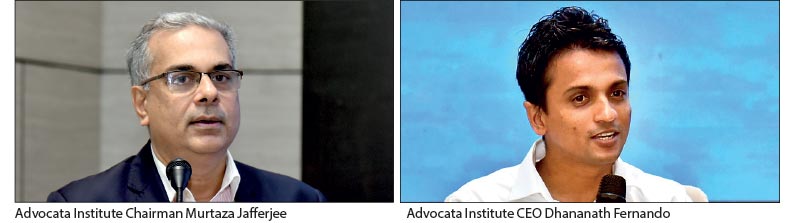
Advocata Institute Chairman Murtaza Jafferjee delivered a wide-ranging assessment of the economy, cautioning that while Sri Lanka has moved out of the acute phase of crisis into a period of relative macroeconomic calm, the foundations of stability remain weak.
He warned that without deep structural reforms, increased competition, and a decisive break from inward-looking policy approaches, the current stability would not translate into sustained growth.
Jafferjee framed his analysis through Michael Porter’s competitiveness framework, arguing that Sri Lanka has long misunderstood the difference between competition and competitiveness. “Competition is merely participation in the market, while competitiveness is the ability to innovate, upgrade, and consistently deliver higher value,” he said.
Using a vivid analogy, he told the audience that “getting into the ring is competition, but winning the fight is competitiveness,” stressing that long-term success depends on productivity gains and innovation rather than protection.
Domestic consumers not sophisticated enough to drive upgrades
Jafferjee cautioned that Sri Lanka’s domestic market does not exert sufficient pressure on apparel brands to move up the value chain.
Citing findings from a recent consumer survey, he said local buyers rarely demand advanced quality, design, or innovation, observing that consumers care far more about food choices than clothing.
“This lack of consumer sophistication weakens the incentive for firms to invest in design, branding, and technology,” he argued.
For an industry aspiring to compete globally, Jafferjee emphasised that openness is essential.
He warned that restricting imports in the name of protecting local firms only dulls competitive pressure and undermines long-term strength.
According to him, genuine upgrading is impossible unless consumers are free to choose, forcing producers to improve or exit.
External accounts improving but for the wrong reasons
Turning to macroeconomic conditions, Jafferjee provided a detailed breakdown of Sri Lanka’s external accounts, noting that the current account surplus is largely the result of suppressed import demand due to economic contraction, particularly in investment goods.
He stressed that this should not be misread as economic strength. “This is not a victory; it is the economy shrinking,” he said, adding that strong remittances, tourism inflows, and unusually high vehicle-related tax revenues were masking deeper structural weaknesses.
“We are measuring stability against a very high crisis-era base,” he said, warning against complacency.
Jafferjee described the recent surge in luxury vehicle imports as economically irrational, yet acknowledged that extremely high taxes on these imports have temporarily boosted Government revenue.
“Inflation appears stable on a monthly basis, but this is partly a statistical effect resulting from comparisons against an exceptionally high crisis-era base, warning that policymakers and businesses should not mistake this for lasting price stability,” he said.
Responding to claims that Sri Lanka’s reserves remain dangerously low, Jafferjee said public debate often misunderstands the distinction between headline reserves and usable reserves.
While some components, including swap-linked Chinese reserves, remain inaccessible, he noted that the Central Bank has continued to accumulate net foreign assets.
“From the peak of the crisis, Sri Lanka’s reserve position has strengthened dramatically, improving by more than $ 6 billion this year alone,” he said.
Retail expansion and consumer behaviour shifts
Jafferjee also highlighted notable shifts in domestic economic behaviour, including a rapid increase in retail outlets that far exceeds household growth, reflecting changes in consumption patterns, pricing dynamics, and urbanisation.
He pointed to a sharp rise in cash circulation occurring alongside the expansion of digital payments, describing it as evidence that consumer activity is normalising, albeit unevenly across sectors.
Although tourism continues to recover, he warned that the composition of arrivals has shifted towards short-stay Asian visitors, reducing average spending. As a result, he said, arrivals may soon match 2018 levels, but earnings are unlikely to follow the same trajectory.
“Sri Lanka’s prolonged underinvestment in capital over nearly a decade, with Government capital expenditure falling to historically low levels,” he stressed.
This erosion of capital deepening, he argued, has left construction severely depressed and several manufacturing segments struggling to regain pre-2018 output levels.
“Economic growth requires capital deepening. We have done the opposite,” he pointed out.
Reforms must happen now, not after elections
Jafferjee made a strong call for immediate structural reforms, arguing that the current Government is uniquely positioned to push through politically difficult changes.
He warned against reversing International Monetary Fund (IMF)-backed reforms and argued that historically, major economic reforms in Sri Lanka were often implemented by left-leaning Governments because of greater trust from trade unions. “Since independence, reforms were mostly done by left-leaning Governments because unions trusted them,” he said. “With macroeconomic stabilisation largely achieved, the next phase must focus on growth. Without reforms, the current positive momentum would fade within four to six quarters,” Jafferjee added.
Apparel sector on fragile stability
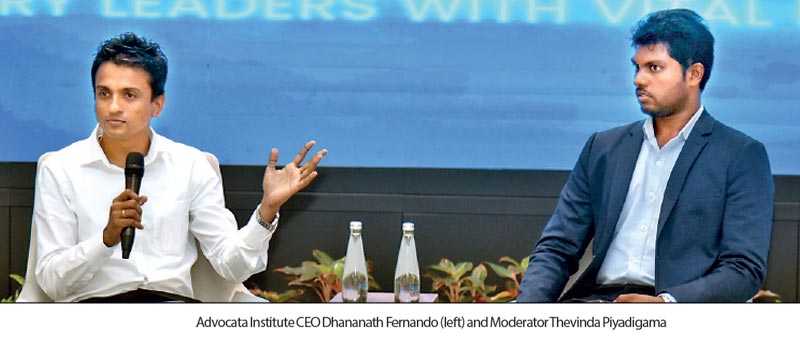
Echoing these concerns during a panel discussion, Advocata CEO Dhananath Fernando cautioned that the apparel industry faces a year of fragile stability, rising operating costs, and heightened exposure to external shocks.
He said investor confidence remains extremely sensitive, noting that even minor disruptions could trigger capital outflows with direct consequences for exchange rates, interest costs, and business planning.
Fernando said the Central Bank’s current exchange rate framework offers greater predictability than in the past, but warned that volatility is now an inherent feature of a market-based system.
He urged businesses not to assume currency stability at current levels, stressing that macroeconomic adjustments will continue. “You should not expect a repeat of the 380-400 levels, but that doesn’t mean the currency will remain at 300,” he noted, stressing that market-based fluctuations are now part of the operating environment.
He identified weak population growth, a shrinking labour force, and heavy reliance on domestic consumption as long-term structural challenges, arguing that local demand alone cannot sustain apparel growth.
“If the population is shrinking and incomes are under pressure, demand for clothing will also change,” he said, urging apparel brands to look beyond domestic markets. “The solution is expanding outward and competing internationally, whether we like it or not.”
Exports and need for radical reform
Without improvements in export performance and productivity, he warned, the macroeconomy would be forced to adjust through higher interest rates, currency pressure, or reserve drawdowns.
“If export performance doesn’t improve, the macroeconomy will be forced to adjust,” he said, adding that productivity improvement – doing more with the same or fewer inputs – was essential for sustainable growth.
Fernando also pointed to deep structural barriers facing businesses, particularly small and medium enterprises (SMEs), citing Customs procedures, import-export clearance delays, and labour regulations as persistent constraints.
“Customs is a problem, import and export clearance is a problem, labour is a problem; everywhere businesses turn, they face barriers,” he said.
He also cautioned against protectionist policies aimed at favouring local apparel brands against international competitors, saying that shrinking domestic demand makes such strategies impractical. “Even if you increase protection, the market is too small. The only viable solution is to improve competitiveness and expand abroad,” he said. However, he acknowledged this is difficult for smaller brands facing price pressures and high operational costs.
He said any Government assistance should be tied to measurable outcomes such as productivity gains or job creation, ideally through transparent tax credit mechanisms to avoid political misuse. “Good intentions alone are not enough; without proper safeguards, the benefits will not reach the intended businesses,” he added.
He said that while Sri Lanka is no longer in immediate crisis, the risks remain significant, and growth must come from productivity, competitiveness, and reform rather than complacency.
“We are not in a crisis, but we are not out of danger. Growth must come from productivity, competitiveness, and reform, not protection or complacency,” Fernando said.
AI for apparel sector
The event also featured a forward-looking presentation by Deloitte Sri Lanka and Maldives Strategy and Analytics Leader Mayura Malagala, who explored the practical implications of artificial intelligence (AI) for the apparel sector, highlighting how data automation and analytics will increasingly shape design, supply chains, and consumer engagement.
The SLABA represents more than 50 leading Sri Lankan apparel brands, directly employing over 25,000 people and supporting nearly 400,000 jobs through subcontractors and SME networks.
Its membership includes well-known local brands such as Rainco, Velona, amanté, Kelly Felder, Kriger, Emerald, EKKO, JEZZA, Mimosa, and GFlock.
- Pix by Ruwan Walpola -




