Friday Oct 16, 2026
Friday Oct 16, 2026
Thursday, 7 May 2026 05:31 - - {{hitsCtrl.values.hits}}
The Asian Development Bank (ADB) is mobilising $ 50 billion by 2035 through new financing tools, policy support, and partnerships to help countries build cross-border power grids across some of the world’s most complex regions, aiming to lower energy costs, strengthen reliability, and expand clean energy trade, ADB President Masato Kanda said this week.
“The $ 50 billion Pan-Asia Power Grid Initiative (PAGI) is about building the infrastructure required for a more connected, resilient, and prosperous Asia and the Pacific,” Kanda said. “Countries that stay connected attract investment and weather shocks better than those that turn inward. Connectivity is our answer to fragmentation.”
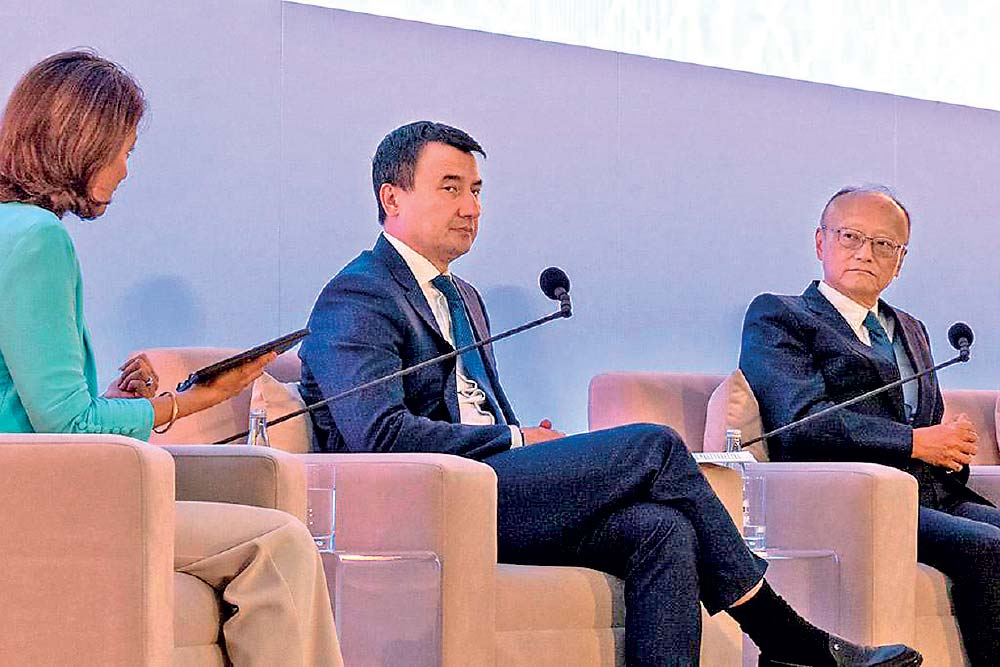
Speaking at the Governors’ Seminar on the PAGI during the ADB’s 59th Annual Meeting, Kanda underscored the ADB’s role in moving beyond standalone projects towards integrated regional systems that underpin growth, resilience, and energy security.
Launched last week, the PAGI is a flagship regional platform designed to accelerate cross border power trade, integrate renewable energy at scale, and strengthen the reliability and affordability of electricity across Asia and the Pacific.
Through the PAGI, the ADB aims to integrate about 20 gigawatts of renewables, connect 22,000 circuit-kilometres of transmission lines, improve energy access for 200 million people, and create 840,000 jobs by 2035.
ADB is leveraging its convening power to bring together governments, regulators, utilities, the private sector, and development partners to align policies, sequence investments, and resolve regulatory barriers that often delay regional infrastructure.
The bank has supported complex, pioneering cross border projects such as the Bangladesh–India grid interconnection and the Monsoon Wind Power Project in the Lao People’s Democratic Republic, mobilising private capital through blended finance.
To accelerate grid interconnections in Southeast Asia, the ADB has launched a dedicated Regional Connectivity Fund which is supported by Australia, Canada, Germany, the United Kingdom, and the European Union. The fund helps de risk early stage projects, finance preparation, and crowd in larger pools of public and private capital.




