Saturday Jul 04, 2026
Saturday Jul 04, 2026
Tuesday, 12 May 2026 00:57 - - {{hitsCtrl.values.hits}}
By Joint Apparel Association Forum
Vietnam’s transformation into one of the world’s fastest-growing apparel export hubs offers important lessons for Sri Lanka as it seeks to strengthen export competitiveness and secure long-term growth in its garment industry.
Over the past 15 years, Vietnam has used trade policy as a central pillar of industrial development, aggressively pursuing free trade agreements, attracting export-oriented investments and integrating into global supply chains. This strategy has helped Vietnam emerge as a preferred sourcing destination for global apparel brands, particularly as manufacturers diversify production under the “China+1” strategy. Vietnam has negotiated 19 bilateral and multilateral free trade agreements covering around 60 economies, including major arrangements such as the Comprehensive and Progressive Agreement for Trans-Pacific Partnership, the EU-Vietnam Free Trade Agreement, and the Regional Comprehensive Economic Partnership. These agreements provide preferential access to major markets including the European Union (EU), the UK, Japan, Canada, Australia, China, South Korea and ASEAN economies.
The impact on trade performance has been significant. Vietnam’s trade openness measured as total trade as a percentage of GDP has expanded from 19% in 1988 to 184% in 2022, reflecting deep integration into global markets. In contrast, Sri Lanka’s trade openness remains in the range of 50% to 55%, indicating a comparatively lower dependence on international trade and a more inward-looking growth model.
Vietnam has negotiated 19 bilateral and multilateral free trade agreements covering around 60 economies, including major arrangements such as the Comprehensive and Progressive Agreement for Trans-Pacific Partnership, the EU-Vietnam Free Trade Agreement, and the Regional Comprehensive Economic Partnership
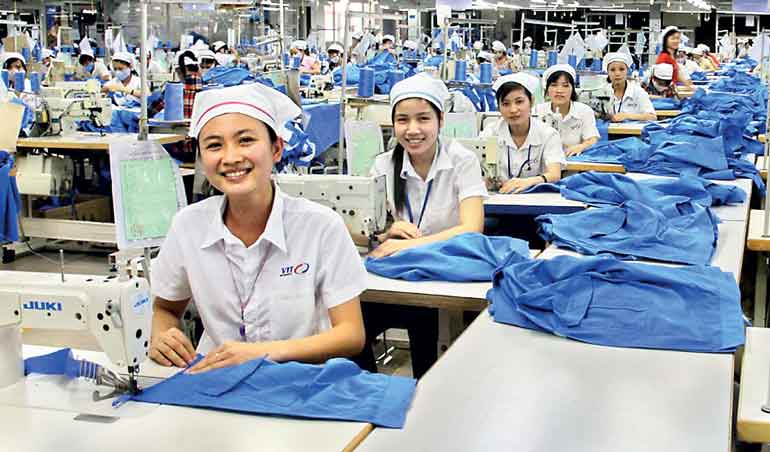
Vietnam’s apparel sector has been one of the biggest beneficiaries of this strategy. Apparel exports have risen from approximately $ 13 billion to around $ 45 billion over the past 15 years, an increase of nearly 250%. By 2025, exports are projected to reach $ 46 billion, supported by an estimated trade surplus of $ 21 billion.
By comparison, Sri Lanka’s apparel exports have grown from $ 3.4 billion to around $ 5.4 billion during the same period, an increase of approximately 58%. While Sri Lanka’s apparel sector remains one of the country’s largest export earners, generating around $ 5 billion annually and employing about 350,000 people, industry analysts say future growth will depend heavily on improved trade access and stronger integration into global value chains.
A key factor behind Vietnam’s success has been its highly coordinated trade negotiation framework. The country’s trade negotiation architecture is centrally managed, technically driven and politically empowered, with chief negotiators operating at deputy minister level and supported by multi-ministry teams for strategic negotiations.
This structure has enabled Vietnam to secure trade deals with major economies, including recent tariff arrangements with the United States following changes in reciprocal tariff policies in 2025. Vietnam also maintains multiple trade agreements with Japan, another major apparel market, as well as longstanding trade arrangements with the EU, the UK and South Korea.
Vietnam’s trade openness measured as total trade as a percentage of GDP has expanded from 19% in 1988 to 184% in 2022, reflecting deep integration into global markets. In contrast, Sri Lanka’s trade openness remains in the range of 50% to 55%, indicating a comparatively lower dependence on international trade and a more inward-looking growth model
Like Vietnam, Sri Lanka sends nearly 40% of its apparel exports to the United States. However, unlike Vietnam, Sri Lanka lacks a comparable network of trade agreements that can secure long-term market access and attract strategic manufacturing investments.
Industry stakeholders argue that Sri Lanka cannot simply replicate Vietnam’s model, but it can adapt key elements to suit its own economic context. This includes building a dedicated institutional mechanism for identifying and negotiating free trade agreements, prioritising agreements with markets that can both absorb Sri Lankan exports and generate strategic investments.
The industry also stresses that trade agreements alone are not sufficient. To fully benefit from preferential market access, Sri Lanka must align trade policy with investment readiness, infrastructure development, workforce skills and sustainability standards.
As the Joint Apparel Association Forum (JAAF) and industry leaders map out the sector’s next phase of growth, Vietnam’s experience underscores a clear message: trade policy, when strategically aligned with industrial development, can become a powerful driver of export expansion, employment generation and economic transformation.
Apparel exports have risen from approximately $ 13 billion to around $ 45 billion over the past 15 years, an increase of nearly 250 percent. By 2025, exports are projected to reach $ 46 billion, supported by an estimated trade surplus of $ 21 billion




