Friday Sep 18, 2026
Friday Sep 18, 2026
Wednesday, 21 January 2026 00:00 - - {{hitsCtrl.values.hits}}

JAAF Secretary General Yohan Lawrence
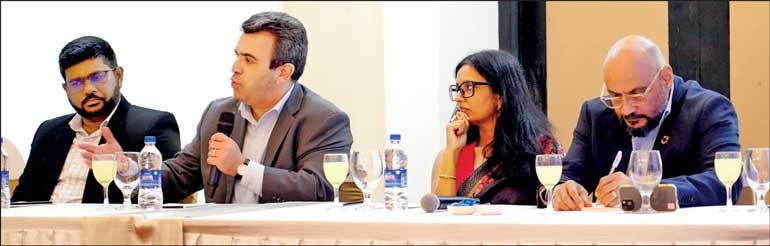
Panel discussion featuring WRAP President and CEO Avedis Seferian (second from left), JAAF Secretary General Yohan Lawrence (extreme right), MAS Holdings Head of Sustainable Business Amanthi Perera, and Star Garments Senior Manager – Group Sustainability and Compliance Senura Dharmadasa
Sri Lanka’s apparel industry reaffirmed its leadership in ethical manufacturing at a high-level forum held in Colombo on 13 January 2026, where local and international experts gathered to examine how social sustainability can strengthen the country’s export competitiveness.
Hosted at the Taj Samudra, the event brought together representatives from WRAP (Worldwide Responsible Accredited Production), Intertek (a global assurance, inspection, testing, and certification company), JAAF (Joint Apparel Association Forum of Sri Lanka), leading apparel manufacturers, and sustainability specialists to discuss how Sri Lanka can position itself in an increasingly regulated global market.
Opening the discussion, WRAP President and CEO Avedis Seferian delivered a keynote on the global momentum of sustainability and the competitive advantage Sri Lanka has developed over decades. His message was clear: the world’s largest markets particularly in the US and EU are moving rapidly toward mandatory human rights due diligence, transparency, and traceability. For exporters, sustainability is no longer optional; it is central to market access.
“The future of global trade is being shaped by sustainability,” Seferian said. “Consumers, regulators, and investors are aligned in demanding responsible production. Sri Lanka has built a strong foundation, and the path forward lies in deepening that commitment and embedding it into every business decision.”
He noted that WRAP certified its first Sri Lankan facility in 2003, and the country’s early embrace of programs like Garments Without Guilt positioned the industry well for today’s compliance-driven environment. This history well documented in the event’s agenda and presentations has now evolved into a strategic economic opportunity.
Following the keynote, JAAF Secretary General Yohan Lawrence highlighted how sustainability has shifted from a marketing tool to a core determinant of economic resilience. In his remarks, supported by insights shared during his session on the ‘Business and Economic Impact through Sustainability’, Lawrence emphasised that Sri Lanka must treat sustainability as a long-term competitive moat rather than a regulatory hurdle.
“Sustainability isn’t a cost it’s currency,” Lawrence underscored. “In a data-driven world, traceability and social compliance will decide who wins and who falls behind. Both the US and EU are tightening expectations on responsible sourcing, and Sri Lanka is extremely well-positioned to build on what we already do best. The future of our industry depends on embedding sustainability into decision-making at every level.”
The forum also underscored the increasing importance of data, especially as global brands seek verifiable, real-time traceability from raw material to finished product. Lawrence described traceability as the “currency of trust,” pointing to growing buyer demand for digital systems that integrate social audit findings, such as WRAP data, into transparent supply-chain platforms.
A panel discussion featuring Seferian, Lawrence, MAS Holdings Head of Sustainable Business Amanthi Perera, and Star Garments’ Senura Dharmadasa and moderated by Courtaulds Group AGM, Group ESG Sumith Siriwardana explored how WRAP certification supports compliance with emerging due-diligence laws, strengthens risk management, and builds confidence among global buyers.
Case studies presented by Courtaulds Group and a WRAP-certified facility reinforced how structured governance frameworks can improve worker well-being, reduce operational risks, and attract sustainable financing.
Adding to the forward-looking tone of the event, Seferian stressed: “Sri Lanka has a unique opportunity in the evolving global landscape. The countries that will thrive are those that invest early in robust, transparent, and people-centred sustainability systems. The future is bright for nations that recognise this, and Sri Lanka is already ahead of many competitors.”
As the afternoon closed with a well-attended networking session, the message resonated strongly: in a world where data, transparency, and responsible business practices increasingly decide market access, Sri Lanka’s apparel industry is not just keeping pace it is shaping the standards.
With global regulations tightening and buyers moving toward verified ethical sourcing, Sri Lanka’s long-standing commitment to social sustainability provides a strong platform for future growth. And as both Seferian and Lawrence emphasised, the industry’s next chapter will be defined by one principle: sustainability is no longer an add-on; it is the strategy.



